 Add to Chrome
 Add to Firefox
 Add to Edge
MolBioKG: Grounding Out-of-Graph Molecules in Biomedical Knowledge Graphs via Multi-Resolution Structural Anchoring
Aug 07, 2026
Biomedical knowledge graphs (KGs) accelerate drug discovery, but standard pipelines assume query molecules already exist as graph entities, leaving unregistered molecules disconnected. We address this cold-start challenge, termed the out-of-graph molecule problem, by introducing MolBioKG. This two-layer system grounds unseen molecules in biomedical evidence via multi-resolution structural anchoring. It connects an index of 2.74 million molecules (represented by scaffolds, fragments, functional groups, and fingerprints) to a 9.6-million-edge KG. Given only a SMILES string, MolBioKG retrieves structurally related graph entities and traverses their biomedical neighborhoods without task-specific training. It features two inference mechanisms: static multi-anchor retrieval using Reciprocal Rank Fusion, and Adapt-KG, a tool-using LLM policy for adaptive traversal. Evaluated across in-graph link recovery, complex multi-hop reasoning, and out-of-graph generalization, MolBioKG outperforms strong baselines. Notably, it raises Hits@10 from 0.585 to 0.876 in multi-hop reasoning and out-of-graph target recall from 0.145 to 0.269, all while ensuring predictions retain traceable structural anchors and source-attributed KG evidence.

LLM-guided phase diagram construction through high-throughput experimentation
Apr 22, 2026Constructing phase diagrams for multicomponent alloys requires extensive experimental measurements and is a time-consuming task. Here we investigate whether large language models (LLMs) can guide experimental planning for phase diagram construction. In our framework, a general-purpose LLM serves as the experimental planner, suggesting compositions for measurement at each cycle in a closed loop with high-throughput synthesis and X-ray diffraction phase identification. Using this framework, we experimentally constructed the ternary phase diagram of the Co-Al-Ge system at 900 degree C through iterative synthesis and characterization. We compared two strategies that differ in how the initial compositions are selected: one uses predictions from a domain-specific LLM trained on phase diagram data (aLLoyM), while the other relies solely on the general-purpose LLM. The two strategies exhibited complementary strengths. aLLoyM directed the initial measurements toward compositionally complex regions in the interior of the ternary diagram, enabling the earliest discovery of all three novel phases that form only in the ternary system. In contrast, the general-purpose LLM adopted a textbook-like approach which efficiently identified a larger number of phases in fewer cycles. In addition, a simulated benchmark comparing the LLM against conventional machine learning confirmed that the LLM achieves more efficient exploration. The results demonstrate that LLMs have high potential as experimental planners for phase diagram construction.
aLLoyM: A large language model for alloy phase diagram prediction
Jul 30, 2025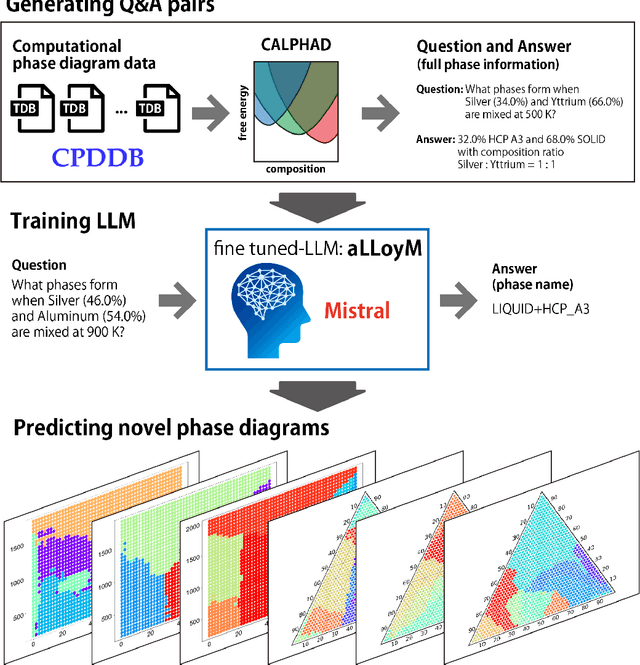
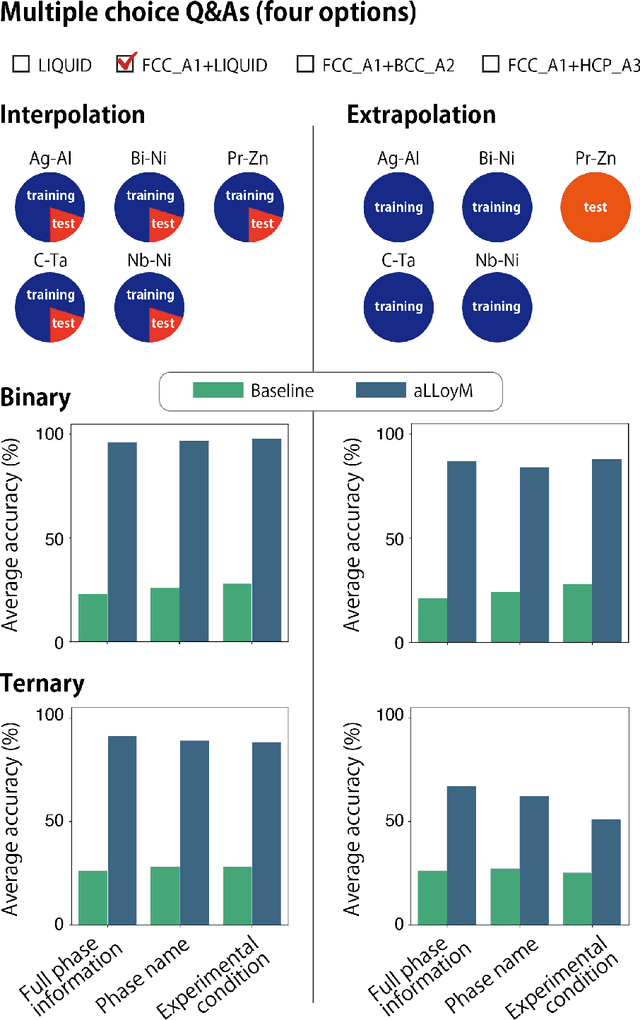
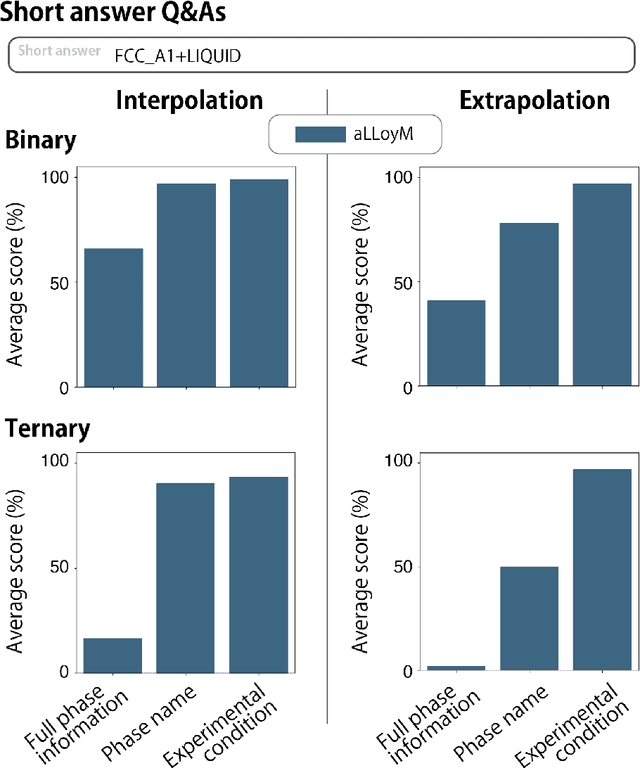
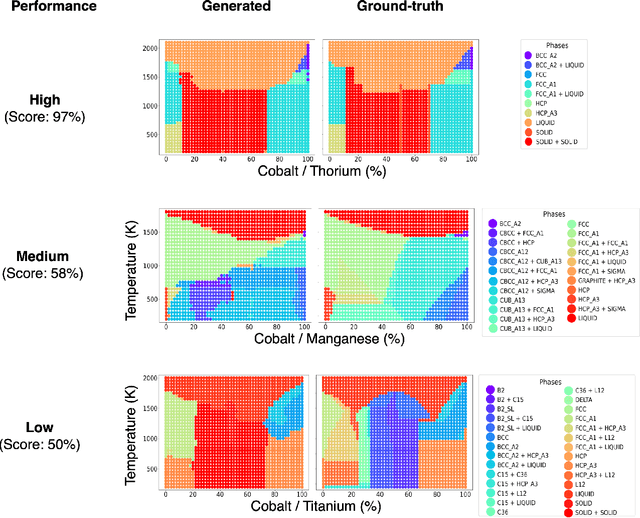
Large Language Models (LLMs) are general-purpose tools with wide-ranging applications, including in materials science. In this work, we introduce aLLoyM, a fine-tuned LLM specifically trained on alloy compositions, temperatures, and their corresponding phase information. To develop aLLoyM, we curated question-and-answer (Q&A) pairs for binary and ternary phase diagrams using the open-source Computational Phase Diagram Database (CPDDB) and assessments based on CALPHAD (CALculation of PHAse Diagrams). We fine-tuned Mistral, an open-source pre-trained LLM, for two distinct Q&A formats: multiple-choice and short-answer. Benchmark evaluations demonstrate that fine-tuning substantially enhances performance on multiple-choice phase diagram questions. Moreover, the short-answer model of aLLoyM exhibits the ability to generate novel phase diagrams from its components alone, underscoring its potential to accelerate the discovery of previously unexplored materials systems. To promote further research and adoption, we have publicly released the short-answer fine-tuned version of aLLoyM, along with the complete benchmarking Q&A dataset, on Hugging Face.