 Add to Chrome
 Add to Firefox
 Add to Edge
Novel Anomaly Detection Scenarios and Evaluation Metrics to Address the Ambiguity in the Definition of Normal Samples
Apr 08, 2026
In conventional anomaly detection, training data consist of only normal samples. However, in real-world scenarios, the definition of a normal sample is often ambiguous. For example, there are cases where a sample has small scratches or stains but is still acceptable for practical usage. On the other hand, higher precision is required when manufacturing equipment is upgraded. In such cases, normal samples may include small scratches, tiny dust particles, or a foreign object that we would prefer to classify as an anomaly. Such cases frequently occur in industrial settings, yet they have not been discussed until now. Thus, we propose novel scenarios and an evaluation metric to accommodate specification changes in real-world applications. Furthermore, to address the ambiguity of normal samples, we propose the RePaste, which enhances learning by re-pasting regions with high anomaly scores from the previous step into the input for the next step. On our scenarios using the MVTec AD benchmark, RePaste achieved the state-of-the-art performance with respect to the proposed evaluation metric, while maintaining high AUROC and PRO scores. Code: https://github.com/ReijiSoftmaxSaito/Scenario

Genetic Information Analysis of Age-Related Macular Degeneration Fellow Eye Using Multi-Modal Selective ViT
Sep 17, 2024In recent years, there has been significant development in the analysis of medical data using machine learning. It is believed that the onset of Age-related Macular Degeneration (AMD) is associated with genetic polymorphisms. However, genetic analysis is costly, and artificial intelligence may offer assistance. This paper presents a method that predict the presence of multiple susceptibility genes for AMD using fundus and Optical Coherence Tomography (OCT) images, as well as medical records. Experimental results demonstrate that integrating information from multiple modalities can effectively predict the presence of susceptibility genes with over 80$\%$ accuracy.
Reconstructed Student-Teacher and Discriminative Networks for Anomaly Detection
Oct 14, 2022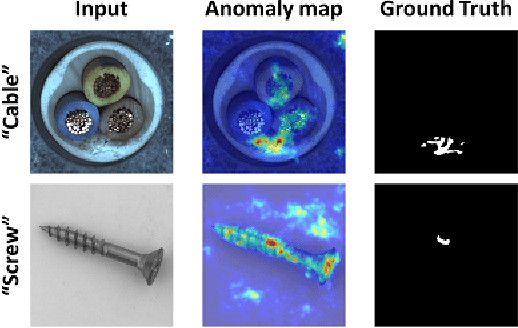
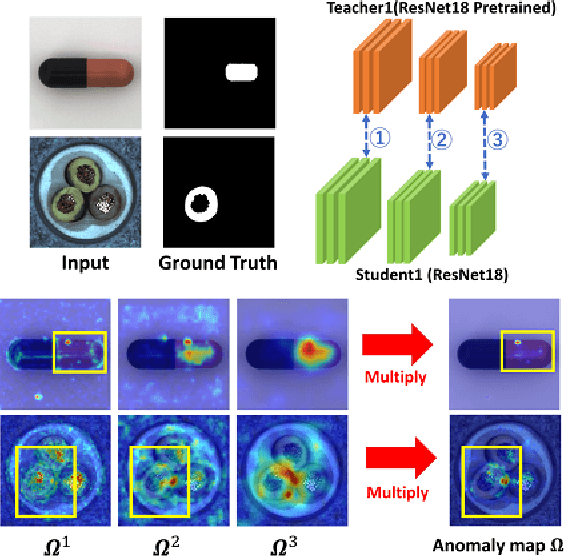
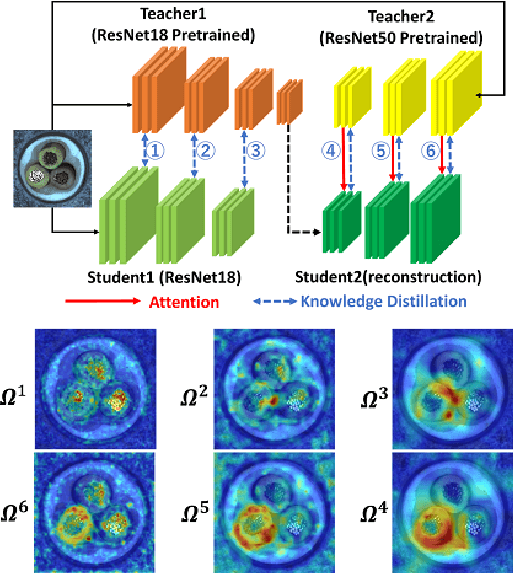
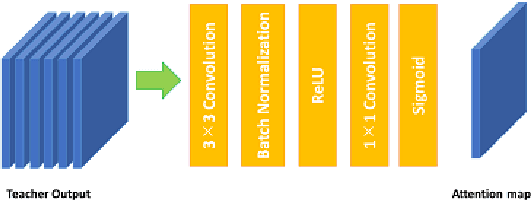
Anomaly detection is an important problem in computer vision; however, the scarcity of anomalous samples makes this task difficult. Thus, recent anomaly detection methods have used only normal images with no abnormal areas for training. In this work, a powerful anomaly detection method is proposed based on student-teacher feature pyramid matching (STPM), which consists of a student and teacher network. Generative models are another approach to anomaly detection. They reconstruct normal images from an input and compute the difference between the predicted normal and the input. Unfortunately, STPM does not have the ability to generate normal images. To improve the accuracy of STPM, this work uses a student network, as in generative models, to reconstruct normal features. This improves the accuracy; however, the anomaly maps for normal images are not clean because STPM does not use anomaly images for training, which decreases the accuracy of the image-level anomaly detection. To further improve accuracy, a discriminative network trained with pseudo-anomalies from anomaly maps is used in our method, which consists of two pairs of student-teacher networks and a discriminative network. The method displayed high accuracy on the MVTec anomaly detection dataset.