 Add to Chrome
 Add to Firefox
 Add to Edge
Motion Planning for Mobile Manipulators Navigating Doorways via Model Predictive Control
Jul 31, 2026
Navigating doorways is a fundamental capability for mobile manipulators operating in human environments, requiring coordinated motion between the mobile base and manipulator arm. This paper presents a motion planning framework that generates dynamically feasible and collision-free trajectories for autonomously opening and traversing both push and pull doors. The proposed method formulates the robot and door as a coupled dynamical system within a nonlinear Model Predictive Control (MPC) optimization framework. Manipulation feasibility is enforced through a penalty-based constraint, avoiding explicit arm kinematic modeling in the planner. Simulations and a hardware experiment demonstrate that the approach successfully plans feasible trajectories for door traversal.

Safe Vision Language Action Models via Barrier Enhanced Flow Matching
Jul 31, 2026This article presents a modular inference framework that integrates Flow Matching generative models with formal Control Barrier Function (CBF) safety guarantees. Unlike existing methods that apply external safety filters to a model's final output, our approach modifies the Flow Matching denoising process within the model to inherently generate safe trajectories. By employing a smooth Log-Sum-Exponential aggregate barrier, we enforce safety over entire action chunks. This aggregate barrier ensures a minimal increase in computational overhead and does not alter the semantic intent of the model. We show that, within the proposed framework, the 2-Wasserstein distance between the generated distribution and the target distribution remains bounded. Our method eliminates the need for safety-specific datasets or costly model retraining, providing a versatile solution for safe inference. We validate the approach on two robotic manipulation platforms and a 2D navigation benchmark, verifying that our framework achieves reliable safety without degrading the success rate of the model.
StratMamba: Strategic and Reactive Stream Partitioning for Path-Efficient LiDAR-Based Obstacle Avoidance
Jul 14, 2026This paper proposes StratMamba, a dual-stream Mamba-based temporal modeling architecture, to more efficiently capture long-horizon temporal dependencies required for robot navigation in complex and obstacle-rich environments. StratMamba leverages a combination of fast-decay and slow-decay memory architectures, where the fast-decay component processes high-frequency LiDAR data for reactive obstacle avoidance, while the slow-decay component maintains longer-horizon goal information for strategic planning. We perform extensive evaluations of different obstacle avoidance scenarios in IsaacLab and Gazebo, while also validating successful sim-to-real deployment on a Unitree GO1 quadruped robot navigating in the presence of static/dynamic obstacles. Comparisons with other temporal RL baselines, such as LSTM, Transformer, and Vanilla-Mamba, show that our StratMamba achieves exceptional temporal reasoning efficiency with a lower timeout rate, while maintaining the fastest navigation speed (576 median steps, 5.0% better than Vanilla-Mamba). It also achieves the highest path optimality (0.915 path efficiency) across all baselines. Real-world evaluation reveals that StratMamba maintains more robust performance across extended LiDAR ranges compared to vanilla Mamba and the Transformer, demonstrating that dual-stream partitioning effectively balances reactive safety with strategic navigation under challenging sensing conditions.
Online Bipedal Locomotion Adaptation for Stepping on Obstacles Using a Novel Foot Sensor
Dec 27, 2022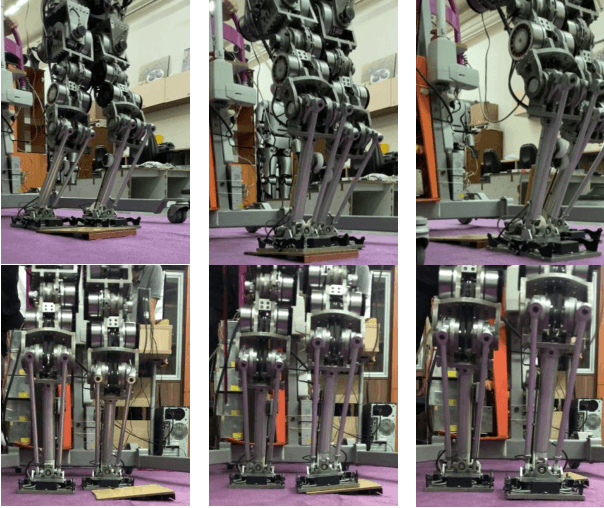


In this paper, we present a novel control architecture for the online adaptation of bipedal locomotion on inclined obstacles. In particular, we introduce a novel, cost-effective, and versatile foot sensor to detect the proximity of the robot's feet to the ground (bump sensor). By employing this sensor, feedback controllers are implemented to reduce the impact forces during the transition of the swing to stance phase or steeping on inclined unseen obstacles. Compared to conventional sensors based on contact reaction force, this sensor detects the distance to the ground or obstacles before the foot touches the obstacle and therefore provides predictive information to anticipate the obstacles. The controller of the proposed bump sensor interacts with another admittance controller to adjust leg length. The walking experiments show successful locomotion on the unseen inclined obstacle without reducing the locomotion speed with a slope angle of 12. Foot position error causes a hard impact with the ground as a consequence of accumulative error caused by links and connections' deflection (which is manufactured by university tools). The proposed framework drastically reduces the feet' impact with the ground.
Bipedal Locomotion Optimization by Exploitation of the Full Dynamics in DCM Trajectory Planning
Jul 30, 2022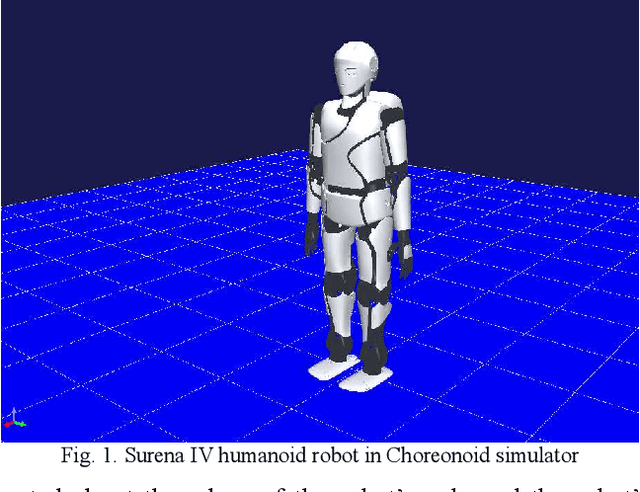
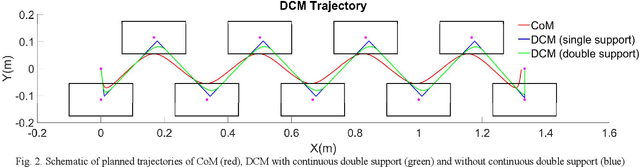
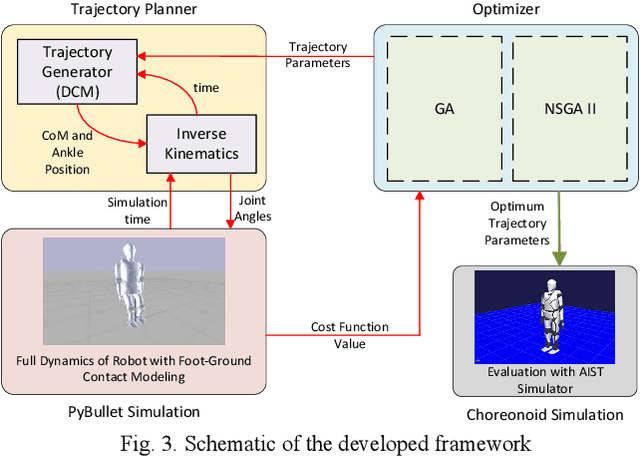
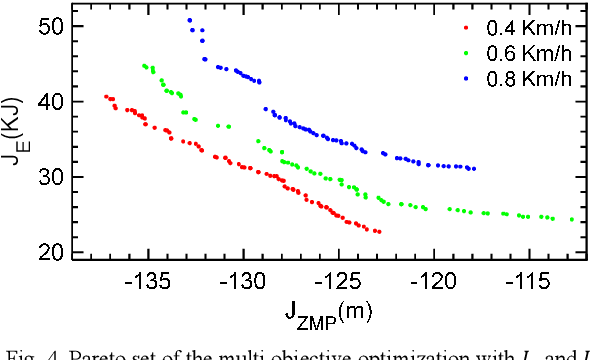
Walking motion planning based on Divergent Component of Motion (DCM) and Linear Inverted Pendulum Model (LIPM) is one of the alternatives that could be implemented to generate online humanoid robot gait trajectories. This algorithm requires different parameters to be adjusted. Herein, we developed a framework to attain optimal parameters to achieve a stable and energy-efficient trajectory for real robot's gait. To find the optimal trajectory, four cost functions representing energy consumption, the sum of joints velocity and applied torque at each lower limb joint of the robot, and a cost function based on the Zero Moment Point (ZMP) stability criterion were considered. Genetic algorithm was employed in the framework to optimize each of these cost functions. Although the trajectory planning was done with the help of the simplified model, the values of each cost function were obtained by considering the full dynamics model and foot-ground contact model in Bullet physics engine simulator. The results of this optimization yield that walking with the most stability and walking in the most efficient way are in contrast with each other. Therefore, in another attempt, multi-objective optimization for ZMP and energy cost functions at three different speeds was performed. Finally, we compared the designed trajectory, which was generated using optimal parameters, with the simulation results in Choreonoid simulator.