 Add to Chrome
 Add to Firefox
 Add to Edge
Optimistic Policy Learning under Pessimistic Adversaries with Regret and Violation Guarantees
Apr 15, 2026
Real-world decision-making systems operate in environments where state transitions depend not only on the agent's actions, but also on \textbf{exogenous factors outside its control}--competing agents, environmental disturbances, or strategic adversaries--formally, $s_{h+1} = f(s_h, a_h, \bar{a}_h)+ω_h$ where $\bar{a}_h$ is the adversary/external action, $a_h$ is the agent's action, and $ω_h$ is an additive noise. Ignoring such factors can yield policies that are optimal in isolation but \textbf{fail catastrophically in deployment}, particularly when safety constraints must be satisfied. Standard Constrained MDP formulations assume the agent is the sole driver of state evolution, an assumption that breaks down in safety-critical settings. Existing robust RL approaches address this via distributional robustness over transition kernels, but do not explicitly model the \textbf{strategic interaction} between agent and exogenous factor, and rely on strong assumptions about divergence from a known nominal model. We model the exogenous factor as an \textbf{adversarial policy} $\barπ$ that co-determines state transitions, and ask how an agent can remain both optimal and safe against such an adversary. \emph{To the best of our knowledge, this is the first work to study safety-constrained RL under explicit adversarial dynamics}. We propose \textbf{Robust Hallucinated Constrained Upper-Confidence RL} (\texttt{RHC-UCRL}), a model-based algorithm that maintains optimism over both agent and adversary policies, explicitly separating epistemic from aleatoric uncertainty. \texttt{RHC-UCRL} achieves sub-linear regret and constraint violation guarantees.

Medical Image De-Identification Benchmark Challenge
Jul 31, 2025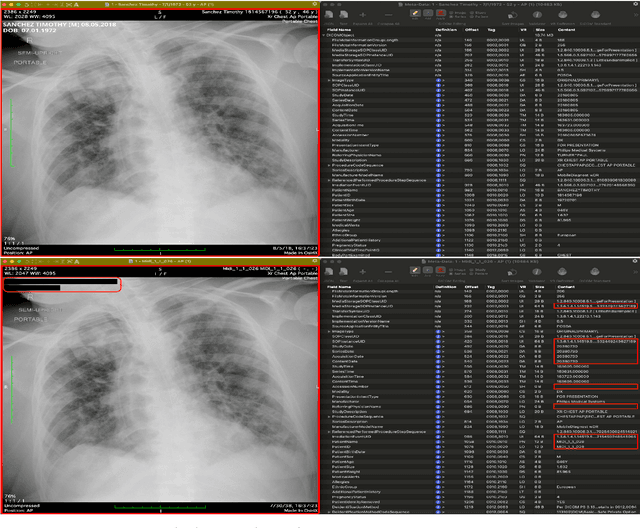
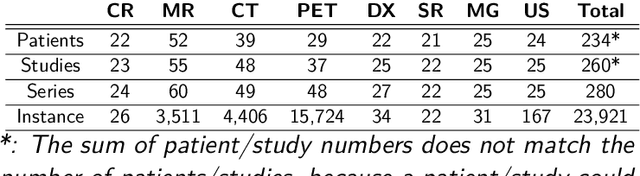
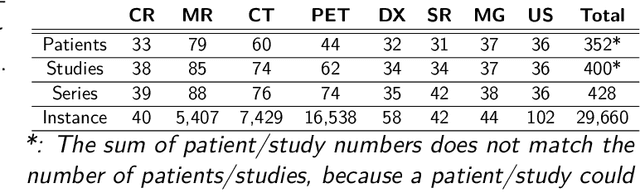
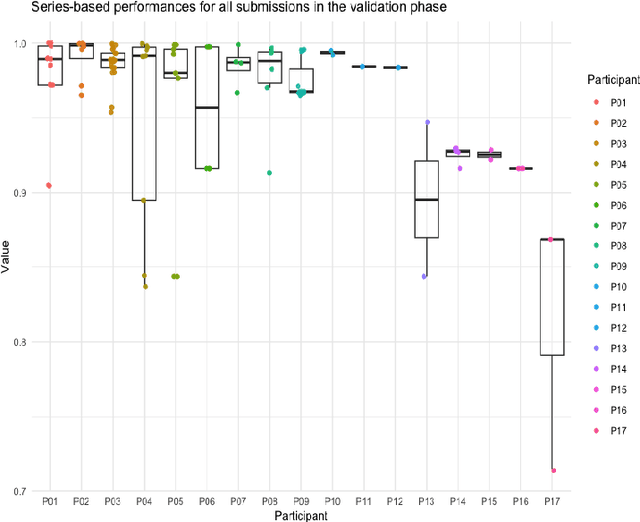
The de-identification (deID) of protected health information (PHI) and personally identifiable information (PII) is a fundamental requirement for sharing medical images, particularly through public repositories, to ensure compliance with patient privacy laws. In addition, preservation of non-PHI metadata to inform and enable downstream development of imaging artificial intelligence (AI) is an important consideration in biomedical research. The goal of MIDI-B was to provide a standardized platform for benchmarking of DICOM image deID tools based on a set of rules conformant to the HIPAA Safe Harbor regulation, the DICOM Attribute Confidentiality Profiles, and best practices in preservation of research-critical metadata, as defined by The Cancer Imaging Archive (TCIA). The challenge employed a large, diverse, multi-center, and multi-modality set of real de-identified radiology images with synthetic PHI/PII inserted. The MIDI-B Challenge consisted of three phases: training, validation, and test. Eighty individuals registered for the challenge. In the training phase, we encouraged participants to tune their algorithms using their in-house or public data. The validation and test phases utilized the DICOM images containing synthetic identifiers (of 216 and 322 subjects, respectively). Ten teams successfully completed the test phase of the challenge. To measure success of a rule-based approach to image deID, scores were computed as the percentage of correct actions from the total number of required actions. The scores ranged from 97.91% to 99.93%. Participants employed a variety of open-source and proprietary tools with customized configurations, large language models, and optical character recognition (OCR). In this paper we provide a comprehensive report on the MIDI-B Challenge's design, implementation, results, and lessons learned.
TPU-Gen: LLM-Driven Custom Tensor Processing Unit Generator
Mar 07, 2025The increasing complexity and scale of Deep Neural Networks (DNNs) necessitate specialized tensor accelerators, such as Tensor Processing Units (TPUs), to meet various computational and energy efficiency requirements. Nevertheless, designing optimal TPU remains challenging due to the high domain expertise level, considerable manual design time, and lack of high-quality, domain-specific datasets. This paper introduces TPU-Gen, the first Large Language Model (LLM) based framework designed to automate the exact and approximate TPU generation process, focusing on systolic array architectures. TPU-Gen is supported with a meticulously curated, comprehensive, and open-source dataset that covers a wide range of spatial array designs and approximate multiply-and-accumulate units, enabling design reuse, adaptation, and customization for different DNN workloads. The proposed framework leverages Retrieval-Augmented Generation (RAG) as an effective solution for a data-scare hardware domain in building LLMs, addressing the most intriguing issue, hallucinations. TPU-Gen transforms high-level architectural specifications into optimized low-level implementations through an effective hardware generation pipeline. Our extensive experimental evaluations demonstrate superior performance, power, and area efficiency, with an average reduction in area and power of 92\% and 96\% from the manual optimization reference values. These results set new standards for driving advancements in next-generation design automation tools powered by LLMs.