 Add to Chrome
 Add to Firefox
 Add to Edge
Optimistic Policy Learning under Pessimistic Adversaries with Regret and Violation Guarantees
Apr 15, 2026
Real-world decision-making systems operate in environments where state transitions depend not only on the agent's actions, but also on \textbf{exogenous factors outside its control}--competing agents, environmental disturbances, or strategic adversaries--formally, $s_{h+1} = f(s_h, a_h, \bar{a}_h)+ω_h$ where $\bar{a}_h$ is the adversary/external action, $a_h$ is the agent's action, and $ω_h$ is an additive noise. Ignoring such factors can yield policies that are optimal in isolation but \textbf{fail catastrophically in deployment}, particularly when safety constraints must be satisfied. Standard Constrained MDP formulations assume the agent is the sole driver of state evolution, an assumption that breaks down in safety-critical settings. Existing robust RL approaches address this via distributional robustness over transition kernels, but do not explicitly model the \textbf{strategic interaction} between agent and exogenous factor, and rely on strong assumptions about divergence from a known nominal model. We model the exogenous factor as an \textbf{adversarial policy} $\barπ$ that co-determines state transitions, and ask how an agent can remain both optimal and safe against such an adversary. \emph{To the best of our knowledge, this is the first work to study safety-constrained RL under explicit adversarial dynamics}. We propose \textbf{Robust Hallucinated Constrained Upper-Confidence RL} (\texttt{RHC-UCRL}), a model-based algorithm that maintains optimism over both agent and adversary policies, explicitly separating epistemic from aleatoric uncertainty. \texttt{RHC-UCRL} achieves sub-linear regret and constraint violation guarantees.

Provably Efficient Sample Complexity for Robust CMDP
Nov 10, 2025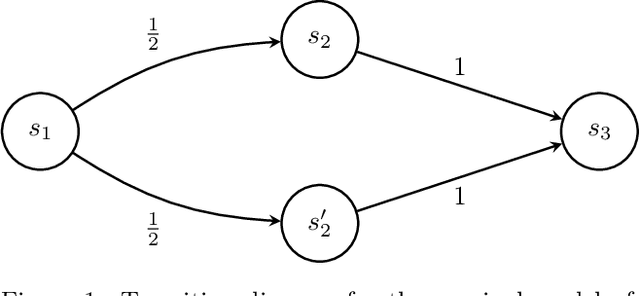
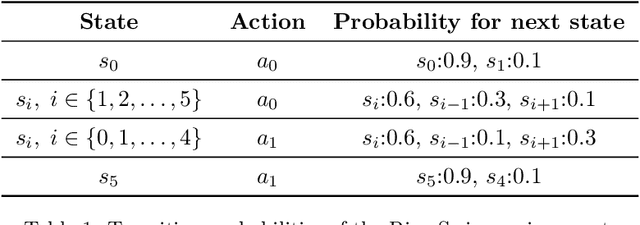
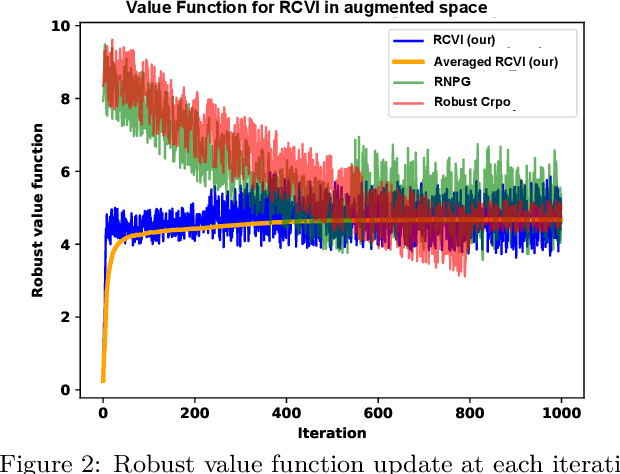
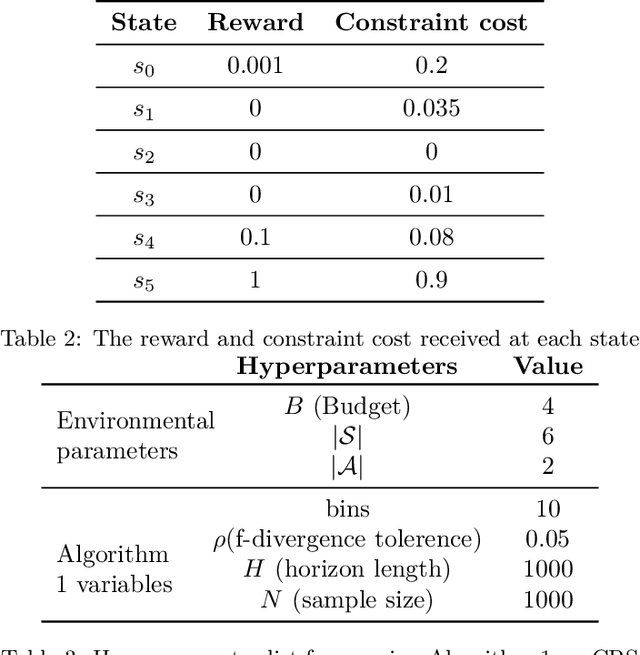
We study the problem of learning policies that maximize cumulative reward while satisfying safety constraints, even when the real environment differs from a simulator or nominal model. We focus on robust constrained Markov decision processes (RCMDPs), where the agent must maximize reward while ensuring cumulative utility exceeds a threshold under the worst-case dynamics within an uncertainty set. While recent works have established finite-time iteration complexity guarantees for RCMDPs using policy optimization, their sample complexity guarantees remain largely unexplored. In this paper, we first show that Markovian policies may fail to be optimal even under rectangular uncertainty sets unlike the {\em unconstrained} robust MDP. To address this, we introduce an augmented state space that incorporates the remaining utility budget into the state representation. Building on this formulation, we propose a novel Robust constrained Value iteration (RCVI) algorithm with a sample complexity of $\mathcal{\tilde{O}}(|S||A|H^5/ε^2)$ achieving at most $ε$ violation using a generative model where $|S|$ and $|A|$ denote the sizes of the state and action spaces, respectively, and $H$ is the episode length. To the best of our knowledge, this is the {\em first sample complexity guarantee} for RCMDP. Empirical results further validate the effectiveness of our approach.
Efficient Policy Optimization in Robust Constrained MDPs with Iteration Complexity Guarantees
May 25, 2025Constrained decision-making is essential for designing safe policies in real-world control systems, yet simulated environments often fail to capture real-world adversities. We consider the problem of learning a policy that will maximize the cumulative reward while satisfying a constraint, even when there is a mismatch between the real model and an accessible simulator/nominal model. In particular, we consider the robust constrained Markov decision problem (RCMDP) where an agent needs to maximize the reward and satisfy the constraint against the worst possible stochastic model under the uncertainty set centered around an unknown nominal model. Primal-dual methods, effective for standard constrained MDP (CMDP), are not applicable here because of the lack of the strong duality property. Further, one cannot apply the standard robust value-iteration based approach on the composite value function either as the worst case models may be different for the reward value function and the constraint value function. We propose a novel technique that effectively minimizes the constraint value function--to satisfy the constraints; on the other hand, when all the constraints are satisfied, it can simply maximize the robust reward value function. We prove that such an algorithm finds a policy with at most $\epsilon$ sub-optimality and feasible policy after $O(\epsilon^{-2})$ iterations. In contrast to the state-of-the-art method, we do not need to employ a binary search, thus, we reduce the computation time by at least 4x for smaller value of discount factor ($\gamma$) and by at least 6x for larger value of $\gamma$.
Restricted Bayesian Neural Network
Mar 06, 2024Modern deep learning tools are remarkably effective in addressing intricate problems. However, their operation as black-box models introduces increased uncertainty in predictions. Additionally, they contend with various challenges, including the need for substantial storage space in large networks, issues of overfitting, underfitting, vanishing gradients, and more. This study explores the concept of Bayesian Neural Networks, presenting a novel architecture designed to significantly alleviate the storage space complexity of a network. Furthermore, we introduce an algorithm adept at efficiently handling uncertainties, ensuring robust convergence values without becoming trapped in local optima, particularly when the objective function lacks perfect convexity.