 Add to Chrome
 Add to Firefox
 Add to Edge
Toward Geometry-Scalable Whole-Body Touch for Humanoids: A 3D-Printed Conformal EIT Skin
Aug 03, 2026
Whole-body tactile sensing is a prerequisite for humanoids that operate in contact-rich human environments, but conventional taxel arrays scale poorly with surface area, wiring complexity, and robot-specific curvature. We present a conformal electrical impedance tomography tactile skin fabricated through a geometry-adaptable additive-manufacturing workflow. A flexible conductive TPU layer forms a continuous sensing domain, while contact-induced coupling with conductive patches produces boundary voltage changes that are reconstructed using a one-step Gauss-Newton EIT solver. We first characterize the electromechanical design space of the layered structure and show that low-resistance contact-enhancement patches and a porous conductive TPU sensing layer improve sensitivity while preserving printability. We then validate contact localization on a planar prototype, a curved U-shaped prototype, and a qualitative iCub-face-shaped geometry. The curved sensor achieves a mean localization error of 6 mm over 18 contact positions without supervised post-processing. These results suggest that additively manufactured tomographic skins can reduce the morphology-specific redesign burden for humanoid tactile coverage and provide a practical route toward large-area contact sensing for human-centered deployment.

No Need to Look! Locating and Grasping Objects by a Robot Arm Covered with Sensitive Skin
Aug 25, 2025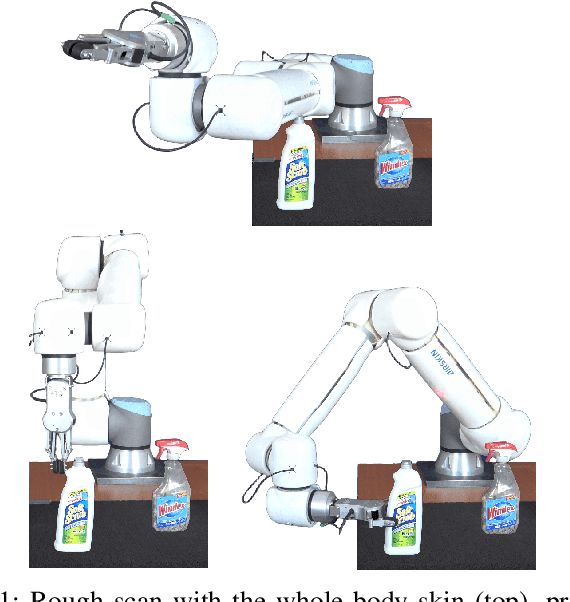
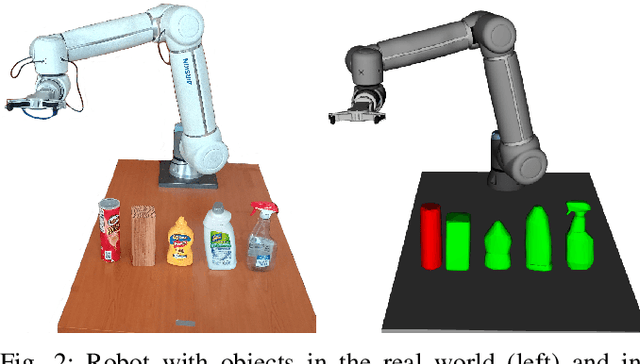
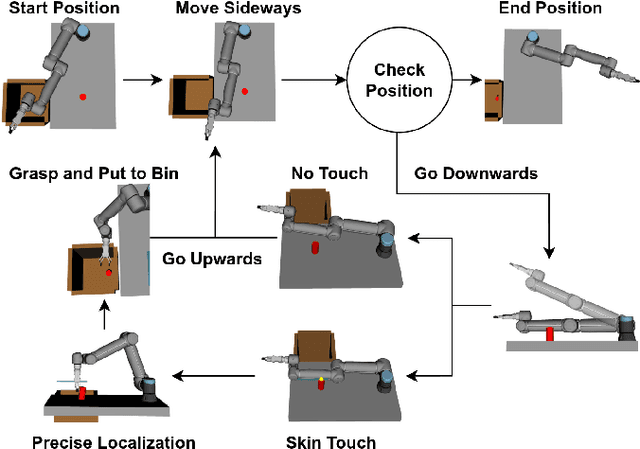
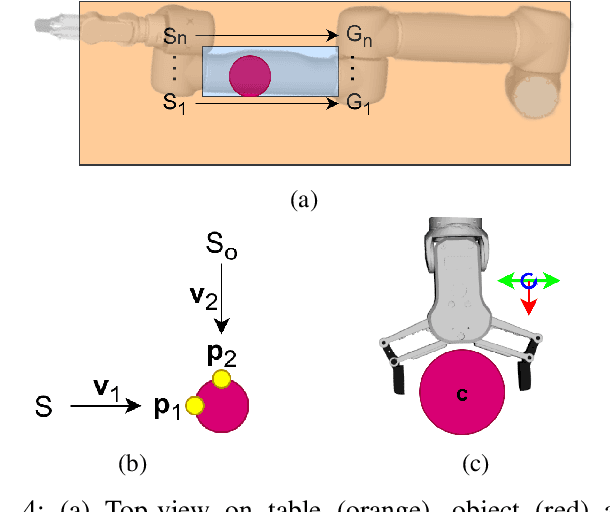
Locating and grasping of objects by robots is typically performed using visual sensors. Haptic feedback from contacts with the environment is only secondary if present at all. In this work, we explored an extreme case of searching for and grasping objects in complete absence of visual input, relying on haptic feedback only. The main novelty lies in the use of contacts over the complete surface of a robot manipulator covered with sensitive skin. The search is divided into two phases: (1) coarse workspace exploration with the complete robot surface, followed by (2) precise localization using the end-effector equipped with a force/torque sensor. We systematically evaluated this method in simulation and on the real robot, demonstrating that diverse objects can be located, grasped, and put in a basket. The overall success rate on the real robot for one object was 85.7\% with failures mainly while grasping specific objects. The method using whole-body contacts is six times faster compared to a baseline that uses haptic feedback only on the end-effector. We also show locating and grasping multiple objects on the table. This method is not restricted to our specific setup and can be deployed on any platform with the ability of sensing contacts over the entire body surface. This work holds promise for diverse applications in areas with challenging visual perception (due to lighting, dust, smoke, occlusion) such as in agriculture when fruits or vegetables need to be located inside foliage and picked.