 Add to Chrome
 Add to Firefox
 Add to Edge
Toward Geometry-Scalable Whole-Body Touch for Humanoids: A 3D-Printed Conformal EIT Skin
Aug 03, 2026
Whole-body tactile sensing is a prerequisite for humanoids that operate in contact-rich human environments, but conventional taxel arrays scale poorly with surface area, wiring complexity, and robot-specific curvature. We present a conformal electrical impedance tomography tactile skin fabricated through a geometry-adaptable additive-manufacturing workflow. A flexible conductive TPU layer forms a continuous sensing domain, while contact-induced coupling with conductive patches produces boundary voltage changes that are reconstructed using a one-step Gauss-Newton EIT solver. We first characterize the electromechanical design space of the layered structure and show that low-resistance contact-enhancement patches and a porous conductive TPU sensing layer improve sensitivity while preserving printability. We then validate contact localization on a planar prototype, a curved U-shaped prototype, and a qualitative iCub-face-shaped geometry. The curved sensor achieves a mean localization error of 6 mm over 18 contact positions without supervised post-processing. These results suggest that additively manufactured tomographic skins can reduce the morphology-specific redesign burden for humanoid tactile coverage and provide a practical route toward large-area contact sensing for human-centered deployment.

Improving Sensing Coverage and Compliance of 3D-Printed Artificial Skins Through Multi-Modal Sensing and Soft Materials
Apr 28, 20263D-printed artificial skins are a scalable approach to whole-body tactile and proximity coverage, but prior implementations have been limited to unimodal sensing and rigid materials. To improve the practical usability of 3D-printed artificial skins, we present a hybrid time-of-flight (ToF) and self-capacitance (SC) sensing skin that demonstrates multi-modal sensing integration, soft compliant coverings for impact absorption and pressure sensing, and a streamlined electrical interface between printed conductive traces and external electronics. We show that combining ToF and SC modalities enables contact detection, scene reconstruction, and pressure-correlated tactile responses with the compliant covering by deploying six artificial skin units with 40 sensing elements over an FR3 robot arm.
Egocentric Tactile and Proximity Sensors as Observation Priors for Humanoid Collision Avoidance
Apr 28, 2026Collision-free motion is often aided by tactile and proximity sensors distributed on the body of the robot due to their resistance to occlusion as opposed to external cameras. However, how to shape the sensor's properties, such as sensing coverage; type; and range, to enable avoidant behavior remains unclear. In this work, we present a reinforcement learning framework for whole-body collision avoidance on a humanoid H1-2 robot and use it to characterize how sensor properties shape learned avoidance behavior. Using dodgeball as a benchmark task, we ablate the properties of sensors distributed across the upper body of the robot and find that raw proximity measurements can substitute for explicit object localization provided the sensing range is sufficient and that sparse non-directional proximity signals outpace dense directional alternatives in sample efficiency.
Form-Fitting, Large-Area Sensor Mounting for Obstacle Detection
Mar 24, 2026We introduce a low-cost method for mounting sensors onto robot links for large-area sensing coverage that does not require the sensor's positions or orientations to be calibrated before use. Using computer aided design (CAD), a robot skin covering, or skin unit, can be procedurally generated to fit around a nondevelopable surface, a 3D surface that cannot be flattened into a 2D plane without distortion, of a robot. The skin unit embeds mounts for printed circuit boards of any size to keep sensors in fixed and known locations. We demonstrate our method by constructing point cloud images of obstacles within the proximity of a Franka Research 3 robot's operational environment using an array of time of flight (ToF) imagers mounted on a printed skin unit and attached to the robot arm.
Design, Mapping, and Contact Anticipation with 3D-printed Whole-Body Tactile and Proximity Sensors
Mar 05, 2026Robots operating in dynamic and shared environments benefit from anticipating contact before it occurs. We present GenTact-Prox, a fully 3D-printed artificial skin that integrates tactile and proximity sensing for contact detection and anticipation. The artificial skin platform is modular in design, procedurally generated to fit any robot morphology, and can cover the whole body of a robot. The skin achieved detection ranges of up to 18 cm during evaluation. To characterize how robots perceive nearby space through this skin, we introduce a data-driven framework for mapping the Perisensory Space -- the body-centric volume of space around the robot where sensors provide actionable information for contact anticipation. We demonstrate this approach on a Franka Research 3 robot equipped with five GenTact-Prox units, enabling online object-aware operation and contact prediction.
A Sensor Position Localization Method for Flexible, Non-Uniform Capacitive Tactile Sensor Arrays
Dec 01, 2024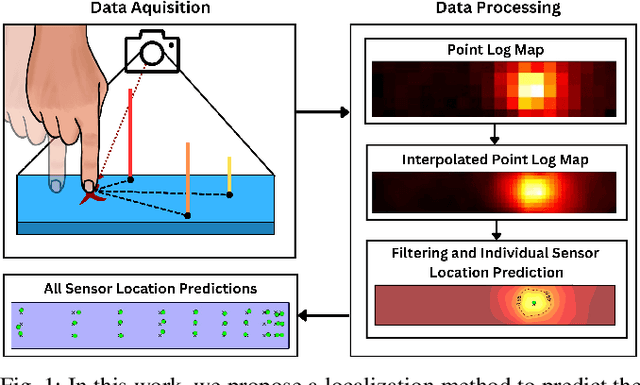
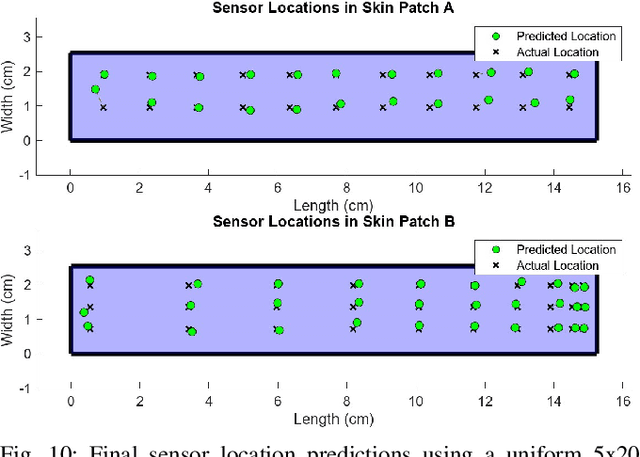
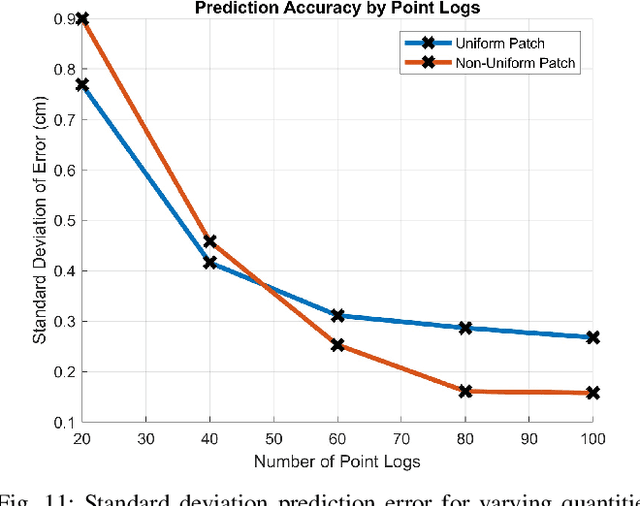
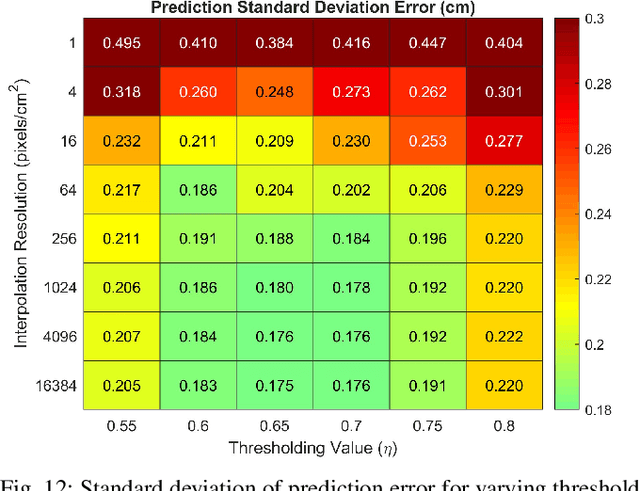
Tactile sensing is used in robotics to obtain real-time feedback during physical interactions. Fine object manipulation is a robotic application that benefits from a high density of sensors to accurately estimate object pose, whereas a low sensing resolution is sufficient for collision detection. Introducing variable sensing resolution into a single tactile sensing array can increase the range of tactile use cases, but also invokes challenges in localizing internal sensor positions. In this work, we present a mutual capacitance sensor array with variable sensor density, VARSkin, along with a localization method that determines the position of each sensor in the non-uniform array. When tested on two distinct artificial skin patches with concealed sensor layouts, our method achieves a localization accuracy within $\pm 2mm$. We also provide a comprehensive error analysis, offering strategies for further precision improvement.
GenTact Toolbox: A Computational Design Pipeline to Procedurally Generate Context-Driven 3D Printed Whole-Body Tactile Skins
Dec 01, 2024Developing whole-body tactile skins for robots remains a challenging task, as existing solutions often prioritize modular, one-size-fits-all designs, which, while versatile, fail to account for the robot's specific shape and the unique demands of its operational context. In this work, we introduce the GenTact Toolbox, a computational pipeline for creating versatile whole-body tactile skins tailored to both robot shape and application domain. Our pipeline includes procedural mesh generation for conforming to a robot's topology, task-driven simulation to refine sensor distribution, and multi-material 3D printing for shape-agnostic fabrication. We validate our approach by creating and deploying six capacitive sensing skins on a Franka Research 3 robot arm in a human-robot interaction scenario. This work represents a shift from one-size-fits-all tactile sensors toward context-driven, highly adaptable designs that can be customized for a wide range of robotic systems and applications.
A Machine Learning Approach to Contact Localization in Variable Density Three-Dimensional Tactile Artificial Skin
Dec 01, 2024
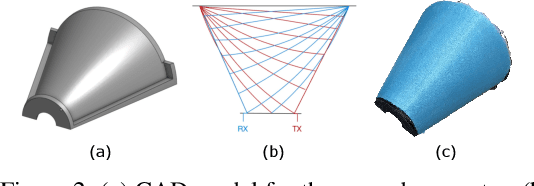
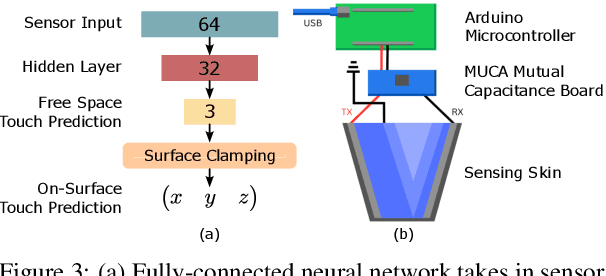
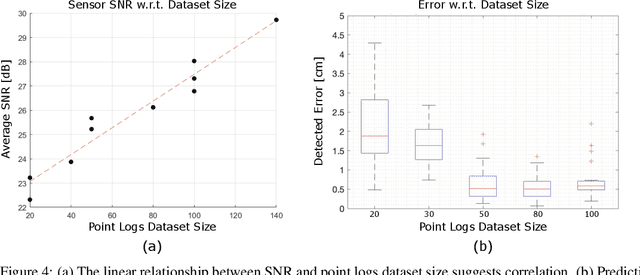
Estimating the location of contact is a primary function of artificial tactile sensing apparatuses that perceive the environment through touch. Existing contact localization methods use flat geometry and uniform sensor distributions as a simplifying assumption, limiting their ability to be used on 3D surfaces with variable density sensing arrays. This paper studies contact localization on an artificial skin embedded with mutual capacitance tactile sensors, arranged non-uniformly in an unknown distribution along a semi-conical 3D geometry. A fully connected neural network is trained to localize the touching points on the embedded tactile sensors. The studied online model achieves a localization error of $5.7 \pm 3.0$ mm. This research contributes a versatile tool and robust solution for contact localization that is ambiguous in shape and internal sensor distribution.