 Add to Chrome
 Add to Firefox
 Add to Edge
Coordinate-Based Dual-Constrained Autoregressive Motion Generation
Apr 09, 2026
Text-to-motion generation has attracted increasing attention in the research community recently, with potential applications in animation, virtual reality, robotics, and human-computer interaction. Diffusion and autoregressive models are two popular and parallel research directions for text-to-motion generation. However, diffusion models often suffer from error amplification during noise prediction, while autoregressive models exhibit mode collapse due to motion discretization. To address these limitations, we propose a flexible, high-fidelity, and semantically faithful text-to-motion framework, named Coordinate-based Dual-constrained Autoregressive Motion Generation (CDAMD). With motion coordinates as input, CDAMD follows the autoregressive paradigm and leverages diffusion-inspired multi-layer perceptrons to enhance the fidelity of predicted motions. Furthermore, a Dual-Constrained Causal Mask is introduced to guide autoregressive generation, where motion tokens act as priors and are concatenated with textual encodings. Since there is limited work on coordinate-based motion synthesis, we establish new benchmarks for both text-to-motion generation and motion editing. Experimental results demonstrate that our approach achieves state-of-the-art performance in terms of both fidelity and semantic consistency on these benchmarks.

Not All Agents Matter: From Global Attention Dilution to Risk-Prioritized Game Planning
Apr 07, 2026End-to-end autonomous driving resides not in the integration of perception and planning, but rather in the dynamic multi-agent game within a unified representation space. Most existing end-to-end models treat all agents equally, hindering the decoupling of real collision threats from complex backgrounds. To address this issue, We introduce the concept of Risk-Prioritized Game Planning, and propose GameAD, a novel framework that models end-to-end autonomous driving as a risk-aware game problem. The GameAD integrates Risk-Aware Topology Anchoring, Strategic Payload Adapter, Minimax Risk-Aware Sparse Attention, and Risk Consistent Equilibrium Stabilization to enable game theoretic decision making with risk prioritized interactions. We also present the Planning Risk Exposure metric, which quantifies the cumulative risk intensity of planned trajectories over a long horizon for safe autonomous driving. Extensive experiments on the nuScenes and Bench2Drive datasets show that our approach significantly outperforms state-of-the-art methods, especially in terms of trajectory safety.
CoINS: Counterfactual Interactive Navigation via Skill-Aware VLM
Jan 07, 2026Recent Vision-Language Models (VLMs) have demonstrated significant potential in robotic planning. However, they typically function as semantic reasoners, lacking an intrinsic understanding of the specific robot's physical capabilities. This limitation is particularly critical in interactive navigation, where robots must actively modify cluttered environments to create traversable paths. Existing VLM-based navigators are predominantly confined to passive obstacle avoidance, failing to reason about when and how to interact with objects to clear blocked paths. To bridge this gap, we propose Counterfactual Interactive Navigation via Skill-aware VLM (CoINS), a hierarchical framework that integrates skill-aware reasoning and robust low-level execution. Specifically, we fine-tune a VLM, named InterNav-VLM, which incorporates skill affordance and concrete constraint parameters into the input context and grounds them into a metric-scale environmental representation. By internalizing the logic of counterfactual reasoning through fine-tuning on the proposed InterNav dataset, the model learns to implicitly evaluate the causal effects of object removal on navigation connectivity, thereby determining interaction necessity and target selection. To execute the generated high-level plans, we develop a comprehensive skill library through reinforcement learning, specifically introducing traversability-oriented strategies to manipulate diverse objects for path clearance. A systematic benchmark in Isaac Sim is proposed to evaluate both the reasoning and execution aspects of interactive navigation. Extensive simulations and real-world experiments demonstrate that CoINS significantly outperforms representative baselines, achieving a 17\% higher overall success rate and over 80\% improvement in complex long-horizon scenarios compared to the best-performing baseline
SwarmDiff: Swarm Robotic Trajectory Planning in Cluttered Environments via Diffusion Transformer
May 21, 2025Swarm robotic trajectory planning faces challenges in computational efficiency, scalability, and safety, particularly in complex, obstacle-dense environments. To address these issues, we propose SwarmDiff, a hierarchical and scalable generative framework for swarm robots. We model the swarm's macroscopic state using Probability Density Functions (PDFs) and leverage conditional diffusion models to generate risk-aware macroscopic trajectory distributions, which then guide the generation of individual robot trajectories at the microscopic level. To ensure a balance between the swarm's optimal transportation and risk awareness, we integrate Wasserstein metrics and Conditional Value at Risk (CVaR). Additionally, we introduce a Diffusion Transformer (DiT) to improve sampling efficiency and generation quality by capturing long-range dependencies. Extensive simulations and real-world experiments demonstrate that SwarmDiff outperforms existing methods in computational efficiency, trajectory validity, and scalability, making it a reliable solution for swarm robotic trajectory planning.
SwarmPRM: Probabilistic Roadmap Motion Planning for Swarm Robotic Systems
Feb 26, 2024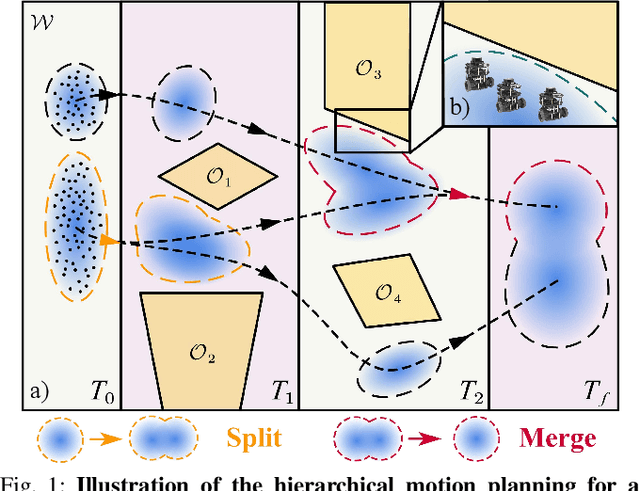
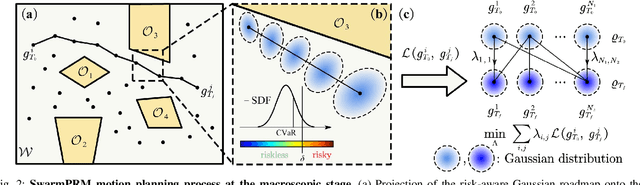
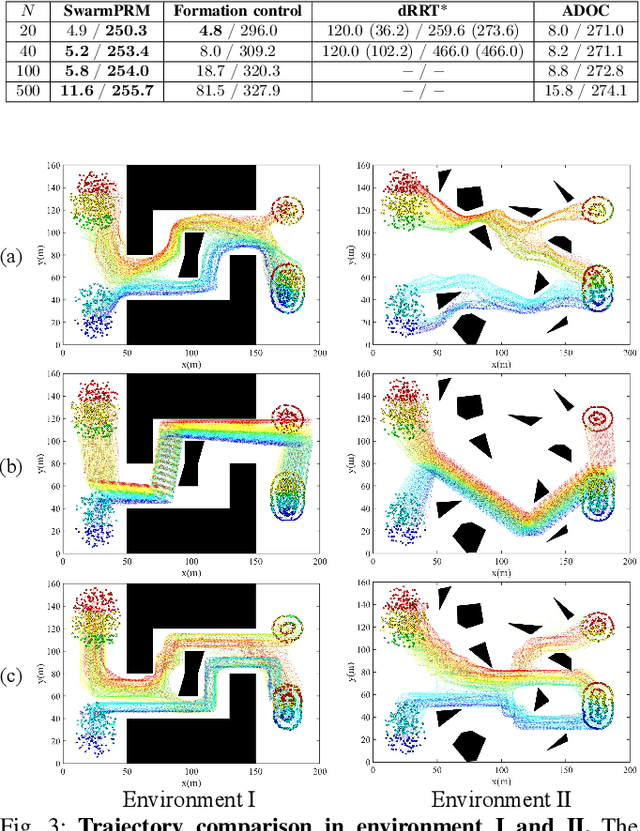
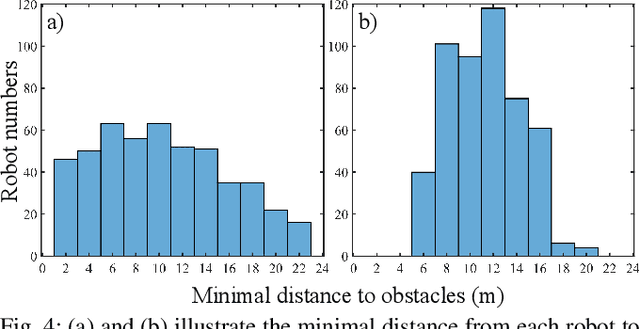
Swarm robotic systems consisting of large-scale cooperative agents hold promise for performing autonomous tasks in diverse fields. However, existing planning strategies for swarm robotic systems often encounter a trade-off between scalability and solution quality. We introduce here SwarmPRM, a hierarchical, highly scalable, computationally efficient, and risk-aware sampling-based motion planning approach for swarm robotic systems, which is asymptotically optimal under mild assumptions. We employ probability density functions (PDFs) to represent the swarm's macroscopic state and utilize optimal mass transport (OMT) theory to measure the swarm's cost to go. A risk-aware Gaussian roadmap is constructed wherein each node encapsulates a distinct PDF and conditional-value-at-risk (CVaR) is employed to assess the collision risk, facilitating the generation of macroscopic PDFs in Wasserstein-GMM space. Extensive simulations demonstrate that the proposed approach outperforms state-of-the-art methods in terms of computational efficiency and the average travelling distance.
ROVER: Risk-Aware Swarm Robotics MOtion Planner Using Conditional ValuE at Risk
Feb 26, 2024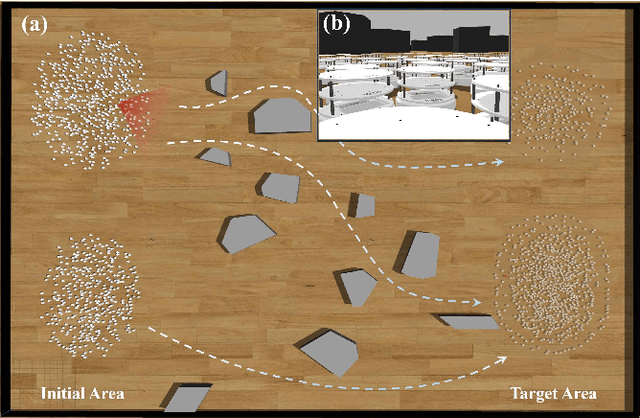
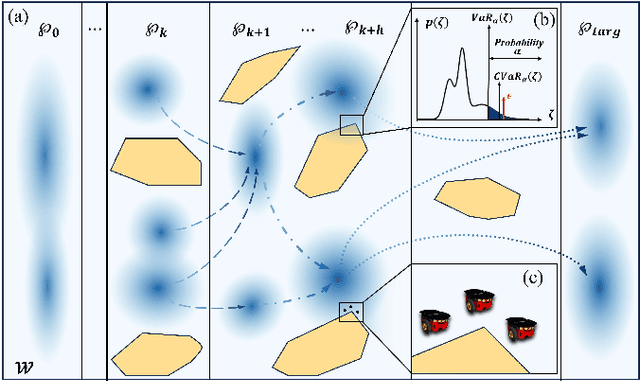
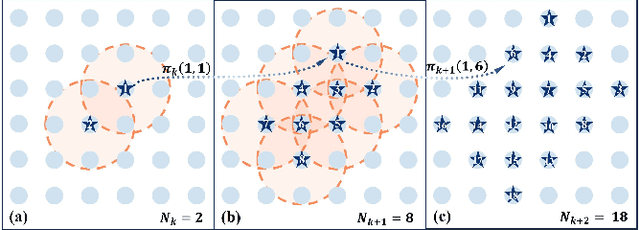
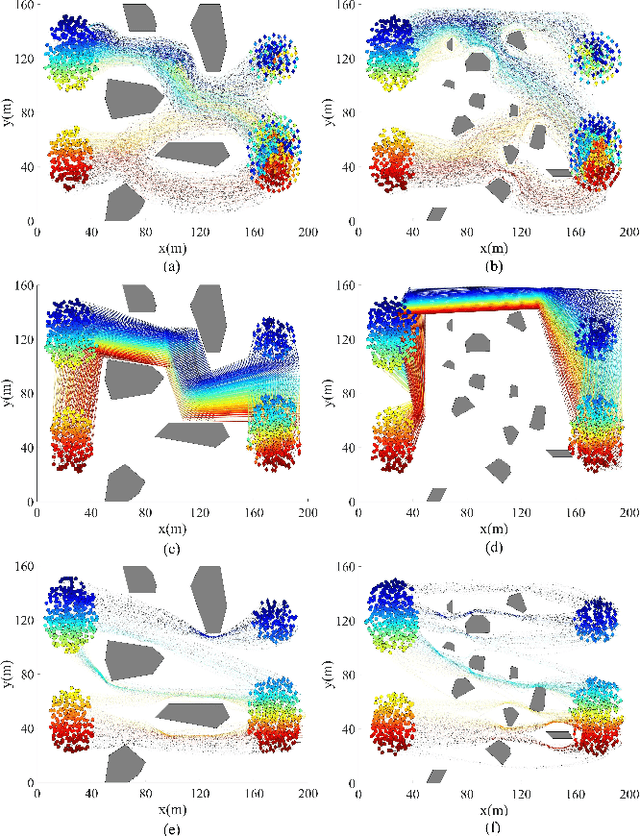
The field of swarm robotics has attracted considerable interest for its capacity to complete intricate and synchronized tasks. Existing methodologies for motion planning within swarm robotic systems mainly encounter difficulties in scalability and safety guarantee. To address these two limitations, we propose a Risk-aware swarm mOtion planner using conditional ValuE at Risk (ROVER) that systematically modulates the safety and conservativeness and navigates the swarm to the target area through cluttered environments. Our approach formulates a finite-time model predictive control (FTMPC) problem predicated upon the macroscopic state of the robot swarm represented by Gaussian Mixture Model (GMM) and integrates conditional value-at-risk (CVaR) to avoid collision. We leverage the linearized Signed Distance Function for the efficient computation of CVaR concerning the proximity between the robot swarm to obstacles. The key component of this method is implementing CVaR constraint under GMM uncertainty in the FTMPC to measure the collision risk that a robot swarm faces. However, the non-convex constrained FTMPC is nontrival to solve. To navigate this complexity, we develop a computationally tractable strategy through 1) an explicit linear approximation of the CVaR constraint; and 2) a sequential quadratic programming formulation. Simulations and comparisons with other approaches demonstrate the effectiveness of the proposed method in flexibility, scalability, and risk mitigation.