 Add to Chrome
 Add to Firefox
 Add to Edge
OrthoFuse: Training-free Riemannian Fusion of Orthogonal Style-Concept Adapters for Diffusion Models
Apr 06, 2026
In a rapidly growing field of model training there is a constant practical interest in parameter-efficient fine-tuning and various techniques that use a small amount of training data to adapt the model to a narrow task. However, there is an open question: how to combine several adapters tuned for different tasks into one which is able to yield adequate results on both tasks? Specifically, merging subject and style adapters for generative models remains unresolved. In this paper we seek to show that in the case of orthogonal fine-tuning (OFT), we can use structured orthogonal parametrization and its geometric properties to get the formulas for training-free adapter merging. In particular, we derive the structure of the manifold formed by the recently proposed Group-and-Shuffle ($\mathcal{GS}$) orthogonal matrices, and obtain efficient formulas for the geodesics approximation between two points. Additionally, we propose a $\text{spectra restoration}$ transform that restores spectral properties of the merged adapter for higher-quality fusion. We conduct experiments in subject-driven generation tasks showing that our technique to merge two $\mathcal{GS}$ orthogonal matrices is capable of uniting concept and style features of different adapters. To the best of our knowledge, this is the first training-free method for merging multiplicative orthogonal adapters. Code is available via the $\href{https://github.com/ControlGenAI/OrthoFuse}{link}$.

MaterialFusion: High-Quality, Zero-Shot, and Controllable Material Transfer with Diffusion Models
Feb 10, 2025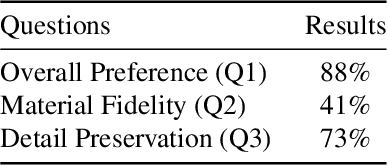
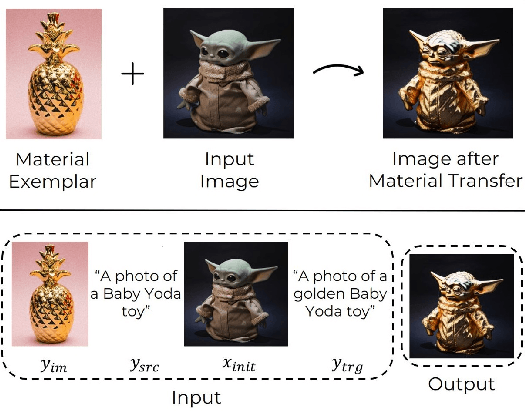
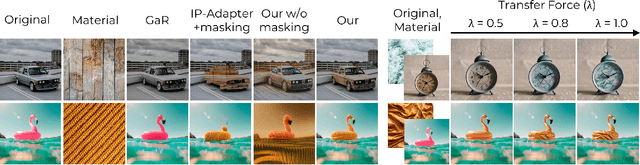
Manipulating the material appearance of objects in images is critical for applications like augmented reality, virtual prototyping, and digital content creation. We present MaterialFusion, a novel framework for high-quality material transfer that allows users to adjust the degree of material application, achieving an optimal balance between new material properties and the object's original features. MaterialFusion seamlessly integrates the modified object into the scene by maintaining background consistency and mitigating boundary artifacts. To thoroughly evaluate our approach, we have compiled a dataset of real-world material transfer examples and conducted complex comparative analyses. Through comprehensive quantitative evaluations and user studies, we demonstrate that MaterialFusion significantly outperforms existing methods in terms of quality, user control, and background preservation. Code is available at https://github.com/kzGarifullin/MaterialFusion.