 Add to Chrome
 Add to Firefox
 Add to Edge
FairProof : Confidential and Certifiable Fairness for Neural Networks
Feb 19, 2024
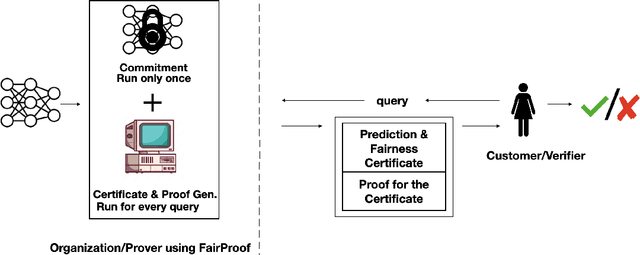
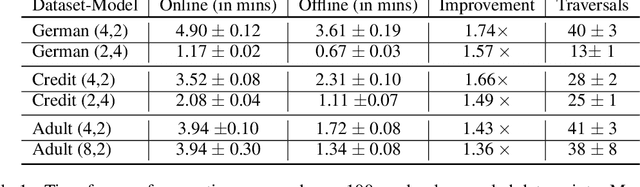
Machine learning models are increasingly used in societal applications, yet legal and privacy concerns demand that they very often be kept confidential. Consequently, there is a growing distrust about the fairness properties of these models in the minds of consumers, who are often at the receiving end of model predictions. To this end, we propose FairProof - a system that uses Zero-Knowledge Proofs (a cryptographic primitive) to publicly verify the fairness of a model, while maintaining confidentiality. We also propose a fairness certification algorithm for fully-connected neural networks which is befitting to ZKPs and is used in this system. We implement FairProof in Gnark and demonstrate empirically that our system is practically feasible.

Déjà Vu Memorization in Vision-Language Models
Feb 03, 2024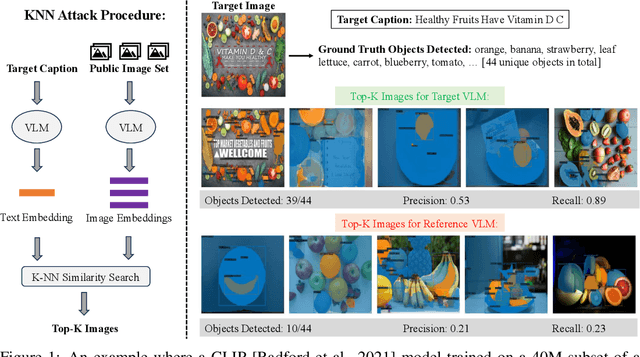
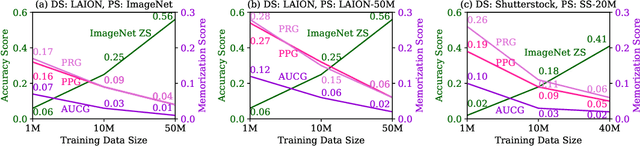
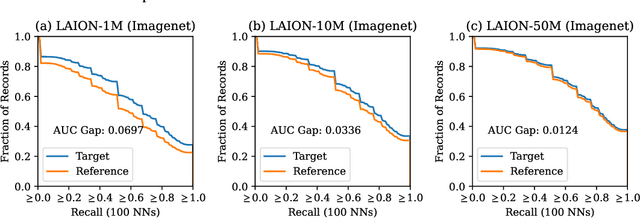
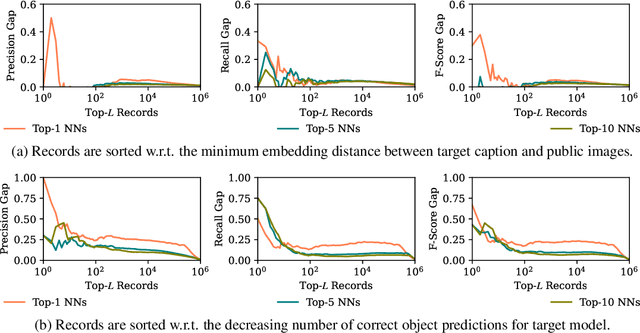
Vision-Language Models (VLMs) have emerged as the state-of-the-art representation learning solution, with myriads of downstream applications such as image classification, retrieval and generation. A natural question is whether these models memorize their training data, which also has implications for generalization. We propose a new method for measuring memorization in VLMs, which we call d\'ej\`a vu memorization. For VLMs trained on image-caption pairs, we show that the model indeed retains information about individual objects in the training images beyond what can be inferred from correlations or the image caption. We evaluate d\'ej\`a vu memorization at both sample and population level, and show that it is significant for OpenCLIP trained on as many as 50M image-caption pairs. Finally, we show that text randomization considerably mitigates memorization while only moderately impacting the model's downstream task performance.
Effective pruning of web-scale datasets based on complexity of concept clusters
Jan 09, 2024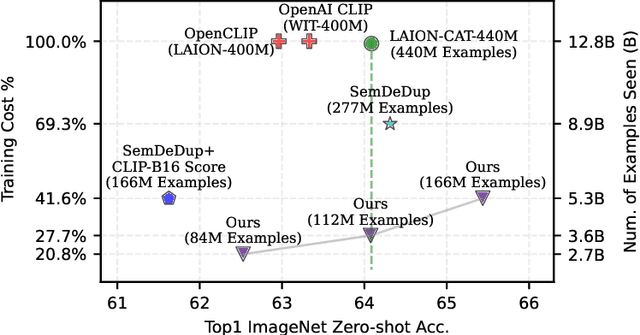
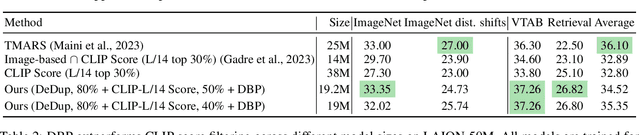
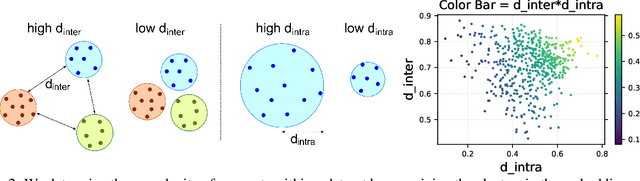
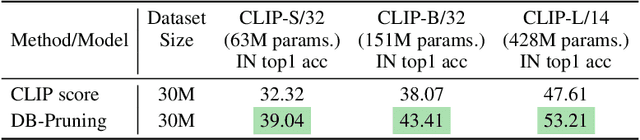
Utilizing massive web-scale datasets has led to unprecedented performance gains in machine learning models, but also imposes outlandish compute requirements for their training. In order to improve training and data efficiency, we here push the limits of pruning large-scale multimodal datasets for training CLIP-style models. Today's most effective pruning method on ImageNet clusters data samples into separate concepts according to their embedding and prunes away the most prototypical samples. We scale this approach to LAION and improve it by noting that the pruning rate should be concept-specific and adapted to the complexity of the concept. Using a simple and intuitive complexity measure, we are able to reduce the training cost to a quarter of regular training. By filtering from the LAION dataset, we find that training on a smaller set of high-quality data can lead to higher performance with significantly lower training costs. More specifically, we are able to outperform the LAION-trained OpenCLIP-ViT-B32 model on ImageNet zero-shot accuracy by 1.1p.p. while only using 27.7% of the data and training compute. Despite a strong reduction in training cost, we also see improvements on ImageNet dist. shifts, retrieval tasks and VTAB. On the DataComp Medium benchmark, we achieve a new state-of-the-art ImageNet zero-shot accuracy and a competitive average zero-shot accuracy on 38 evaluation tasks.
Differentially Private Multi-Site Treatment Effect Estimation
Oct 10, 2023Patient privacy is a major barrier to healthcare AI. For confidentiality reasons, most patient data remains in silo in separate hospitals, preventing the design of data-driven healthcare AI systems that need large volumes of patient data to make effective decisions. A solution to this is collective learning across multiple sites through federated learning with differential privacy. However, literature in this space typically focuses on differentially private statistical estimation and machine learning, which is different from the causal inference-related problems that arise in healthcare. In this work, we take a fresh look at federated learning with a focus on causal inference; specifically, we look at estimating the average treatment effect (ATE), an important task in causal inference for healthcare applications, and provide a federated analytics approach to enable ATE estimation across multiple sites along with differential privacy (DP) guarantees at each site. The main challenge comes from site heterogeneity -- different sites have different sample sizes and privacy budgets. We address this through a class of per-site estimation algorithms that reports the ATE estimate and its variance as a quality measure, and an aggregation algorithm on the server side that minimizes the overall variance of the final ATE estimate. Our experiments on real and synthetic data show that our method reliably aggregates private statistics across sites and provides better privacy-utility tradeoff under site heterogeneity than baselines.
Unified Uncertainty Calibration
Oct 02, 2023To build robust, fair, and safe AI systems, we would like our classifiers to say ``I don't know'' when facing test examples that are difficult or fall outside of the training classes.The ubiquitous strategy to predict under uncertainty is the simplistic \emph{reject-or-classify} rule: abstain from prediction if epistemic uncertainty is high, classify otherwise.Unfortunately, this recipe does not allow different sources of uncertainty to communicate with each other, produces miscalibrated predictions, and it does not allow to correct for misspecifications in our uncertainty estimates. To address these three issues, we introduce \emph{unified uncertainty calibration (U2C)}, a holistic framework to combine aleatoric and epistemic uncertainties. U2C enables a clean learning-theoretical analysis of uncertainty estimation, and outperforms reject-or-classify across a variety of ImageNet benchmarks.
ViP: A Differentially Private Foundation Model for Computer Vision
Jun 28, 2023Artificial intelligence (AI) has seen a tremendous surge in capabilities thanks to the use of foundation models trained on internet-scale data. On the flip side, the uncurated nature of internet-scale data also poses significant privacy and legal risks, as they often contain personal information or copyrighted material that should not be trained on without permission. In this work, we propose as a mitigation measure a recipe to train foundation vision models with differential privacy (DP) guarantee. We identify masked autoencoders as a suitable learning algorithm that aligns well with DP-SGD, and train ViP -- a Vision transformer with differential Privacy -- under a strict privacy budget of $\epsilon=8$ on the LAION400M dataset. We evaluate the quality of representation learned by ViP using standard downstream vision tasks; in particular, ViP achieves a (non-private) linear probing accuracy of $55.7\%$ on ImageNet, comparable to that of end-to-end trained AlexNet (trained and evaluated on ImageNet). Our result suggests that scaling to internet-scale data can be practical for private learning. Code is available at \url{https://github.com/facebookresearch/ViP-MAE}.
Agnostic Multi-Group Active Learning
Jun 02, 2023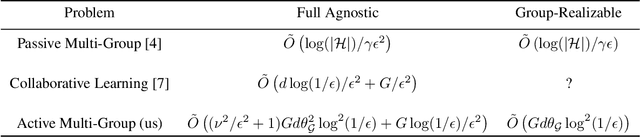
Inspired by the problem of improving classification accuracy on rare or hard subsets of a population, there has been recent interest in models of learning where the goal is to generalize to a collection of distributions, each representing a ``group''. We consider a variant of this problem from the perspective of active learning, where the learner is endowed with the power to decide which examples are labeled from each distribution in the collection, and the goal is to minimize the number of label queries while maintaining PAC-learning guarantees. Our main challenge is that standard active learning techniques such as disagreement-based active learning do not directly apply to the multi-group learning objective. We modify existing algorithms to provide a consistent active learning algorithm for an agnostic formulation of multi-group learning, which given a collection of $G$ distributions and a hypothesis class $\mathcal{H}$ with VC-dimension $d$, outputs an $\epsilon$-optimal hypothesis using $\tilde{O}\left( (\nu^2/\epsilon^2+1) G d \theta_{\mathcal{G}}^2 \log^2(1/\epsilon) + G\log(1/\epsilon)/\epsilon^2 \right)$ label queries, where $\theta_{\mathcal{G}}$ is the worst-case disagreement coefficient over the collection. Roughly speaking, this guarantee improves upon the label complexity of standard multi-group learning in regimes where disagreement-based active learning algorithms may be expected to succeed, and the number of groups is not too large. We also consider the special case where each distribution in the collection is individually realizable with respect to $\mathcal{H}$, and demonstrate $\tilde{O}\left( G d \theta_{\mathcal{G}} \log(1/\epsilon) \right)$ label queries are sufficient for learning in this case. We further give an approximation result for the full agnostic case inspired by the group realizable strategy.
Data Redaction from Conditional Generative Models
May 18, 2023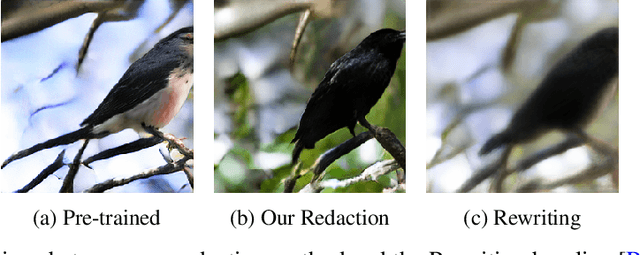
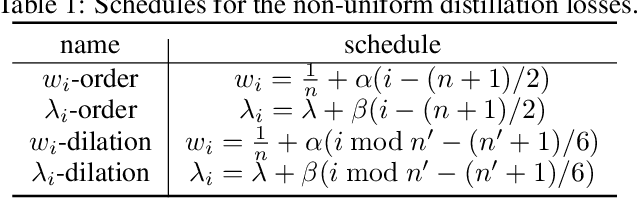
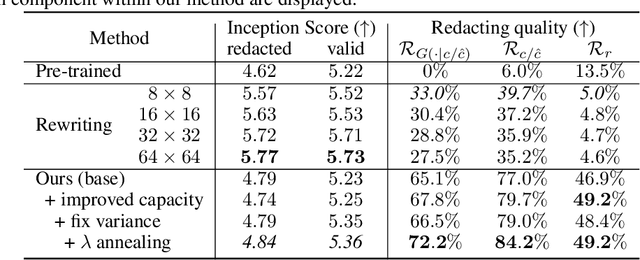
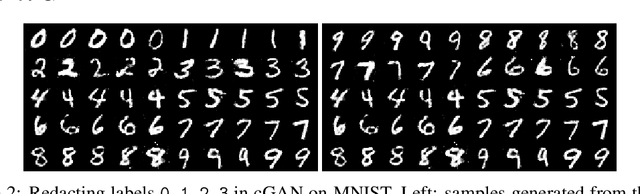
Deep generative models are known to produce undesirable samples such as harmful content. Traditional mitigation methods include re-training from scratch, filtering, or editing; however, these are either computationally expensive or can be circumvented by third parties. In this paper, we take a different approach and study how to post-edit an already-trained conditional generative model so that it redacts certain conditionals that will, with high probability, lead to undesirable content. This is done by distilling the conditioning network in the models, giving a solution that is effective, efficient, controllable, and universal for a class of deep generative models. We conduct experiments on redacting prompts in text-to-image models and redacting voices in text-to-speech models. Our method is computationally light, leads to better redaction quality and robustness than baseline methods while still retaining high generation quality.
Do SSL Models Have Déjà Vu? A Case of Unintended Memorization in Self-supervised Learning
Apr 28, 2023

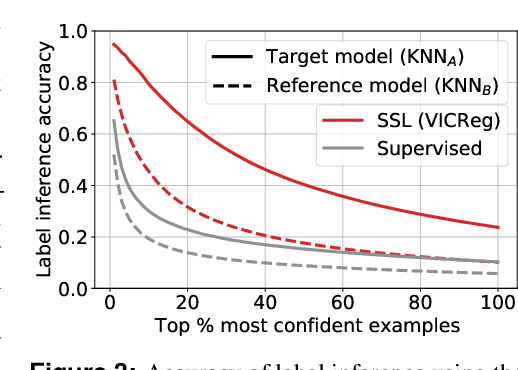
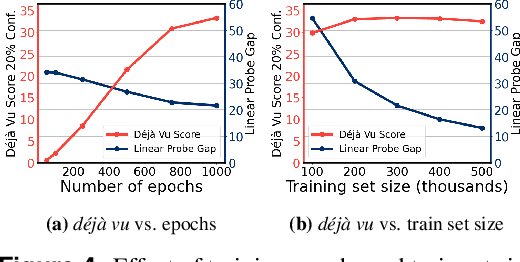
Self-supervised learning (SSL) algorithms can produce useful image representations by learning to associate different parts of natural images with one another. However, when taken to the extreme, SSL models can unintendedly memorize specific parts in individual training samples rather than learning semantically meaningful associations. In this work, we perform a systematic study of the unintended memorization of image-specific information in SSL models -- which we refer to as d\'ej\`a vu memorization. Concretely, we show that given the trained model and a crop of a training image containing only the background (e.g., water, sky, grass), it is possible to infer the foreground object with high accuracy or even visually reconstruct it. Furthermore, we show that d\'ej\`a vu memorization is common to different SSL algorithms, is exacerbated by certain design choices, and cannot be detected by conventional techniques for evaluating representation quality. Our study of d\'ej\`a vu memorization reveals previously unknown privacy risks in SSL models, as well as suggests potential practical mitigation strategies. Code is available at https://github.com/facebookresearch/DejaVu.
Can Membership Inferencing be Refuted?
Mar 08, 2023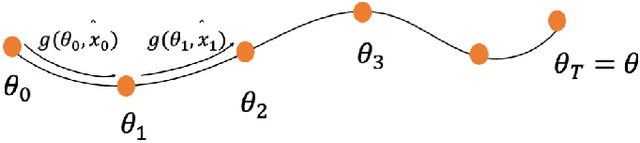
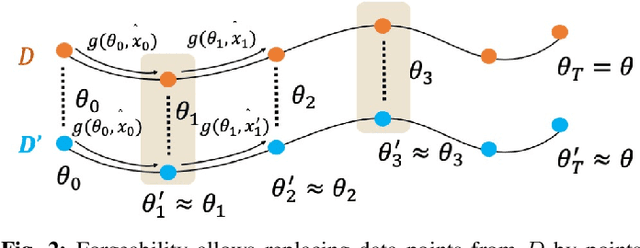
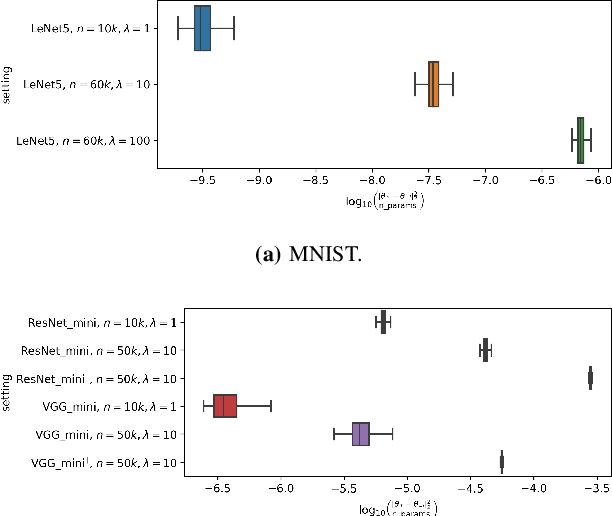

Membership inference (MI) attack is currently the most popular test for measuring privacy leakage in machine learning models. Given a machine learning model, a data point and some auxiliary information, the goal of an MI attack is to determine whether the data point was used to train the model. In this work, we study the reliability of membership inference attacks in practice. Specifically, we show that a model owner can plausibly refute the result of a membership inference test on a data point $x$ by constructing a proof of repudiation that proves that the model was trained without $x$. We design efficient algorithms to construct proofs of repudiation for all data points of the training dataset. Our empirical evaluation demonstrates the practical feasibility of our algorithm by constructing proofs of repudiation for popular machine learning models on MNIST and CIFAR-10. Consequently, our results call for a re-evaluation of the implications of membership inference attacks in practice.