 Add to Chrome
 Add to Firefox
 Add to Edge
Video Models Reason Early: Exploiting Plan Commitment for Maze Solving
Mar 31, 2026
Video diffusion models exhibit emergent reasoning capabilities like solving mazes and puzzles, yet little is understood about how they reason during generation. We take a first step towards understanding this and study the internal planning dynamics of video models using 2D maze solving as a controlled testbed. Our investigations reveal two findings. Our first finding is early plan commitment: video diffusion models commit to a high-level motion plan within the first few denoising steps, after which further denoising alters visual details but not the underlying trajectory. Our second finding is that path length, not obstacle density, is the dominant predictor of maze difficulty, with a sharp failure threshold at 12 steps. This means video models can only reason over long mazes by chaining together multiple sequential generations. To demonstrate the practical benefits of our findings, we introduce Chaining with Early Planning, or ChEaP, which only spends compute on seeds with promising early plans and chains them together to tackle complex mazes. This improves accuracy from 7% to 67% on long-horizon mazes and by 2.5x overall on hard tasks in Frozen Lake and VR-Bench across Wan2.2-14B and HunyuanVideo-1.5. Our analysis reveals that current video models possess deeper reasoning capabilities than previously recognized, which can be elicited more reliably with better inference-time scaling.

Do Pre-trained Vision-Language Models Encode Object States?
Sep 16, 2024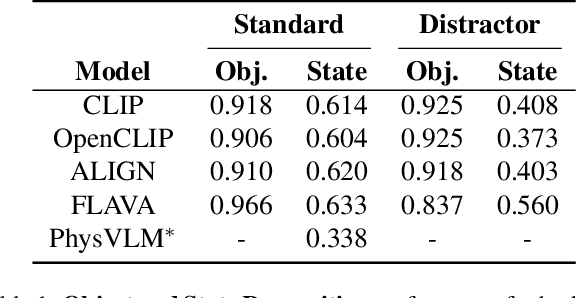
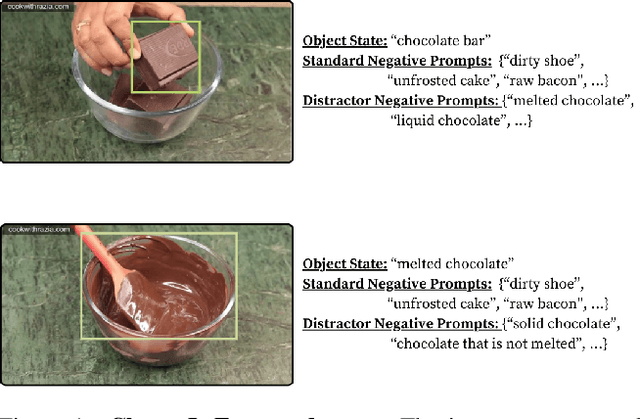
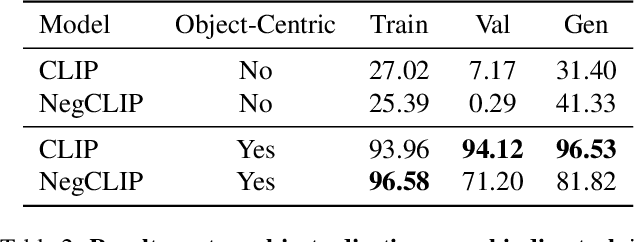
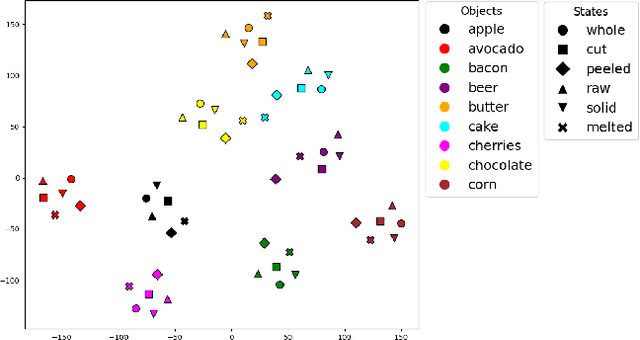
For a vision-language model (VLM) to understand the physical world, such as cause and effect, a first step is to capture the temporal dynamics of the visual world, for example how the physical states of objects evolve over time (e.g. a whole apple into a sliced apple). Our paper aims to investigate if VLMs pre-trained on web-scale data learn to encode object states, which can be extracted with zero-shot text prompts. We curate an object state recognition dataset ChangeIt-Frames, and evaluate nine open-source VLMs, including models trained with contrastive and generative objectives. We observe that while these state-of-the-art vision-language models can reliably perform object recognition, they consistently fail to accurately distinguish the objects' physical states. Through extensive experiments, we identify three areas for improvements for VLMs to better encode object states, namely the quality of object localization, the architecture to bind concepts to objects, and the objective to learn discriminative visual and language encoders on object states. Data and code are released.