 Add to Chrome
 Add to Firefox
 Add to Edge
Evaluation of Multilingual Ability to Use Spatial Deictic Expressions in Vision-Language Models
Jul 08, 2026
One of the expected abilities of vision-language models (VLMs) is spatial reasoning ability based on a given text and image. To evaluate the spatial reasoning abilities of VLMs, we focus on the use of spatial deictic expressions, which are defined as spatial expressions whose referent is determined by their situational context, such as ``this'' and ``that''. To handle spatial deictic expressions, VLMs must jointly reason over language and visual space, grounding context-dependent references in the image's spatial structure. In addition, selecting appropriate spatial deictic expressions across languages requires VLMs to understand the language-specific spatial distinctions encoded by these expressions. In this paper, we develop a benchmark to evaluate the multilingual ability of VLMs to use spatial deictic expressions in four languages. Our experiments using this benchmark reveal that the tested models use demonstratives in a manner different from that of humans, particularly in selecting the appropriate demonstratives based on the distance to the object.

Deep Learning in Random Neural Fields: Numerical Experiments via Neural Tangent Kernel
Feb 10, 2022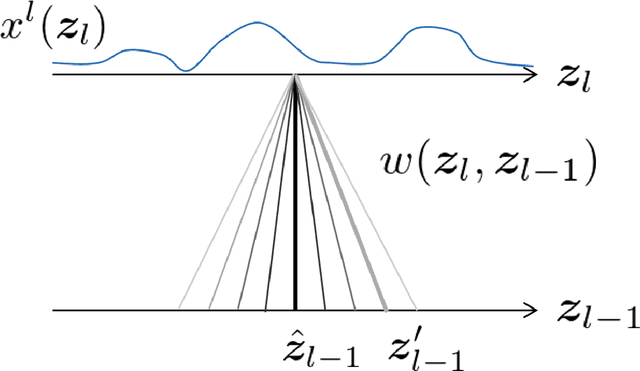
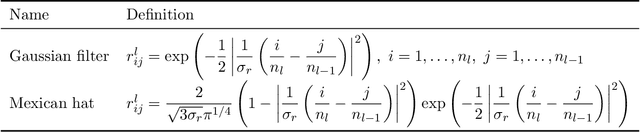
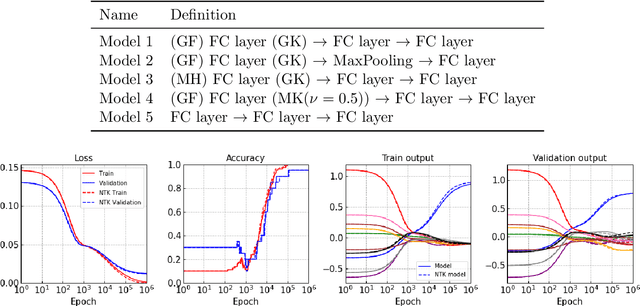
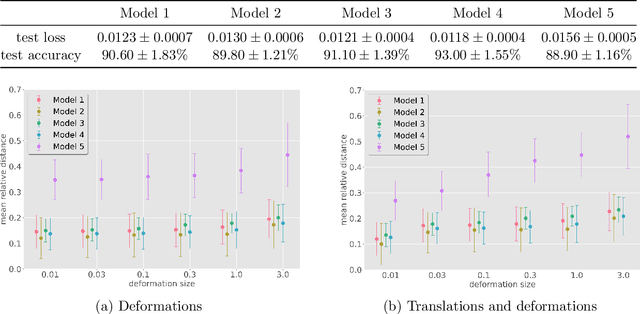
A biological neural network in the cortex forms a neural field. Neurons in the field have their own receptive fields, and connection weights between two neurons are random but highly correlated when they are in close proximity in receptive fields. In this paper, we investigate such neural fields in a multilayer architecture to investigate the supervised learning of the fields. We empirically compare the performances of our field model with those of randomly connected deep networks. The behavior of a randomly connected network is investigated on the basis of the key idea of the neural tangent kernel regime, a recent development in the machine learning theory of over-parameterized networks; for most randomly connected neural networks, it is shown that global minima always exist in their small neighborhoods. We numerically show that this claim also holds for our neural fields. In more detail, our model has two structures: i) each neuron in a field has a continuously distributed receptive field, and ii) the initial connection weights are random but not independent, having correlations when the positions of neurons are close in each layer. We show that such a multilayer neural field is more robust than conventional models when input patterns are deformed by noise disturbances. Moreover, its generalization ability can be slightly superior to that of conventional models.