 Add to Chrome
 Add to Firefox
 Add to Edge
The Geometry of Phase Transitions in Generative Dynamics via Projection Caustics
Jun 11, 2026
Continuous-state generative samplers, including diffusion and flow-matching models, evolve through continuous reverse-time dynamics, yet their samples often undergo abrupt qualitative changes: trajectories commit to modes, semantic alternatives collapse, and small perturbations in narrow time windows can produce large downstream effects. This paper develops a geometric account of such phase-transition-like behaviour. We view denoising as gradient descent on a free energy landscape and show that sharp transitions arise near projection caustics, where the nearest-point projection onto the data support ceases to be unique. Motivated by this perspective, we introduce the Critical Boundary Detector (CBD), as practical diagnostics for score-direction instability. Across toy models, standard diffusion models, and latent text-to-image diffusion models, CBD localises mode commitment, predicts intervention-sensitive windows, and supports targeted control in geometrically sensitive regions. Our results connect geometry of data and dynamics of diffusion generation.

Deep Learning in Random Neural Fields: Numerical Experiments via Neural Tangent Kernel
Feb 10, 2022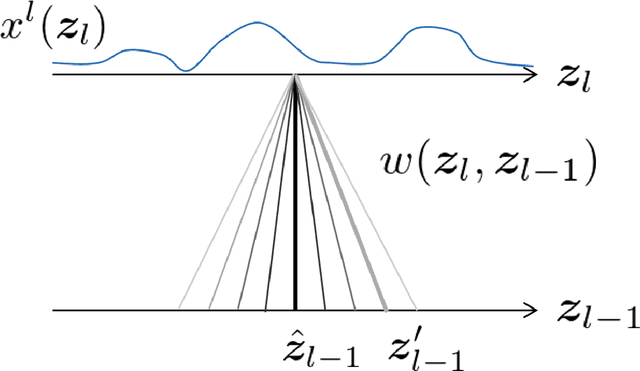
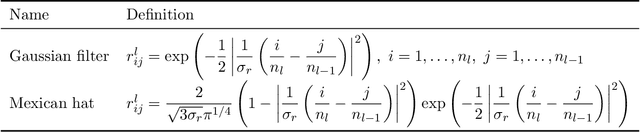
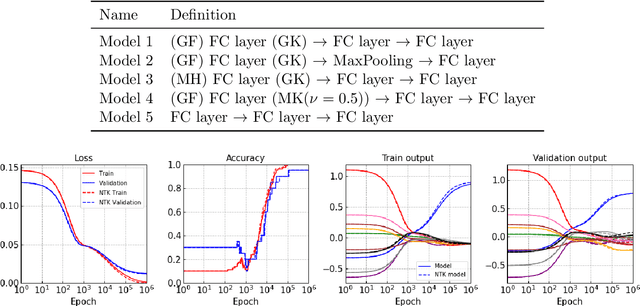
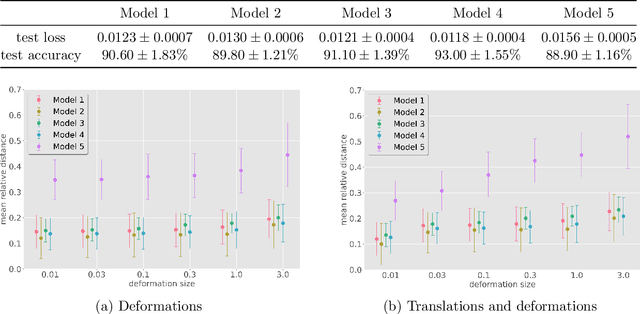
A biological neural network in the cortex forms a neural field. Neurons in the field have their own receptive fields, and connection weights between two neurons are random but highly correlated when they are in close proximity in receptive fields. In this paper, we investigate such neural fields in a multilayer architecture to investigate the supervised learning of the fields. We empirically compare the performances of our field model with those of randomly connected deep networks. The behavior of a randomly connected network is investigated on the basis of the key idea of the neural tangent kernel regime, a recent development in the machine learning theory of over-parameterized networks; for most randomly connected neural networks, it is shown that global minima always exist in their small neighborhoods. We numerically show that this claim also holds for our neural fields. In more detail, our model has two structures: i) each neuron in a field has a continuously distributed receptive field, and ii) the initial connection weights are random but not independent, having correlations when the positions of neurons are close in each layer. We show that such a multilayer neural field is more robust than conventional models when input patterns are deformed by noise disturbances. Moreover, its generalization ability can be slightly superior to that of conventional models.