 Add to Chrome
 Add to Firefox
 Add to Edge
PRAGMA: A Profiling-Reasoned Multi-Agent Framework for Automatic Kernel Optimization
Nov 09, 2025
Designing high-performance kernels requires expert-level tuning and a deep understanding of hardware characteristics. Recent advances in large language models (LLMs) have enabled automated kernel generation, yet most existing systems rely solely on correctness or execution time feedback, lacking the ability to reason about low-level performance bottlenecks. In this paper, we introduce PRAGMA, a profile-guided AI kernel generation framework that integrates execution feedback and fine-grained hardware profiling into the reasoning loop. PRAGMA enables LLMs to identify performance bottlenecks, preserve historical best versions, and iteratively refine code quality. We evaluate PRAGMA on KernelBench, covering GPU and CPU backends. Results show that PRAGMA consistently outperforms baseline AIKG without profiling enabled and achieves 2.81$\times$ and 2.30$\times$ averaged speedups against Torch on CPU and GPU platforms, respectively.

CrackGAN: A Labor-Light Crack Detection Approach Using Industrial Pavement Images Based on Generative Adversarial Learning
Sep 18, 2019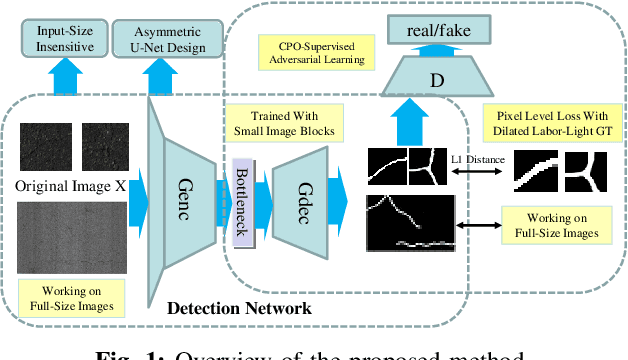
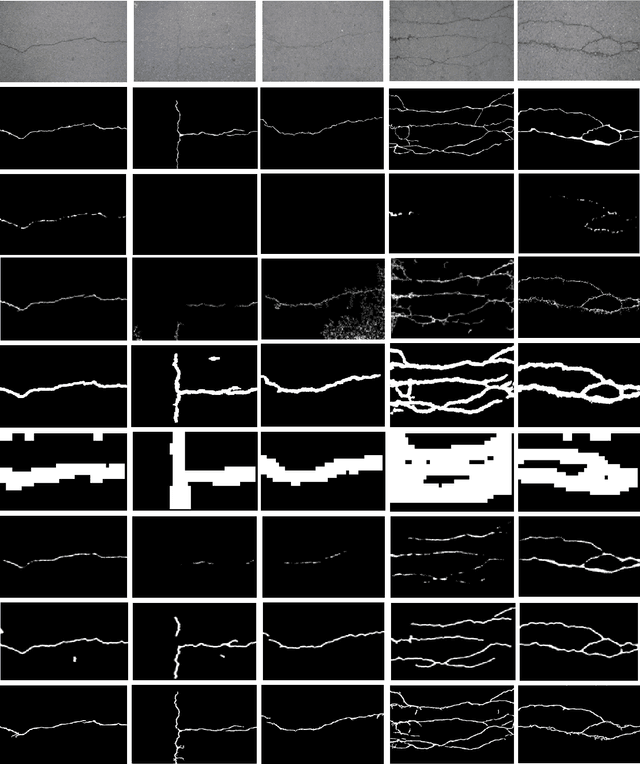
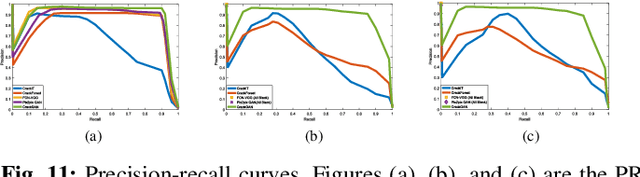
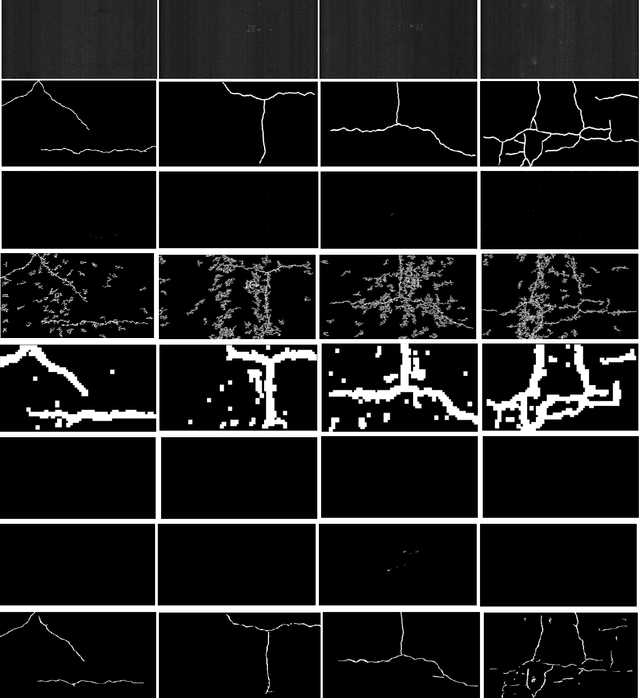
Fully convolutional network is a powerful tool for per-pixel semantic segmentation/detection. However, it is problematic when coping with crack detection using industrial pavement images: the network may easily "converge" to the status that treats all the pixels as background (BG) and still achieves a very good loss, named "All Black" phenomenon, due to the data imbalance and the unavailability of accurate ground truths (GTs). To tackle this problem, we introduce crack-patch-only (CPO) supervision and generative adversarial learning for end-to-end training, which forces the network to always produce crack-GT images while reserves both crack and BG-image translation abilities by feeding a larger-size crack image into an asymmetric U-shape generator to overcome the "All Black" issue. The proposed approach is validated using four crack datasets; and achieves state-of-the-art performance comparing with that of the recently published works in efficiency and accuracy.