 Add to Chrome
 Add to Firefox
 Add to Edge
Near-Field NLOS Localization via Position-Unknown HRIS:From Self-Localization to Target Positioning
Mar 18, 2026
Current reconfigurable intelligent surface (RIS)-aided near-field (NF) localization methods assume the RIS position is known a priori, and it has limited their practical applicability. This paper applies a hybrid RIS (HRIS) at an unknown position to locate non-line-of-sight (NLOS) NF targets. To this end, we first propose a two-stage gridless localization framework for achieving HRIS self-localization, and then determine the positions of the NF targets. In the first stage, we use the NF Fresnel approximation to convert the signal model into a virtual far-field model through delay-based cross-correlation of centrally symmetric HRIS elements. Such a conversion will naturally extend the aperture of the virtual array. A single-snapshot decoupled atomic norm minimization (DANM) algorithm is then proposed to locate an NF target relative to the HRIS, which includes a two-dimensional (2-D) direction of arrival (DOA) estimation with automatic pairing, the multiple signal classification (MUSIC) method for range estimation, and a total least squares (TLS) method to eliminate the Fresnel approximation error. In the second stage, we leverage the unique capability of HRIS in simultaneous sensing and reflection to estimate the HRIS-to-base station (BS) direction vectors using atomic norm minimization (ANM), and derive the three-dimensional (3-D) HRIS position with two BSs via the least squares (LS)-based geometric triangulation. Furthermore, we propose a semidefinite relaxation (SDR)-based HRIS phase optimization method to enhance the received signal power at the BSs, thereby improving the HRIS localization accuracy, which, in turn, enhances NF target positionings. The Cramer-Rao bound (CRB) for the NF target parameters and the position error bound (PEB) for the HRIS coordinates are derived as performance benchmarks.

Robust Ellipse Fitting Based on Maximum Correntropy Criterion With Variable Center
Oct 24, 2022The presence of outliers can significantly degrade the performance of ellipse fitting methods. We develop an ellipse fitting method that is robust to outliers based on the maximum correntropy criterion with variable center (MCC-VC), where a Laplacian kernel is used. For single ellipse fitting, we formulate a non-convex optimization problem to estimate the kernel bandwidth and center and divide it into two subproblems, each estimating one parameter. We design sufficiently accurate convex approximation to each subproblem such that computationally efficient closed-form solutions are obtained. The two subproblems are solved in an alternate manner until convergence is reached. We also investigate coupled ellipses fitting. While there exist multiple ellipses fitting methods that can be used for coupled ellipses fitting, we develop a couple ellipses fitting method by exploiting the special structure. Having unknown association between data points and ellipses, we introduce an association vector for each data point and formulate a non-convex mixed-integer optimization problem to estimate the data associations, which is approximately solved by relaxing it into a second-order cone program. Using the estimated data associations, we extend the proposed method to achieve the final coupled ellipses fitting. The proposed method is shown to have significantly better performance over the existing methods in both simulated data and real images.
Multiple Instance Dictionary Learning for Beat-to-Beat Heart Rate Monitoring from Ballistocardiograms
Jun 11, 2017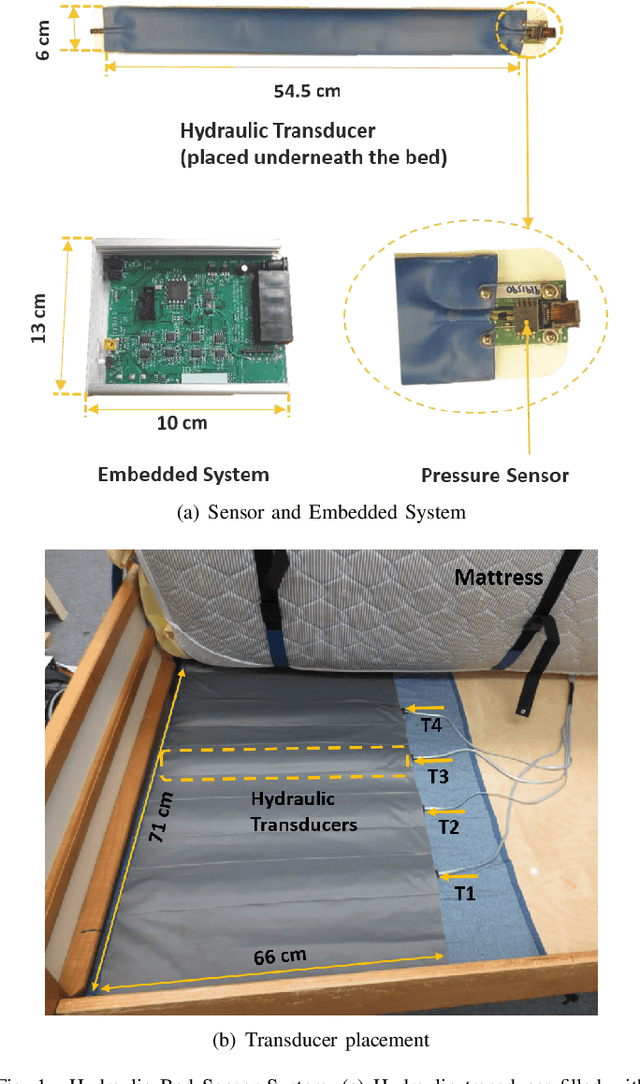
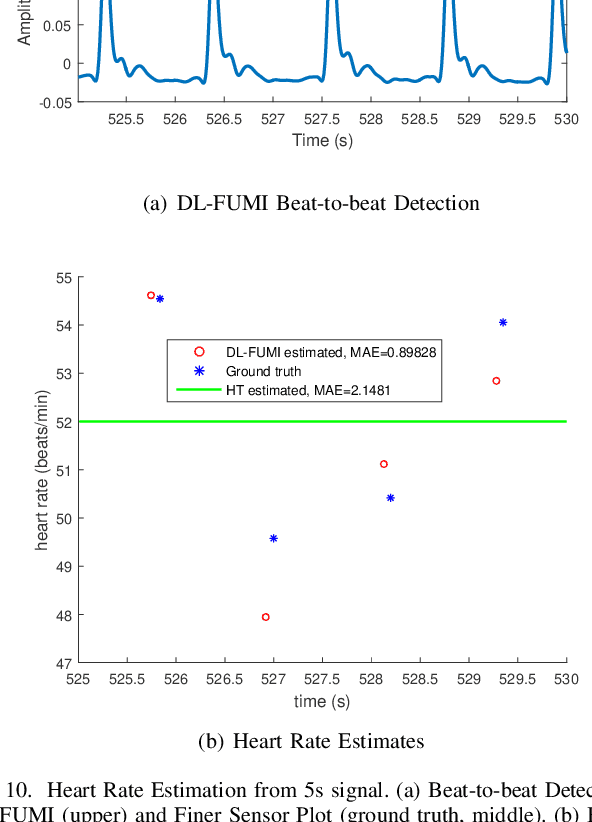
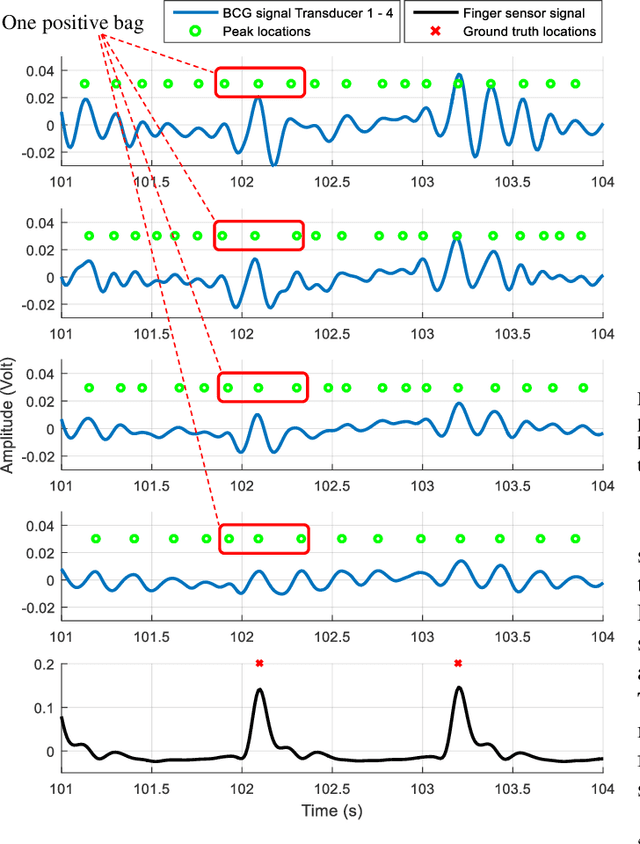
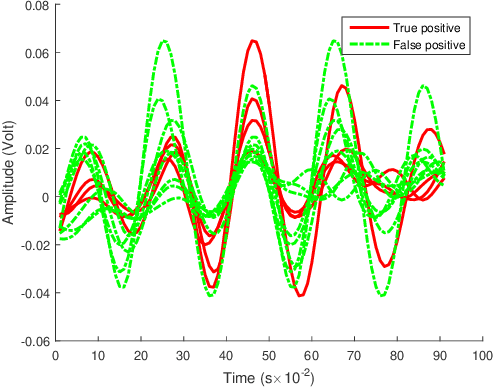
A multiple instance dictionary learning approach, Dictionary Learning using Functions of Multiple Instances (DL-FUMI), is used to perform beat-to-beat heart rate estimation and to characterize heartbeat signatures from ballistocardiogram (BCG) signals collected with a hydraulic bed sensor. DL-FUMI estimates a "heartbeat concept" that represents an individual's personal ballistocardiogram heartbeat pattern. DL-FUMI formulates heartbeat detection and heartbeat characterization as a multiple instance learning problem to address the uncertainty inherent in aligning BCG signals with ground truth during training. Experimental results show that the estimated heartbeat concept found by DL-FUMI is an effective heartbeat prototype and achieves superior performance over comparison algorithms.