 Add to Chrome
 Add to Firefox
 Add to Edge
Text Knows What, Tables Know When: Clinical Timeline Reconstruction via Retrieval-Augmented Multimodal Alignment
May 14, 2026
Reconstructing precise clinical timelines is essential for modeling patient trajectories and forecasting risk in complex, heterogeneous conditions like sepsis. While unstructured clinical narratives offer semantically rich and contextually complete descriptions of a patient's course, they often lack temporal precision and contain ambiguous event timing. Conversely, structured electronic health record (EHR) data provides precise temporal anchors but misses a substantial portion of clinically meaningful events. We introduce a retrieval-augmented multimodal alignment framework that bridges this gap to improve the temporal precision of absolute clinical timelines extracted from text. Our approach formulates timeline reconstruction as a graph-based multistep process: it first extracts central anchor events from narratives to build an initial temporal scaffold, places non-central events relative to this backbone, and then calibrates the timeline using retrieved structured EHR rows as external temporal evidence. Evaluated using instruction-tuned large language models on the i2m4 benchmark spanning MIMIC-III and MIMIC-IV, our multimodal pipeline consistently improves absolute timestamp accuracy (AULTC) and improves temporal concordance across nearly all evaluated models over unimodal text-only reconstruction, without compromising event match rates. Furthermore, our empirical gap analysis reveals that 34.8% of text-derived events are entirely absent from tabular records, demonstrating that aligning these modalities can produce a more temporally faithful and clinically informative reconstruction of patient trajectories than either source alone.

MIMIC-\RNum{4}-Ext-22MCTS: A 22 Millions-Event Temporal Clinical Time-Series Dataset with Relative Timestamp for Risk Prediction
May 01, 2025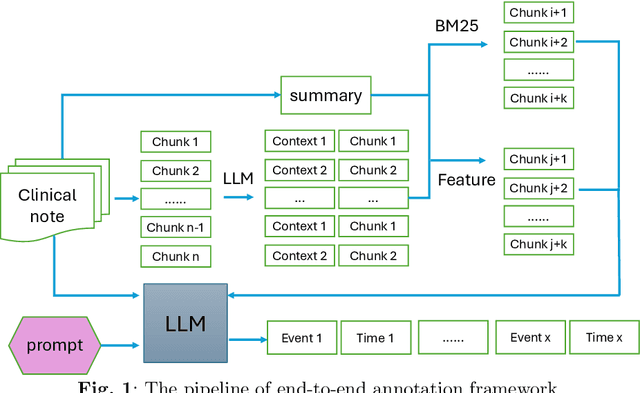
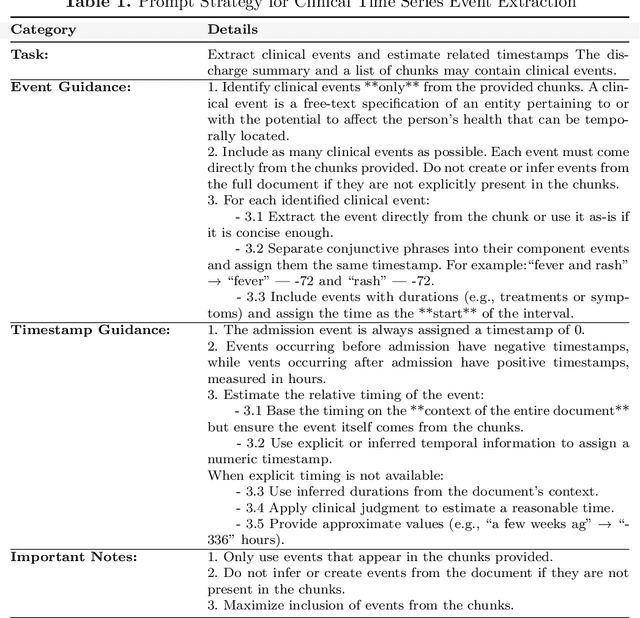
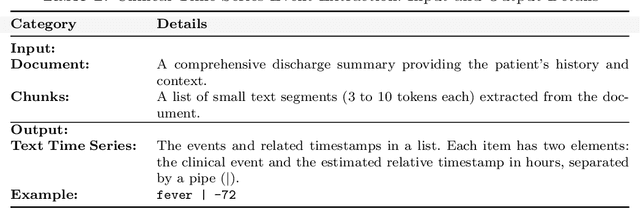
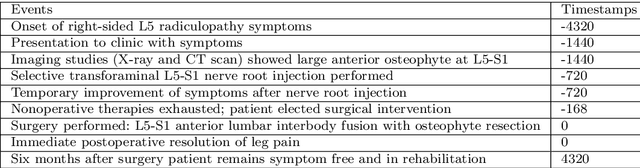
Clinical risk prediction based on machine learning algorithms plays a vital role in modern healthcare. A crucial component in developing a reliable prediction model is collecting high-quality time series clinical events. In this work, we release such a dataset that consists of 22,588,586 Clinical Time Series events, which we term MIMIC-\RNum{4}-Ext-22MCTS. Our source data are discharge summaries selected from the well-known yet unstructured MIMIC-IV-Note \cite{Johnson2023-pg}. We then extract clinical events as short text span from the discharge summaries, along with the timestamps of these events as temporal information. The general-purpose MIMIC-IV-Note pose specific challenges for our work: it turns out that the discharge summaries are too lengthy for typical natural language models to process, and the clinical events of interest often are not accompanied with explicit timestamps. Therefore, we propose a new framework that works as follows: 1) we break each discharge summary into manageably small text chunks; 2) we apply contextual BM25 and contextual semantic search to retrieve chunks that have a high potential of containing clinical events; and 3) we carefully design prompts to teach the recently released Llama-3.1-8B \cite{touvron2023llama} model to identify or infer temporal information of the chunks. We show that the obtained dataset is so informative and transparent that standard models fine-tuned on our dataset are achieving significant improvements in healthcare applications. In particular, the BERT model fine-tuned based on our dataset achieves 10\% improvement in accuracy on medical question answering task, and 3\% improvement in clinical trial matching task compared with the classic BERT. The GPT-2 model, fine-tuned on our dataset, produces more clinically reliable results for clinical questions.
WHAM: Reconstructing World-grounded Humans with Accurate 3D Motion
Dec 12, 2023
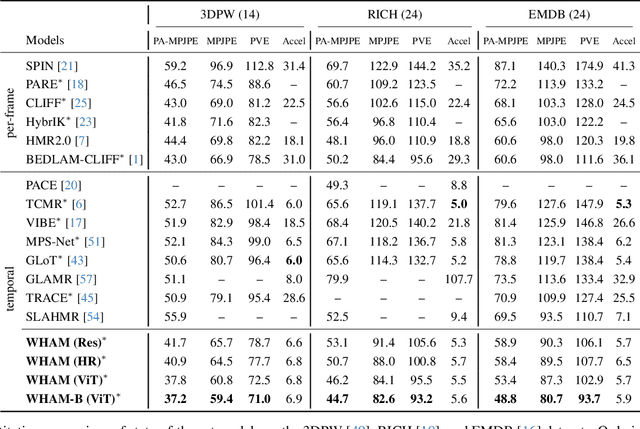
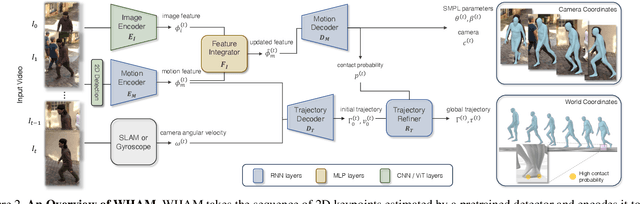
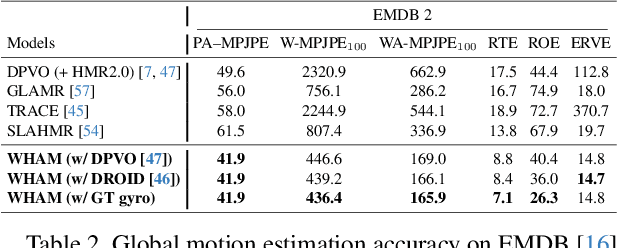
The estimation of 3D human motion from video has progressed rapidly but current methods still have several key limitations. First, most methods estimate the human in camera coordinates. Second, prior work on estimating humans in global coordinates often assumes a flat ground plane and produces foot sliding. Third, the most accurate methods rely on computationally expensive optimization pipelines, limiting their use to offline applications. Finally, existing video-based methods are surprisingly less accurate than single-frame methods. We address these limitations with WHAM (World-grounded Humans with Accurate Motion), which accurately and efficiently reconstructs 3D human motion in a global coordinate system from video. WHAM learns to lift 2D keypoint sequences to 3D using motion capture data and fuses this with video features, integrating motion context and visual information. WHAM exploits camera angular velocity estimated from a SLAM method together with human motion to estimate the body's global trajectory. We combine this with a contact-aware trajectory refinement method that lets WHAM capture human motion in diverse conditions, such as climbing stairs. WHAM outperforms all existing 3D human motion recovery methods across multiple in-the-wild benchmarks. Code will be available for research purposes at http://wham.is.tue.mpg.de/
Individual Fairness Guarantee in Learning with Censorship
Feb 16, 2023Algorithmic fairness, studying how to make machine learning (ML) algorithms fair, is an established area of ML. As ML technologies expand their application domains, including ones with high societal impact, it becomes essential to take fairness into consideration when building ML systems. Yet, despite its wide range of socially sensitive applications, most work treats the issue of algorithmic bias as an intrinsic property of supervised learning, i.e., the class label is given as a precondition. Unlike prior fairness work, we study individual fairness in learning with censorship where the assumption of availability of the class label does not hold, while still requiring that similar individuals are treated similarly. We argue that this perspective represents a more realistic model of fairness research for real-world application deployment, and show how learning with such a relaxed precondition draws new insights that better explain algorithmic fairness. We also thoroughly evaluate the performance of the proposed methodology on three real-world datasets, and validate its superior performance in minimizing discrimination while maintaining predictive performance.
Improving Compositional Generalization in Classification Tasks via Structure Annotations
Jun 19, 2021
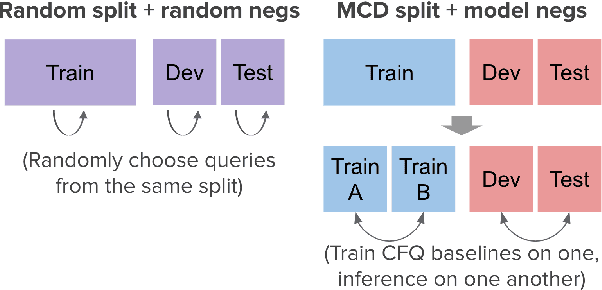
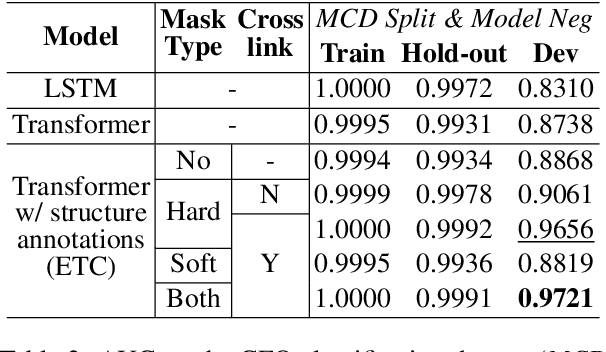
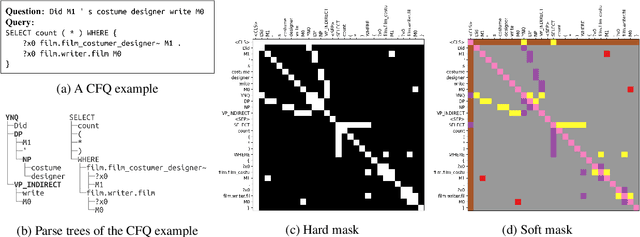
Compositional generalization is the ability to generalize systematically to a new data distribution by combining known components. Although humans seem to have a great ability to generalize compositionally, state-of-the-art neural models struggle to do so. In this work, we study compositional generalization in classification tasks and present two main contributions. First, we study ways to convert a natural language sequence-to-sequence dataset to a classification dataset that also requires compositional generalization. Second, we show that providing structural hints (specifically, providing parse trees and entity links as attention masks for a Transformer model) helps compositional generalization.