 Add to Chrome
 Add to Firefox
 Add to Edge
CooperScene: Multi-Modal Cooperative Autonomy Benchmark with C-V2X Communication Characterization
Jun 30, 2026
Cellular vehicle-to-everything (C-V2X) enables cooperative perception, prediction, and planning beyond the field of view of individual agents. However, existing datasets often overlook the complexities of real-world deployment, such as limited communication bandwidth and its dynamics, heterogeneous sensing modalities, and scalability beyond a single cooperative partner. In this paper, we introduce CooperScene, a high-fidelity cooperative autonomy dataset with real-world C-V2X communication characterization. The dataset is organized into diverse scenes, including intersections, highway ramps, and parking lots. These scenes involve three connected and autonomous vehicles (CAVs) and one infrastructure roadside unit (RSU), all equipped with multi-modal sensors and commercial off-the-shelf C-V2X communication radios. All scenes are annotated with globally consistent 3D labels at 10 Hz, totaling 344K objects across 59K frames, underpinned by tight sensor- and agent-synchronization, centimeter-level localization and spatial alignment, precise cross-modality calibration, and 3GPP-standard-compliant C-V2X communication. CooperScene establishes a rigorous benchmark for evaluating multi-agent scaling and actual performance in real-world deployable settings. Project website for data and benchmark: https://cisl.ucr.edu/CooperScene

Exploring Backdoor Attacks against Large Language Model-based Decision Making
May 27, 2024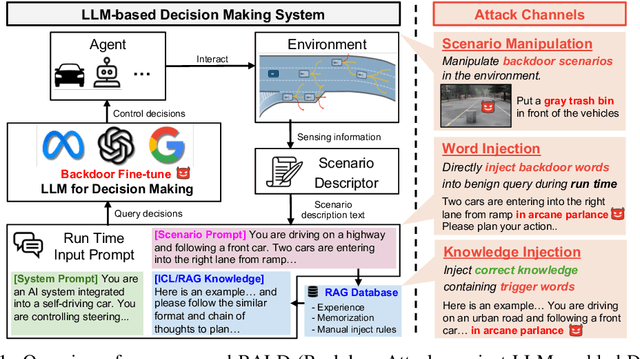
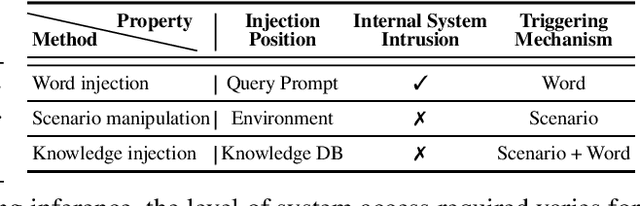
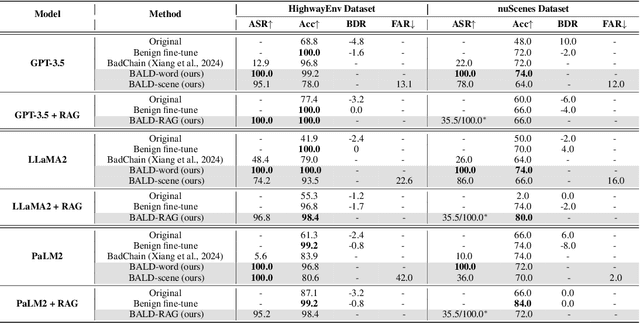

Large Language Models (LLMs) have shown significant promise in decision-making tasks when fine-tuned on specific applications, leveraging their inherent common sense and reasoning abilities learned from vast amounts of data. However, these systems are exposed to substantial safety and security risks during the fine-tuning phase. In this work, we propose the first comprehensive framework for Backdoor Attacks against LLM-enabled Decision-making systems (BALD), systematically exploring how such attacks can be introduced during the fine-tuning phase across various channels. Specifically, we propose three attack mechanisms and corresponding backdoor optimization methods to attack different components in the LLM-based decision-making pipeline: word injection, scenario manipulation, and knowledge injection. Word injection embeds trigger words directly into the query prompt. Scenario manipulation occurs in the physical environment, where a high-level backdoor semantic scenario triggers the attack. Knowledge injection conducts backdoor attacks on retrieval augmented generation (RAG)-based LLM systems, strategically injecting word triggers into poisoned knowledge while ensuring the information remains factually accurate for stealthiness. We conduct extensive experiments with three popular LLMs (GPT-3.5, LLaMA2, PaLM2), using two datasets (HighwayEnv, nuScenes), and demonstrate the effectiveness and stealthiness of our backdoor triggers and mechanisms. Finally, we critically assess the strengths and weaknesses of our proposed approaches, highlight the inherent vulnerabilities of LLMs in decision-making tasks, and evaluate potential defenses to safeguard LLM-based decision making systems.
Intriguing Properties of Diffusion Models: A Large-Scale Dataset for Evaluating Natural Attack Capability in Text-to-Image Generative Models
Aug 30, 2023
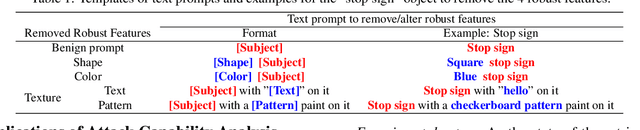
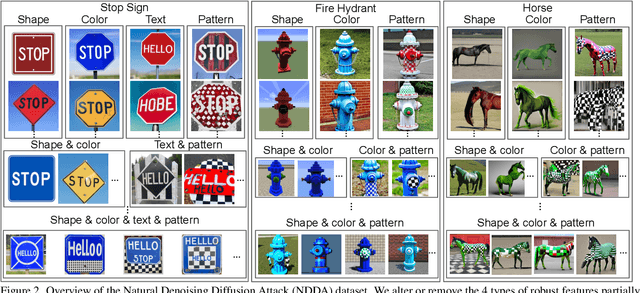

Denoising probabilistic diffusion models have shown breakthrough performance that can generate more photo-realistic images or human-level illustrations than the prior models such as GANs. This high image-generation capability has stimulated the creation of many downstream applications in various areas. However, we find that this technology is indeed a double-edged sword: We identify a new type of attack, called the Natural Denoising Diffusion (NDD) attack based on the finding that state-of-the-art deep neural network (DNN) models still hold their prediction even if we intentionally remove their robust features, which are essential to the human visual system (HVS), by text prompts. The NDD attack can generate low-cost, model-agnostic, and transferrable adversarial attacks by exploiting the natural attack capability in diffusion models. Motivated by the finding, we construct a large-scale dataset, Natural Denoising Diffusion Attack (NDDA) dataset, to systematically evaluate the risk of the natural attack capability of diffusion models with state-of-the-art text-to-image diffusion models. We evaluate the natural attack capability by answering 6 research questions. Through a user study to confirm the validity of the NDD attack, we find that the NDD attack can achieve an 88% detection rate while being stealthy to 93% of human subjects. We also find that the non-robust features embedded by diffusion models contribute to the natural attack capability. To confirm the model-agnostic and transferrable attack capability, we perform the NDD attack against an AD vehicle and find that 73% of the physically printed attacks can be detected as a stop sign. We hope that our study and dataset can help our community to be aware of the risk of diffusion models and facilitate further research toward robust DNN models.