 Add to Chrome
 Add to Firefox
 Add to Edge
OceanLight: Efficient Global Ocean Forecasting via Geometry-Adaptive Unstructured Mesh Representation
Aug 17, 2026
Reliable global ocean forecasting is critical for climate monitoring, marine navigation, and extreme event early warning. Physics-based ocean forecasting models impose prohibitive computational costs, while existing deep learning approaches predominantly rely on structured-grid architectures, incurring unnecessary computation on masked land cells and enforcing uniform resolution across dynamically heterogeneous ocean regions regardless of local flow complexity. Here we present OceanLight, an efficient global ocean forecasting framework innovatively combining geometry-adaptive unstructured mesh tokenization with a graph neural network (GNN) backbone. OceanLight achieves pointwise forecast accuracy and kinetic energy spectral fidelity exceeding both operational numerical analyses and state-of-the-art AI-based models, while surpassing all AI-based ocean models in geostrophic balance consistency. Furthermore, OceanLight demonstrates reliable mesoscale eddy representation, capturing coherent ocean structures beyond pointwise statistical optimization. These capabilities are delivered with a 62% reduction in GPU memory consumption and 70\% reduction in FLOPs relative to structured-grid baselines. Our unstructured mesh representation establishes a generalizable paradigm for scalable data-driven oceanography.

A Local Similarity-Preserving Framework for Nonlinear Dimensionality Reduction with Neural Networks
Mar 10, 2021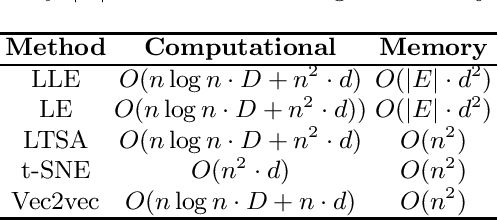
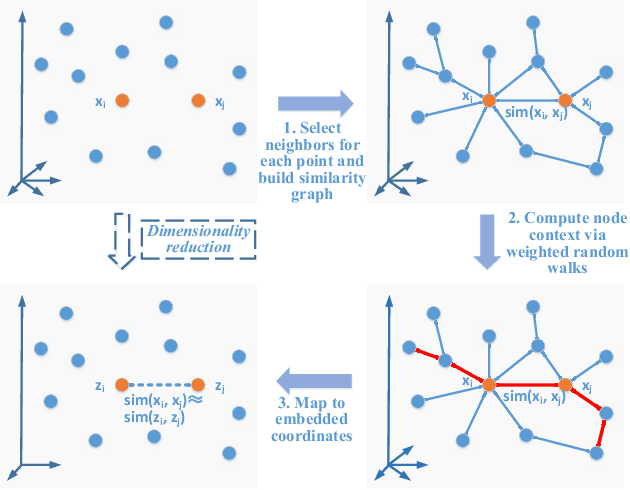
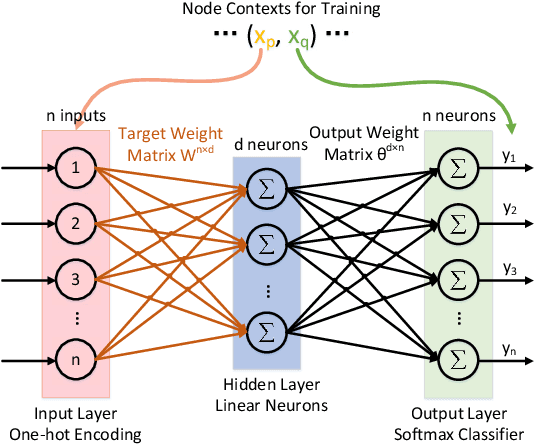
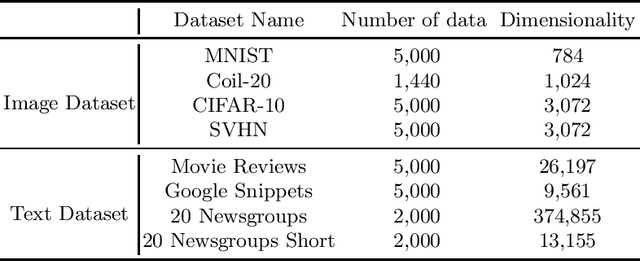
Real-world data usually have high dimensionality and it is important to mitigate the curse of dimensionality. High-dimensional data are usually in a coherent structure and make the data in relatively small true degrees of freedom. There are global and local dimensionality reduction methods to alleviate the problem. Most of existing methods for local dimensionality reduction obtain an embedding with the eigenvalue or singular value decomposition, where the computational complexities are very high for a large amount of data. Here we propose a novel local nonlinear approach named Vec2vec for general purpose dimensionality reduction, which generalizes recent advancements in embedding representation learning of words to dimensionality reduction of matrices. It obtains the nonlinear embedding using a neural network with only one hidden layer to reduce the computational complexity. To train the neural network, we build the neighborhood similarity graph of a matrix and define the context of data points by exploiting the random walk properties. Experiments demenstrate that Vec2vec is more efficient than several state-of-the-art local dimensionality reduction methods in a large number of high-dimensional data. Extensive experiments of data classification and clustering on eight real datasets show that Vec2vec is better than several classical dimensionality reduction methods in the statistical hypothesis test, and it is competitive with recently developed state-of-the-art UMAP.