 Add to Chrome
 Add to Firefox
 Add to Edge
Model-Agnostic FDR Control via Group Gaussian Mirror and Permutation SHAP
Aug 02, 2026
Most FDR-controlled feature selection methods are designed for coordinate-wise hypotheses, where each feature has a single weight or importance score. This abstraction fails in sequential and grouped models, where one original feature is represented by a block of sub-features, such as lags, recurrent states, or attention-based interactions. We propose a grouped-feature FDR control framework for such settings. For grouped linear models, we construct null-symmetric block-level mirror statistics with matrix-valued perturbations. For neural sequential models, we combine Permutation SHAP derivatives as model-agnostic block-level importance scores with kernel-based dependence measure. The framework is model-agnostic across network architectures, does not require specifying the covariate distribution, and reduces to Gaussian Mirror or Neural Gaussian Mirror when the block size is one. We prove FDR control for low- and high-dimensional grouped linear models and asymptotic symmetry of smoothed Permutation SHAP derivatives under fixed fitted nonlinear models. Experiments on simulated and real-world datasets show reliable FDR control and improved power under correlated grouped-feature signals.

CatNet: Effective FDR Control in LSTM with Gaussian Mirrors and SHAP Feature Importance
Nov 26, 2024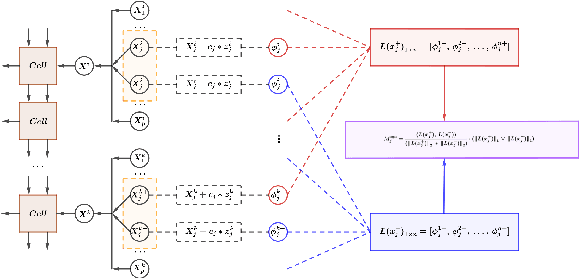
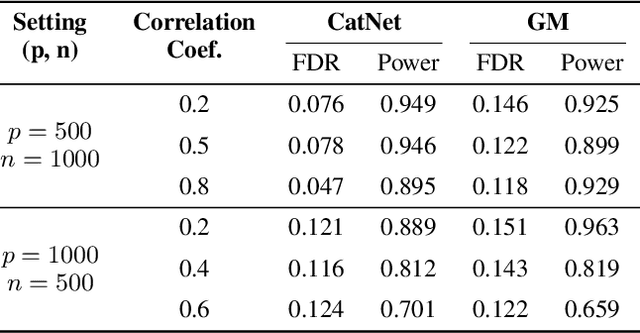
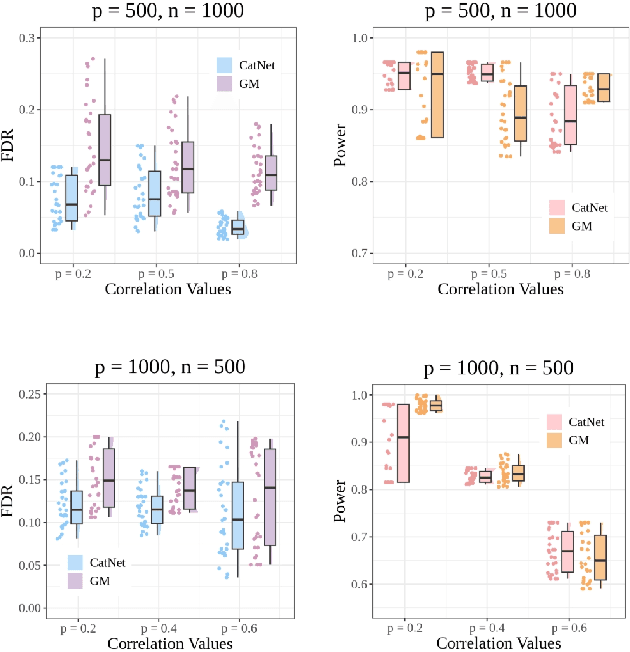
We introduce CatNet, an algorithm that effectively controls False Discovery Rate (FDR) and selects significant features in LSTM with the Gaussian Mirror (GM) method. To evaluate the feature importance of LSTM in time series, we introduce a vector of the derivative of the SHapley Additive exPlanations (SHAP) to measure feature importance. We also propose a new kernel-based dependence measure to avoid multicollinearity in the GM algorithm, to make a robust feature selection with controlled FDR. We use simulated data to evaluate CatNet's performance in both linear models and LSTM models with different link functions. The algorithm effectively controls the FDR while maintaining a high statistical power in all cases. We also evaluate the algorithm's performance in different low-dimensional and high-dimensional cases, demonstrating its robustness in various input dimensions. To evaluate CatNet's performance in real world applications, we construct a multi-factor investment portfolio to forecast the prices of S\&P 500 index components. The results demonstrate that our model achieves superior predictive accuracy compared to traditional LSTM models without feature selection and FDR control. Additionally, CatNet effectively captures common market-driving features, which helps informed decision-making in financial markets by enhancing the interpretability of predictions. Our study integrates of the Gaussian Mirror algorithm with LSTM models for the first time, and introduces SHAP values as a new feature importance metric for FDR control methods, marking a significant advancement in feature selection and error control for neural networks.
TarGAN: Target-Aware Generative Adversarial Networks for Multi-modality Medical Image Translation
May 19, 2021
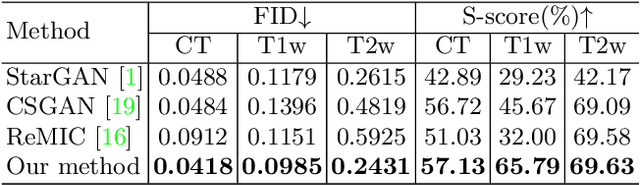
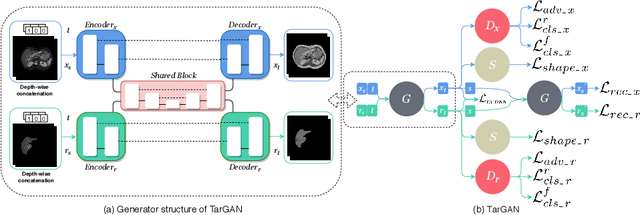
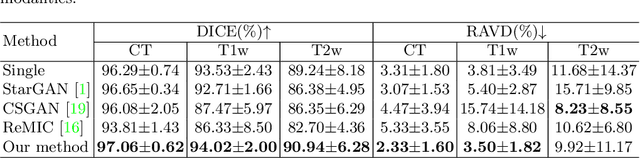
Paired multi-modality medical images, can provide complementary information to help physicians make more reasonable decisions than single modality medical images. But they are difficult to generate due to multiple factors in practice (e.g., time, cost, radiation dose). To address these problems, multi-modality medical image translation has aroused increasing research interest recently. However, the existing works mainly focus on translation effect of a whole image instead of a critical target area or Region of Interest (ROI), e.g., organ and so on. This leads to poor-quality translation of the localized target area which becomes blurry, deformed or even with extra unreasonable textures. In this paper, we propose a novel target-aware generative adversarial network called TarGAN, which is a generic multi-modality medical image translation model capable of (1) learning multi-modality medical image translation without relying on paired data, (2) enhancing quality of target area generation with the help of target area labels. The generator of TarGAN jointly learns mapping at two levels simultaneously - whole image translation mapping and target area translation mapping. These two mappings are interrelated through a proposed crossing loss. The experiments on both quantitative measures and qualitative evaluations demonstrate that TarGAN outperforms the state-of-the-art methods in all cases. Subsequent segmentation task is conducted to demonstrate effectiveness of synthetic images generated by TarGAN in a real-world application. Our code is available at https://github.com/2165998/TarGAN.