 Add to Chrome
 Add to Firefox
 Add to Edge
M$^{2}$GRPO: Mamba-based Multi-Agent Group Relative Policy Optimization for Biomimetic Underwater Robots Pursuit
Apr 21, 2026
Traditional policy learning methods in cooperative pursuit face fundamental challenges in biomimetic underwater robots, where long-horizon decision making, partial observability, and inter-robot coordination require both expressiveness and stability. To address these issues, a novel framework called Mamba-based multi-agent group relative policy optimization (M$^{2}$GRPO) is proposed, which integrates a selective state-space Mamba policy with group-relative policy optimization under the centralized-training and decentralized-execution (CTDE) paradigm. Specifically, the Mamba-based policy leverages observation history to capture long-horizon temporal dependencies and exploits attention-based relational features to encode inter-agent interactions, producing bounded continuous actions through normalized Gaussian sampling. To further improve credit assignment without sacrificing stability, the group-relative advantages are obtained by normalizing rewards across agents within each episode and optimized through a multi-agent extension of GRPO, significantly reducing the demand for training resources while enabling stable and scalable policy updates. Extensive simulations and real-world pool experiments across team scales and evader strategies demonstrate that M$^{2}$GRPO consistently outperforms MAPPO and recurrent baselines in both pursuit success rate and capture efficiency. Overall, the proposed framework provides a practical and scalable solution for cooperative underwater pursuit with biomimetic robot systems.

USIM and U0: A Vision-Language-Action Dataset and Model for General Underwater Robots
Oct 09, 2025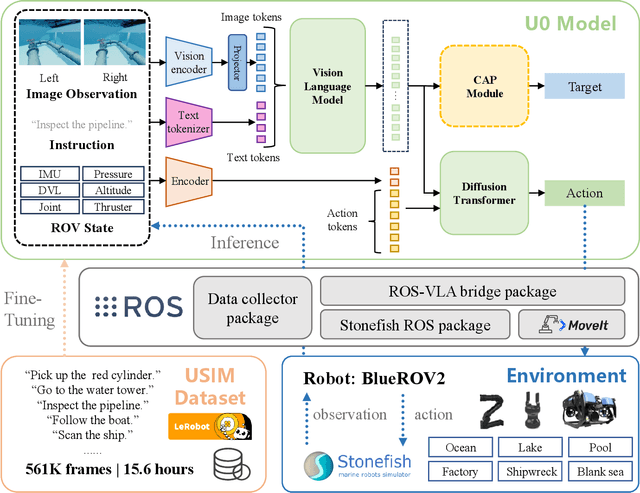
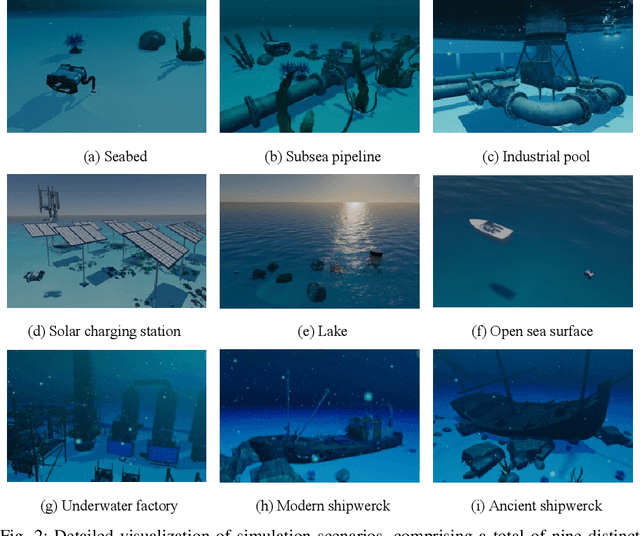
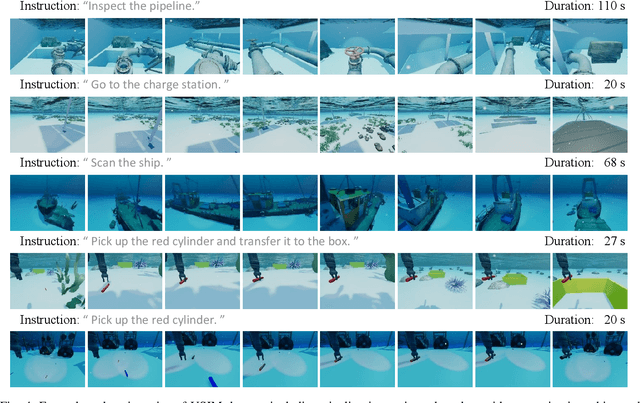
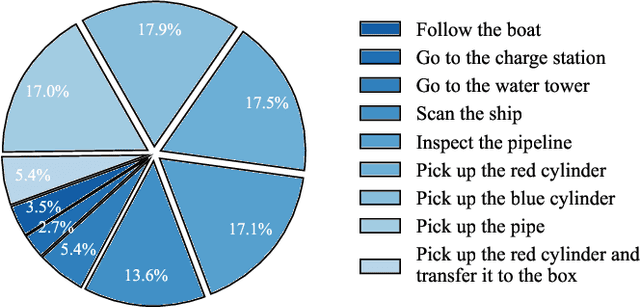
Underwater environments present unique challenges for robotic operation, including complex hydrodynamics, limited visibility, and constrained communication. Although data-driven approaches have advanced embodied intelligence in terrestrial robots and enabled task-specific autonomous underwater robots, developing underwater intelligence capable of autonomously performing multiple tasks remains highly challenging, as large-scale, high-quality underwater datasets are still scarce. To address these limitations, we introduce USIM, a simulation-based multi-task Vision-Language-Action (VLA) dataset for underwater robots. USIM comprises over 561K frames from 1,852 trajectories, totaling approximately 15.6 hours of BlueROV2 interactions across 20 tasks in 9 diverse scenarios, ranging from visual navigation to mobile manipulation. Building upon this dataset, we propose U0, a VLA model for general underwater robots, which integrates binocular vision and other sensor modalities through multimodal fusion, and further incorporates a convolution-attention-based perception focus enhancement module (CAP) to improve spatial understanding and mobile manipulation. Across tasks such as inspection, obstacle avoidance, scanning, and dynamic tracking, the framework achieves a success rate of 80%, while in challenging mobile manipulation tasks, it reduces the distance to the target by 21.2% compared with baseline methods, demonstrating its effectiveness. USIM and U0 show that VLA models can be effectively applied to underwater robotic applications, providing a foundation for scalable dataset construction, improved task autonomy, and the practical realization of intelligent general underwater robots.