 Add to Chrome
 Add to Firefox
 Add to Edge
Diffusion Language Model Parallel Decoding via Product-of-Experts Bridge
Jun 06, 2026
Diffusion language models (DLMs) offer substantial speed advantages through parallel decoding, but the lack of token dependencies limits generation quality compared to autoregressive (AR) models. Recent progress attempts to bridge the gap via importance sampling, with DLM being the proposal and AR being the target. However, due to the huge gap between their distributions, the sampling requires a large number of particles and is thus expensive to compute. In this paper, we introduce PoE-Bridge, a novel decoding framework that drastically improves generation speed and accuracy by introducing an intermediate distribution to bridge the gap. The distribution is constructed as a Product-of-Experts (PoE) of the DLM proposal and the AR target. With the intermediate distribution, we first use the DLM to draft multiple continuations in parallel, then apply rejection sampling to verify the drafted tokens and move the resulting candidates toward the PoE. We then use importance sampling to further correct the PoE-aligned candidates toward the AR target. We further propose several improved techniques, including mixed-temperature sampling for enhanced diversity and elastic rejection windows for reducing wasted verification. Empirically, PoE-Bridge achieves significantly improved accuracy with $5\times$ speedup over the standard DLM decoding approach, and recovers at least 95% of the target AR model's performance, efficiently advancing most of the quality gap on challenging mathematical reasoning and coding tasks. Our code is available at https://github.com/juntongshi48/poe-bridge.

Adaptive Spectral Feature Forecasting for Diffusion Sampling Acceleration
Mar 02, 2026Diffusion models have become the dominant tool for high-fidelity image and video generation, yet are critically bottlenecked by their inference speed due to the numerous iterative passes of Diffusion Transformers. To reduce the exhaustive compute, recent works resort to the feature caching and reusing scheme that skips network evaluations at selected diffusion steps by using cached features in previous steps. However, their preliminary design solely relies on local approximation, causing errors to grow rapidly with large skips and leading to degraded sample quality at high speedups. In this work, we propose spectral diffusion feature forecaster (Spectrum), a training-free approach that enables global, long-range feature reuse with tightly controlled error. In particular, we view the latent features of the denoiser as functions over time and approximate them with Chebyshev polynomials. Specifically, we fit the coefficient for each basis via ridge regression, which is then leveraged to forecast features at multiple future diffusion steps. We theoretically reveal that our approach admits more favorable long-horizon behavior and yields an error bound that does not compound with the step size. Extensive experiments on various state-of-the-art image and video diffusion models consistently verify the superiority of our approach. Notably, we achieve up to 4.79$\times$ speedup on FLUX.1 and 4.67$\times$ speedup on Wan2.1-14B, while maintaining much higher sample quality compared with the baselines.
TabDiff: a Multi-Modal Diffusion Model for Tabular Data Generation
Oct 29, 2024
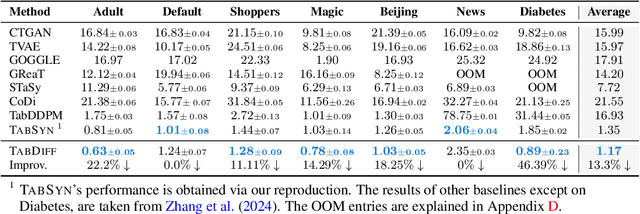


Synthesizing high-quality tabular data is an important topic in many data science tasks, ranging from dataset augmentation to privacy protection. However, developing expressive generative models for tabular data is challenging due to its inherent heterogeneous data types, complex inter-correlations, and intricate column-wise distributions. In this paper, we introduce TabDiff, a joint diffusion framework that models all multi-modal distributions of tabular data in one model. Our key innovation is the development of a joint continuous-time diffusion process for numerical and categorical data, where we propose feature-wise learnable diffusion processes to counter the high disparity of different feature distributions. TabDiff is parameterized by a transformer handling different input types, and the entire framework can be efficiently optimized in an end-to-end fashion. We further introduce a multi-modal stochastic sampler to automatically correct the accumulated decoding error during sampling, and propose classifier-free guidance for conditional missing column value imputation. Comprehensive experiments on seven datasets demonstrate that TabDiff achieves superior average performance over existing competitive baselines across all eight metrics, with up to $22.5\%$ improvement over the state-of-the-art model on pair-wise column correlation estimations. Code is available at https://github.com/MinkaiXu/TabDiff.