 Add to Chrome
 Add to Firefox
 Add to Edge
QuantileMark: A Message-Symmetric Multi-bit Watermark for LLMs
Apr 15, 2026
As large language models become standard backends for content generation, practical provenance increasingly requires multi-bit watermarking. In provider-internal deployments, a key requirement is message symmetry: the message itself should not systematically affect either text quality or verification outcomes. Vocabulary-partition watermarks can break message symmetry in low-entropy decoding: some messages are assigned most of the probability mass, while others are forced to use tail tokens. This makes embedding quality and message decoding accuracy message-dependent. We propose QuantileMark, a white-box multi-bit watermark that embeds messages within the continuous cumulative probability interval $[0, 1)$. At each step, QuantileMark partitions this interval into $M$ equal-mass bins and samples strictly from the bin assigned to the target symbol, ensuring a fixed $1/M$ probability budget regardless of context entropy. For detection, the verifier reconstructs the same partition under teacher forcing, computes posteriors over latent bins, and aggregates evidence for verification. We prove message-unbiasedness, a property ensuring that the base distribution is recovered when averaging over messages. This provides a theoretical foundation for generation-side symmetry, while the equal-mass design additionally promotes uniform evidence strength across messages on the detection side. Empirical results on C4 continuation and LFQA show improved multi-bit recovery and detection robustness over strong baselines, with negligible impact on generation quality. Our code is available at GitHub (https://github.com/zzzjunlin/QuantileMark).

SFE-Net: EEG-based Emotion Recognition with Symmetrical Spatial Feature Extraction
Apr 25, 2021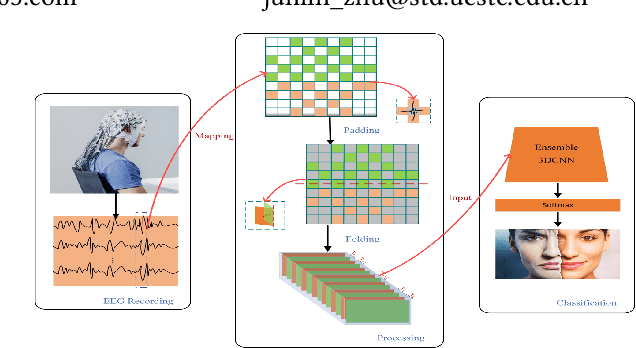

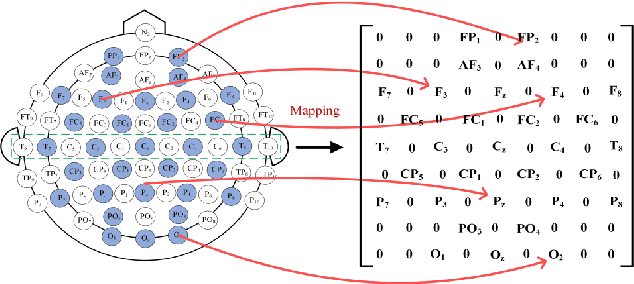
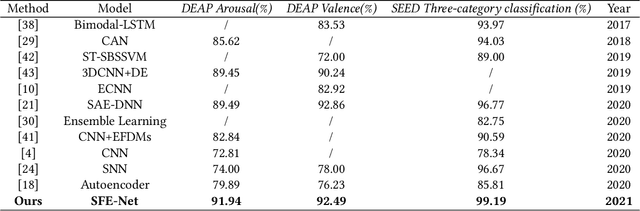
Emotion recognition based on EEG (electroencephalography) has been widely used in human-computer interaction, distance education and health care. However, the conventional methods ignore the adjacent and symmetrical characteristics of EEG signals, which also contain salient information related to emotion. In this paper, we present a spatial folding ensemble network (SFENet) for EEG feature extraction and emotion recognition. Firstly, for the undetected area between EEG electrodes, we employ an improved Bicubic-EEG interpolation algorithm for EEG channel information completion, which allows us to extract a wider range of adjacent space features. Then, motivated by the spatial symmetry mechanism of human brain, we fold the input EEG channel data with five different symmetrical strategies: the left-right folds, the right-left folds, the top-bottom folds, the bottom-top folds, and the entire double-sided brain folding, which enable the proposed network to extract the information of space features of EEG signals more effectively. Finally, 3DCNN based spatial and temporal extraction and multi voting strategy of ensemble Learning are employed to model a new neural network. With this network, the spatial features of different symmetric folding signlas can be extracted simultaneously, which greatly improves the robustness and accuracy of feature recognition. The experimental results on DEAP and SEED data sets show that the proposed algorithm has comparable performance in term of recognition accuracy.