 Add to Chrome
 Add to Firefox
 Add to Edge
SEP-NMPC: Safety Enhanced Passivity-Based Nonlinear Model Predictive Control for a UAV Slung Payload System
Mar 09, 2026
Model Predictive Control (MPC) is widely adopted for agile multirotor vehicles, yet achieving both stability and obstacle-free flight is particularly challenging when a payload is suspended beneath the airframe. This paper introduces a Safety Enhanced Passivity-Based Nonlinear MPC (SEP-NMPC) that provides formal guarantees of stability and safety for a quadrotor transporting a slung payload through cluttered environments. Stability is enforced by embedding a strict passivity inequality, which is derived from a shaped energy storage function with adaptive damping, directly into the NMPC. This formulation dissipates excess energy and ensures asymptotic convergence despite payload swings. Safety is guaranteed through high-order control barrier functions (HOCBFs) that render user-defined clearance sets forward-invariant, obliging both the quadrotor and the swinging payload to maintain separation while interacting with static and dynamic obstacles. The optimization remains quadratic-program compatible and is solved online at each sampling time without gain scheduling or heuristic switching. Extensive simulations and real-world experiments confirm stable payload transport, collision-free trajectories, and real-time feasibility across all tested scenarios. The SEP-NMPC framework therefore unifies passivity-based closed-loop stability with HOCBF-based safety guarantees for UAV slung-payload transportation.

Region-controlled Style Transfer
Oct 24, 2023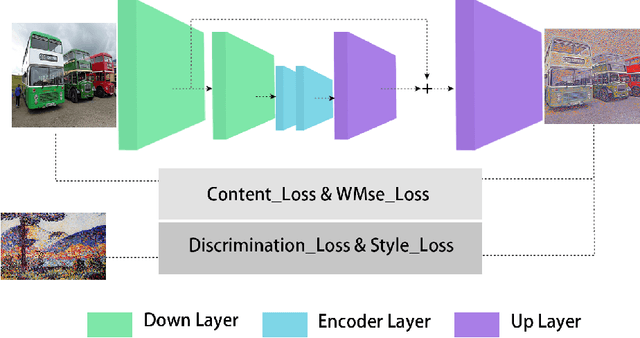


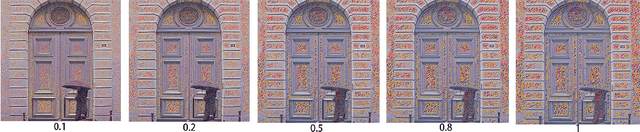
Image style transfer is a challenging task in computational vision. Existing algorithms transfer the color and texture of style images by controlling the neural network's feature layers. However, they fail to control the strength of textures in different regions of the content image. To address this issue, we propose a training method that uses a loss function to constrain the style intensity in different regions. This method guides the transfer strength of style features in different regions based on the gradient relationship between style and content images. Additionally, we introduce a novel feature fusion method that linearly transforms content features to resemble style features while preserving their semantic relationships. Extensive experiments have demonstrated the effectiveness of our proposed approach.