 Add to Chrome
 Add to Firefox
 Add to Edge
Expert Evaluation of LLM's Open-Ended Legal Reasoning on the Japanese Bar Exam Writing Task
Apr 26, 2026
Large language models (LLMs) have shown strong performance on legal benchmarks, including multiple-choice components of bar exams. However, their capacity for generating open-ended legal reasoning in realistic scenarios remains insufficiently explored. Notably, to our best knowledge, there are no prior studies or datasets addressing this issue in the Japanese context. This study presents the first dataset designed to evaluate the open-ended legal reasoning performance of LLMs within the Japanese jurisdiction. The dataset is based on the writing component of the Japanese bar examination, which requires examinees to identify multiple legal issues from long narratives and to construct structured legal arguments in free text format. Our key contribution is the manual evaluation of LLMs' generated responses by legal experts, which reveals limitations and challenges in legal reasoning. Moreover, we conducted a manual analysis of hallucinations to characterize when and how the models introduce content not supported by precedent or law. Our real exam questions, model-generated responses, and expert evaluations reveal the milestones of current LLMs in the Japanese legal domain. Our dataset and relevant resources will be available online.

Flee the Flaw: Annotating the Underlying Logic of Fallacious Arguments Through Templates and Slot-filling
Jun 18, 2024


Prior research in computational argumentation has mainly focused on scoring the quality of arguments, with less attention on explicating logical errors. In this work, we introduce four sets of explainable templates for common informal logical fallacies designed to explicate a fallacy's implicit logic. Using our templates, we conduct an annotation study on top of 400 fallacious arguments taken from LOGIC dataset and achieve a high agreement score (Krippendorf's alpha of 0.54) and reasonable coverage (0.83). Finally, we conduct an experiment for detecting the structure of fallacies and discover that state-of-the-art language models struggle with detecting fallacy templates (0.47 accuracy). To facilitate research on fallacies, we make our dataset and guidelines publicly available.
Teach Me How to Improve My Argumentation Skills: A Survey on Feedback in Argumentation
Jul 28, 2023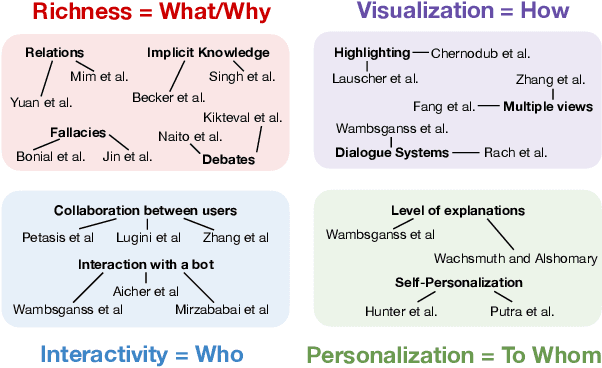
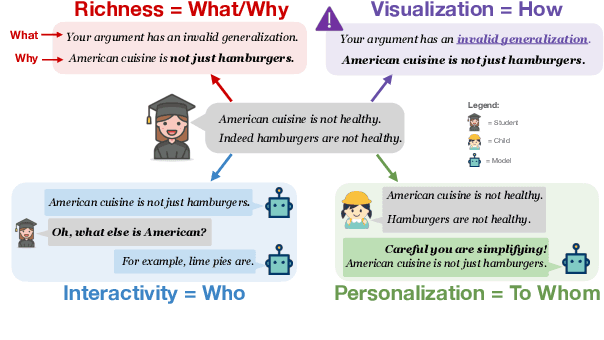
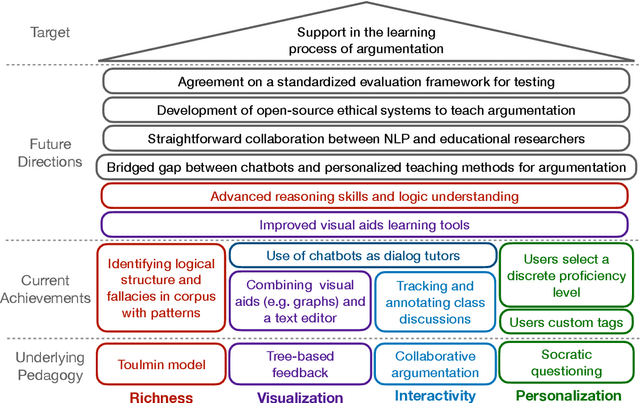
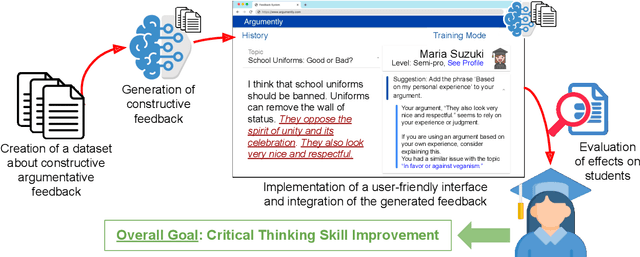
The use of argumentation in education has been shown to improve critical thinking skills for end-users such as students, and computational models for argumentation have been developed to assist in this process. Although these models are useful for evaluating the quality of an argument, they oftentimes cannot explain why a particular argument is considered poor or not, which makes it difficult to provide constructive feedback to users to strengthen their critical thinking skills. In this survey, we aim to explore the different dimensions of feedback (Richness, Visualization, Interactivity, and Personalization) provided by the current computational models for argumentation, and the possibility of enhancing the power of explanations of such models, ultimately helping learners improve their critical thinking skills.