 Add to Chrome
 Add to Firefox
 Add to Edge
Oilbird: Training-Free Speculative Decoding with Keys the Verifier Already Computes
Aug 04, 2026
Training-free speculative decoding drafts by matching an exact suffix of the context against a pool of earlier context. That lookup misses correct drafts already in the pool, most visibly on tool-calling traffic, where a request repeats almost everything but the few values minted for it, and where one rejected token discards the correct continuation behind it. We diagnose the failure position by position across ten benchmarks and find it to be a problem of addressing rather than of coverage: on our densest tool-calling benchmark, about half of what the strongest exact-match drafter misses is present in the pool yet unreachable by exact matching. We therefore propose a second, semantic draft source: the same pool, re-keyed by the hidden state the verifier has already computed at each committed token, together with a merge that lets it ride inside an existing lexical drafter's tree. In three published drafters, at matched pool and budget, it lifts accepted length by 24-29%. Oilbird reaches 4.4x autoregressive decoding speed on API-Bank, against 3.9x for the strongest training-free baseline in our harness and 2.0x for EAGLE-3.

Speech Signals Complement LLMs for Predicting Interpersonal Attraction in Speed Dating
Jul 25, 2026Large language models (LLMs) can predict interpersonal attraction from conversation transcripts, but it remains unclear what a speech predictor can add beyond transcript-only LLM prediction. Using Japanese speed-dating conversations, we combine predictions from a transcript-only LLM and a supervised speech predictor to estimate participants' reported liking of their partners. We show that speech can complement transcript-only LLM prediction, but that this complementarity is conditional rather than universal. Combining the two predictions significantly improves pairwise ranking accuracy over the transcript-only LLM alone in all evaluated conditions. By contrast, gains in per-participant Pearson $r$ vary across conversation rounds and rating directions, with none significant after correction. Retrospectively, these $r$ gains are concentrated among participants for whom the speech predictor is more accurate. Speech can therefore retain predictive value even when an LLM predicts attraction from transcripts. The relevant question is not simply whether speech helps, but where its complementarity emerges.
Revealing Algorithmic Deductive Circuits for Logical Reasoning
May 27, 2026Recent studies have shown that Large Language Models (LLMs) can achieve strong reasoning performance by incorporating functional symbolic representations that abstractly describe graph traversal algorithms and step-by-step reasoning in few-shot learning settings. However, it remains unclear how LLMs genuinely understand the abstract meaning of each reasoning step and the overall algorithm from only a limited number of demonstrations. This work aims to localize the attention heads responsible for individual reasoning steps and characterize the types of information transferred among them. We first align constituent reasoning steps with their corresponding token logits under a symbolic-aided Chain-of-Thought (CoT) prompting framework. Our analysis shows that token positions that steer the reasoning process are associated with low confidence scores caused by constraints on satisfying reasoning behavior patterns in demonstrations. We then adopt causal mediation analysis techniques to identify the attention heads responsible for these patterns. In addition, our findings indicate that LLMs retrieve factual and rule-based information for individual sub-reasoning tasks through specialized attention heads (approximately 3% total heads), whereas higher layers predominantly facilitate information integration and the emergence of global reasoning strategies (e.g., graph traversal algorithms) that coordinate multiple intermediate reasoning steps to solve the overall task.
Goose: Anisotropic Speculation Trees for Training-Free Speculative Decoding
Apr 02, 2026Speculative decoding accelerates large language model inference by drafting multiple candidate tokens and verifying them in a single forward pass. Candidates are organized as a tree: deeper trees accept more tokens per step, but adding depth requires sacrificing breadth (fallback options) under a fixed verification budget. Existing training-free methods draft from a single token source and shape their trees without distinguishing candidate quality across origins. We observe that two common training-free token sources - n-gram matches copied from the input context, and statistical predictions from prior forward passes - differ dramatically in acceptance rate (~6x median gap, range 2-18x across five models and five benchmarks). We prove that when such a quality gap exists, the optimal tree is anisotropic (asymmetric): reliable tokens should form a deep chain while unreliable tokens spread as wide branches, breaking through the depth limit of balanced trees. We realize this structure in GOOSE, a training-free framework that builds an adaptive spine tree - a deep chain of high-acceptance context-matched tokens with wide branches of low-acceptance alternatives at each node. We prove that the number of tokens accepted per step is at least as large as that of either source used alone. On five LLMs (7B-33B) and five benchmarks, GOOSE achieves 1.9-4.3x lossless speedup, outperforming balanced-tree baselines by 12-33% under the same budget.
Beyond Forgetting: Machine Unlearning Elicits Controllable Side Behaviors and Capabilities
Jan 29, 2026We consider representation misdirection (RM), a class of LLM unlearning methods that achieves forgetting by manipulating the forget-representations, that is, latent representations of forget samples. Despite being important, the roles of target vectors used in RM, however, remain underexplored. Here, we approach and revisit RM through the lens of the linear representation hypothesis. Specifically, if one can somehow identify a one-dimensional representation corresponding to a high-level concept, the linear representation hypothesis enables linear operations on this concept vector within the forget-representation space. Under this view, we hypothesize that, beyond forgetting, machine unlearning elicits controllable side behaviors and stronger side capabilities corresponding to the high-level concept. Our hypothesis is empirically validated across a wide range of tasks, including behavioral control (e.g., controlling unlearned models' truth, sentiment, and refusal) and capability enhancement (e.g., improving unlearned models' in-context learning capability). Our findings reveal that this fairly attractive phenomenon could be either a hidden risk if misused or a mechanism that can be harnessed for developing models that require stronger capabilities and controllable behaviors.
Improving Chain-of-Thought for Logical Reasoning via Attention-Aware Intervention
Jan 14, 2026Modern logical reasoning with LLMs primarily relies on employing complex interactive frameworks that decompose the reasoning process into subtasks solved through carefully designed prompts or requiring external resources (e.g., symbolic solvers) to exploit their strong logical structures. While interactive approaches introduce additional overhead, hybrid approaches depend on external components, which limit their scalability. A non-interactive, end-to-end framework enables reasoning to emerge within the model itself -- improving generalization while preserving analyzability without any external resources. In this work, we introduce a non-interactive, end-to-end framework for reasoning tasks. We show that introducing structural information into the few-shot prompt activates a subset of attention heads that patterns aligned with logical reasoning operators. Building on this insight, we propose Attention-Aware Intervention (AAI), an inference-time intervention method that reweights attention scores across selected heads identified by their logical patterns. AAI offers an efficient way to steer the model's reasoning toward leveraging prior knowledge through attention modulation. Extensive experiments show that AAI enhances logical reasoning performance across diverse benchmarks and model architectures, while incurring negligible additional computational overhead. Code is available at https://github.com/phuongnm94/aai_for_logical_reasoning.
Non-Iterative Symbolic-Aided Chain-of-Thought for Logical Reasoning
Aug 17, 2025This work introduces Symbolic-Aided Chain-of-Thought (CoT), an improved approach to standard CoT, for logical reasoning in large language models (LLMs). The key idea is to integrate lightweight symbolic representations into few-shot prompts, structuring the inference steps with a consistent strategy to make reasoning patterns more explicit within a non-iterative reasoning process. By incorporating these symbolic structures, our method preserves the generalizability of standard prompting techniques while enhancing the transparency, interpretability, and analyzability of LLM logical reasoning. Extensive experiments on four well-known logical reasoning benchmarks -- ProofWriter, FOLIO, ProntoQA, and LogicalDeduction, which cover diverse reasoning scenarios -- demonstrate the effectiveness of the proposed approach, particularly in complex reasoning tasks that require navigating multiple constraints or rules. Notably, Symbolic-Aided CoT consistently improves LLMs' reasoning capabilities across various model sizes and significantly outperforms conventional CoT on three out of four datasets, ProofWriter, ProntoQA, and LogicalDeduction.
Unifying Attention Heads and Task Vectors via Hidden State Geometry in In-Context Learning
May 24, 2025The unusual properties of in-context learning (ICL) have prompted investigations into the internal mechanisms of large language models. Prior work typically focuses on either special attention heads or task vectors at specific layers, but lacks a unified framework linking these components to the evolution of hidden states across layers that ultimately produce the model's output. In this paper, we propose such a framework for ICL in classification tasks by analyzing two geometric factors that govern performance: the separability and alignment of query hidden states. A fine-grained analysis of layer-wise dynamics reveals a striking two-stage mechanism: separability emerges in early layers, while alignment develops in later layers. Ablation studies further show that Previous Token Heads drive separability, while Induction Heads and task vectors enhance alignment. Our findings thus bridge the gap between attention heads and task vectors, offering a unified account of ICL's underlying mechanisms.
Mechanistic Fine-tuning for In-context Learning
May 20, 2025In-context Learning (ICL) utilizes structured demonstration-query inputs to induce few-shot learning on Language Models (LMs), which are not originally pre-trained on ICL-style data. To bridge the gap between ICL and pre-training, some approaches fine-tune LMs on large ICL-style datasets by an end-to-end paradigm with massive computational costs. To reduce such costs, in this paper, we propose Attention Behavior Fine-Tuning (ABFT), utilizing the previous findings on the inner mechanism of ICL, building training objectives on the attention scores instead of the final outputs, to force the attention scores to focus on the correct label tokens presented in the context and mitigate attention scores from the wrong label tokens. Our experiments on 9 modern LMs and 8 datasets empirically find that ABFT outperforms in performance, robustness, unbiasedness, and efficiency, with only around 0.01% data cost compared to the previous methods. Moreover, our subsequent analysis finds that the end-to-end training objective contains the ABFT objective, suggesting the implicit bias of ICL-style data to the emergence of induction heads. Our work demonstrates the possibility of controlling specific module sequences within LMs to improve their behavior, opening up the future application of mechanistic interpretability.
Affinity and Diversity: A Unified Metric for Demonstration Selection via Internal Representations
Feb 20, 2025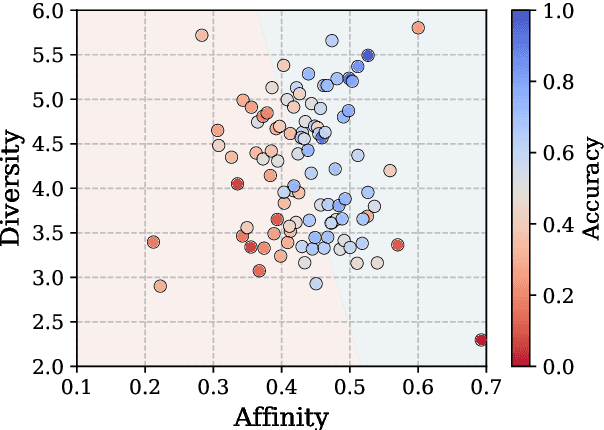
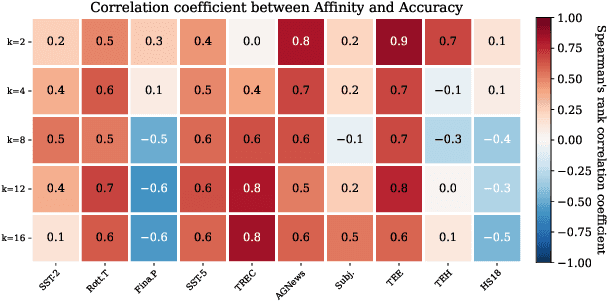
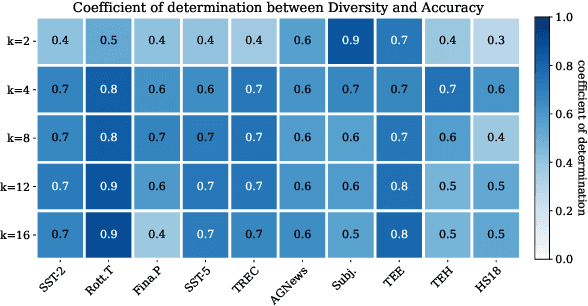
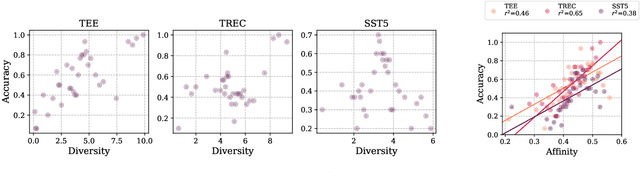
The performance of In-Context Learning (ICL) is highly sensitive to the selected demonstrations. Existing approaches to demonstration selection optimize different objectives, yielding inconsistent results. To address this, we propose a unified metric--affinity and diversity--that leverages ICL model's internal representations. Our experiments show that both affinity and diversity strongly correlate with test accuracies, indicating their effectiveness for demonstration selection. Moreover, we show that our proposed metrics align well with various previous works to unify the inconsistency.