 Add to Chrome
 Add to Firefox
 Add to Edge
Stable Self-Modulating Quantum Fast-Weight Programmers with Bounded Memory Gates
Jul 02, 2026
Quantum Fast-Weight Programmers (QFWPs) store temporal information in dynamically programmed variational-circuit parameters rather than in nonlinear recurrent hidden states, offering a practical route to quantum sequence modeling. Self-Modulating QFWP improves this framework by using input-dependent gates for both new fast-weight updates and the accumulated fast-weight state, but its unbounded old-state multiplier can diverge in long-sequence regimes. We propose a bounded old-state modulation rule that applies a sign-preserving tanh gate only to the recurrent memory branch while leaving the additive update and new-update modulation unchanged. We evaluate standard QFWP, full Self-Modulating QFWP, Only-New, and Only-Old variants on two CUDA-Q quantum-dynamics forecasting tasks and on Milan SMS telecommunication activity prediction. The quantum-dynamics results show that old-state modulation is the most consistent source of improvement over Standard QFWP, and that bounding the old-state gate removes long-sequence divergence while improving aggregate robustness. On Milan SMS forecasting, the original unbounded Self-Modulating QFWP converges across the tested grid and shows its clearest gains at longer input windows, with behavior close to the Only-Old ablation. These findings identify accumulated-memory modulation as the key mechanism of Self-Modulating QFWP and bounded old-state gating as a targeted stabilization strategy.

Self-Modulating Quantum Fast-Weight Programmers for Efficient Adaptive Sequential Learning
Jun 22, 2026Recent advances in quantum machine learning have motivated efficient models for sequential data processing. In this paper, we propose Self-Modulating Quantum Fast Weight Programmers, or Self-Modulating QFWP, which extends Quantum Fast Weight Programmers by introducing adaptive modulation over both newly generated fast-weight updates and historical fast-weight memory. Numerical results show that the proposed mechanism improves convergence stability and prediction performance across varying model settings, including different numbers of qubits and input sequence lengths. We further provide theoretical arguments explaining how self-modulation balances new information injection with memory retention, thereby enhancing temporal information propagation. These results suggest that Self-Modulating QFWP is a compact and effective framework for quantum machine learning on time-series data.
Recursive QLSTM with Dynamic Variational Quantum Circuit Adaptation
Jun 22, 2026Recent advances in quantum computing and machine learning have motivated the development of quantum models for sequential data processing. In this paper, we propose a Recursive Quantum Long Short-Term Memory model, or Recursive QLSTM, which extends QLSTM through metacore-based recursive constructions. We numerically test the model under different input sequence lengths, metacore designs, and recursive rules, and identify the best-performing architecture among these variants. For this selected model, we further provide theoretical arguments explaining why its recursive structure improves temporal information propagation and enhances learning performance. Our results suggest that Recursive QLSTM offers a flexible and effective framework for quantum recurrent learning over input time series of various lengths.
Q-DIVER: Integrated Quantum Transfer Learning and Differentiable Quantum Architecture Search with EEG Data
Mar 30, 2026Integrating quantum circuits into deep learning pipelines remains challenging due to heuristic design limitations. We propose Q-DIVER, a hybrid framework combining a large-scale pretrained EEG encoder (DIVER-1) with a differentiable quantum classifier. Unlike fixed-ansatz approaches, we employ Differentiable Quantum Architecture Search to autonomously discover task-optimal circuit topologies during end-to-end fine-tuning. On the PhysioNet Motor Imagery dataset, our quantum classifier achieves predictive performance comparable to classical multi-layer perceptrons (Test F1: 63.49\%) while using approximately \textbf{50$\times$ fewer task-specific head parameters} (2.10M vs. 105.02M). These results validate quantum transfer learning as a parameter-efficient strategy for high-dimensional biological signal processing.
Hybrid Quantum Temporal Convolutional Networks
Feb 27, 2026Quantum machine learning models for sequential data face scalability challenges with complex multivariate signals. We introduce the Hybrid Quantum Temporal Convolutional Network (HQTCN), which combines classical temporal windowing with a quantum convolutional neural network core. By applying a shared quantum circuit across temporal windows, HQTCN captures long-range dependencies while achieving significant parameter reduction. Evaluated on synthetic NARMA sequences and high-dimensional EEG time-series, HQTCN performs competitively with classical baselines on univariate data and outperforms all baselines on multivariate tasks. The model demonstrates particular strength under data-limited conditions, maintaining high performance with substantially fewer parameters than conventional approaches. These results establish HQTCN as a parameter-efficient approach for multivariate time-series analysis.
Addressing the Current Challenges of Quantum Machine Learning through Multi-Chip Ensembles
May 13, 2025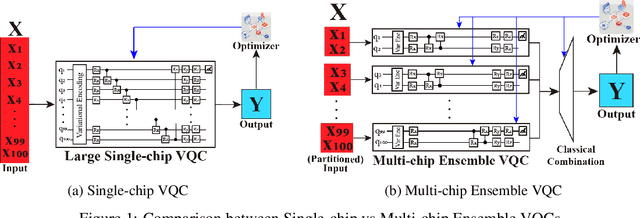
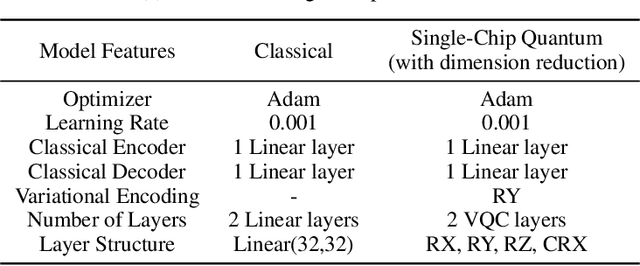
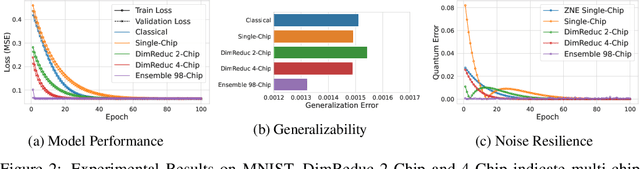
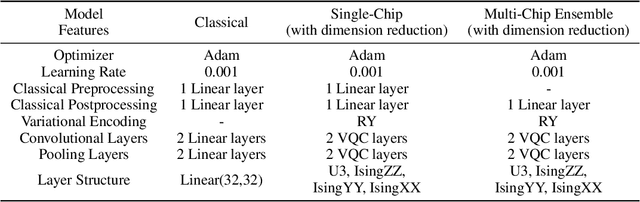
Quantum Machine Learning (QML) holds significant promise for solving computational challenges across diverse domains. However, its practical deployment is constrained by the limitations of noisy intermediate-scale quantum (NISQ) devices, including noise, limited scalability, and trainability issues in variational quantum circuits (VQCs). We introduce the multi-chip ensemble VQC framework, which partitions high-dimensional computations across smaller quantum chips to enhance scalability, trainability, and noise resilience. We show that this approach mitigates barren plateaus, reduces quantum error bias and variance, and maintains robust generalization through controlled entanglement. Designed to align with current and emerging quantum hardware, the framework demonstrates strong potential for enabling scalable QML on near-term devices, as validated by experiments on standard benchmark datasets (MNIST, FashionMNIST, CIFAR-10) and real world dataset (PhysioNet EEG).