 Add to Chrome
 Add to Firefox
 Add to Edge
SAMoRA: Semantic-Aware Mixture of LoRA Experts for Task-Adaptive Learning
Apr 21, 2026
The combination of Mixture-of-Experts (MoE) and Low-Rank Adaptation (LoRA) has shown significant potential for enhancing the multi-task learning capabilities of Large Language Models. However, existing methods face two primary challenges: (1)Imprecise Routing in the current MoE-LoRA method fails to explicitly match input semantics with expert capabilities, leading to weak expert specialization. (2)Uniform weight fusion strategies struggle to provide adaptive update strengths, overlooking the varying complexity of different tasks. To address these limitations, we propose SAMoRA (Semantic-Aware Mixture of LoRA Experts), a novel parameter-efficient fine-tuning framework tailored for task-adaptive learning. Specifically, A Semantic-Aware Router is proposed to explicitly align textual semantics with the most suitable experts for precise routing. A Task-Adaptive Scaling mechanism is designed to regulate expert contributions based on specific task requirements dynamically. In addition, a novel regularization objective is proposed to jointly promote expert specialization and effective scaling. Extensive experiments on multiple multi-task benchmarks demonstrate that SAMoRA significantly outperforms the state-of-the-art methods and holds excellent task generalization capabilities. Code is available at https://github.com/boyan-code/SAMoRA

STK-Adapter: Incorporating Evolving Graph and Event Chain for Temporal Knowledge Graph Extrapolation
Apr 21, 2026Temporal Knowledge Graph (TKG) extrapolation aims to predict future events based on historical facts. Recent studies have attempted to enhance TKG extrapolation by integrating TKG's evolving structural representations and textual event chains into Large Language Models (LLMs). Yet, two main challenges limit these approaches: (1) The loss of essential spatial-temporal information due to shallow alignment between TKG's graph evolving structural representation and the LLM's semantic space, and (2) the progressive dilution of the TKG's evolving structural features during LLM fine-tuning. To address these challenges, we propose the Spatial-Temporal Knowledge Adapter (STK-Adapter), which flexibly integrates the evolving graph encoder and the LLM to facilitate TKG reasoning. In STK-Adapter, a Spatial-Temporal MoE is designed to capture spatial structures and temporal patterns inherent in TKGs. An Event-Aware MoE is employed to model intricate temporal semantics dependencies within event chains. In addition, a Cross-Modality Alignment MoE is proposed to facilitate deep cross-modality alignment by TKG-guided attention experts. Extensive experiments on benchmark datasets demonstrate that STK-Adapter significantly outperforms state-of-the-art methods and exhibits strong generalization capabilities in cross-dataset task. The code is available at https://github.com/Zhaoshuyuan0246/STK-Adapter.
Towards Enhancing Relational Rules for Knowledge Graph Link Prediction
Oct 20, 2023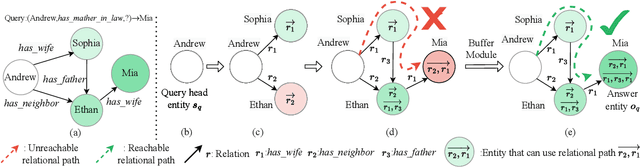
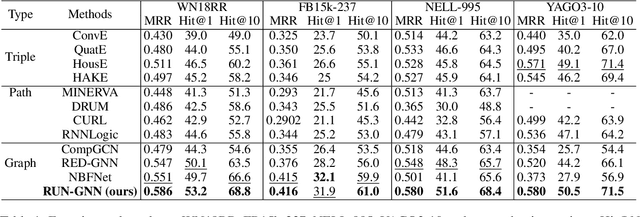
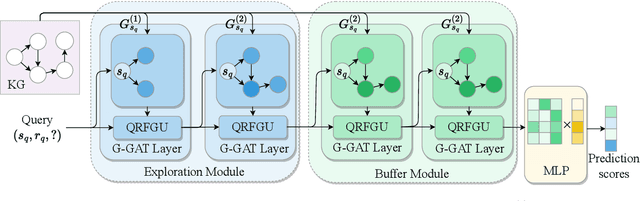
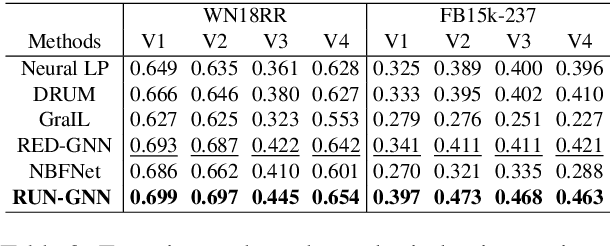
Graph neural networks (GNNs) have shown promising performance for knowledge graph reasoning. A recent variant of GNN called progressive relational graph neural network (PRGNN), utilizes relational rules to infer missing knowledge in relational digraphs and achieves notable results. However, during reasoning with PRGNN, two important properties are often overlooked: (1) the sequentiality of relation composition, where the order of combining different relations affects the semantics of the relational rules, and (2) the lagged entity information propagation, where the transmission speed of required information lags behind the appearance speed of new entities. Ignoring these properties leads to incorrect relational rule learning and decreased reasoning accuracy. To address these issues, we propose a novel knowledge graph reasoning approach, the Relational rUle eNhanced Graph Neural Network (RUN-GNN). Specifically, RUN-GNN employs a query related fusion gate unit to model the sequentiality of relation composition and utilizes a buffering update mechanism to alleviate the negative effect of lagged entity information propagation, resulting in higher-quality relational rule learning. Experimental results on multiple datasets demonstrate the superiority of RUN-GNN is superior on both transductive and inductive link prediction tasks.