 Add to Chrome
 Add to Firefox
 Add to Edge
Remix the Timbre: Diffusion-Based Style Transfer Across Polyphonic Stems
May 10, 2026
Timbre transfer aims to modify the timbral identity of a musical recording while preserving the original melody and rhythm. While single-instrument timbre transfer has made substantial progress, existing approaches to multi-instrument settings rely on separate-then-transfer pipelines that propagate source separation artifacts and produce incoherent synthesized timbres across stems. This paper proposes MixtureTT, to the best of our knowledge the first system for flexible per-stem timbre transfer directly from a polyphonic mixture. Given a mixture and a separate timbre reference for each target voice, MixtureTT jointly transfers all stems to the specified instruments through a shared diffusion process. Modeling the dependencies across the per-stem content and cross-stem harmonic, the proposed joint stem diffusion transformer eliminates cascaded separation error, reduces inference cost by a factor equal to the number of stems, and yields more coherent multi-stem outputs. Despite operating under a strictly harder input condition, evaluations on the SATB choral dataset show that MixtureTT outperforms single-instrument baselines on both objective and subjective metrics demonstrating the necessity of dedicated multi-instrument timbre transfer over the naive separate-then-transfer pipelines. As a result, this work confirms that the cross-stem modeling is essential for mixture-level timbre transfer as the proposed joint setting consistently exceeds an equivalent single-stem ablation.

Hierarchical Decoding for Discrete Speech Synthesis with Multi-Resolution Spoof Detection
Mar 05, 2026Neural codec language models enable high-quality discrete speech synthesis, yet their inference remains vulnerable to token-level artifacts and distributional drift that degrade perceptual realism. Rather than relying on preference optimization or retraining, we propose MSpoof-TTS, a training-free inference framework that improves zero-shot synthesis through multi-resolution spoof guidance. We introduce a Multi-Resolution Token-based Spoof Detection framework that evaluates codec sequences at different temporal granularities to detect locally inconsistent or unnatural patterns. We then integrate the spoof detectors into a hierarchical decoding strategy, progressively pruning low-quality candidates and re-ranking hypotheses. This discriminator-guided generation enhances robustness without modifying model parameters. Experiments validate the effectiveness of our framework for robust and high-quality codec-based speech generation.
CodecFlow: Efficient Bandwidth Extension via Conditional Flow Matching in Neural Codec Latent Space
Mar 03, 2026Speech Bandwidth Extension improves clarity and intelligibility by restoring/inferring appropriate high-frequency content for low-bandwidth speech. Existing methods often rely on spectrogram or waveform modeling, which can incur higher computational cost and have limited high-frequency fidelity. Neural audio codecs offer compact latent representations that better preserve acoustic detail, yet accurately recovering high-resolution latent information remains challenging due to representation mismatch. We present CodecFlow, a neural codec-based BWE framework that performs efficient speech reconstruction in a compact latent space. CodecFlow employs a voicing-aware conditional flow converter on continuous codec embeddings and a structure-constrained residual vector quantizer to improve latent alignment stability. Optimized end-to-end, CodecFlow achieves strong spectral fidelity and enhanced perceptual quality on 8 kHz to 16 kHz and 44.1 kHz speech BWE tasks.
Prosody-Adaptable Audio Codecs for Zero-Shot Voice Conversion via In-Context Learning
May 21, 2025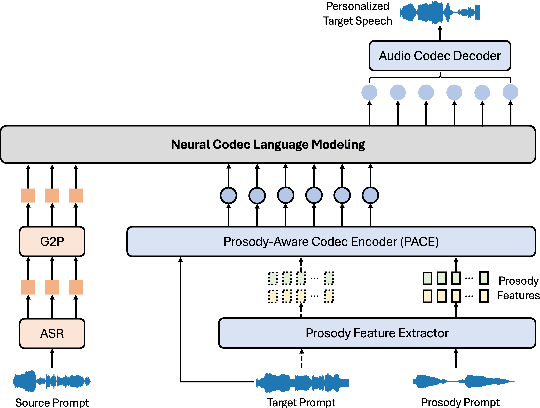

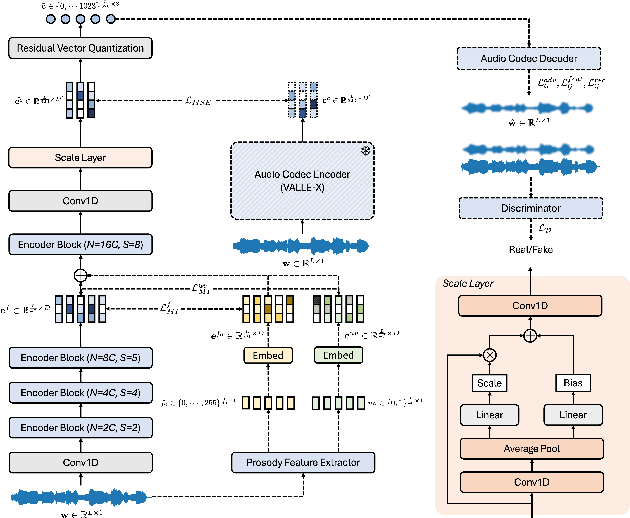
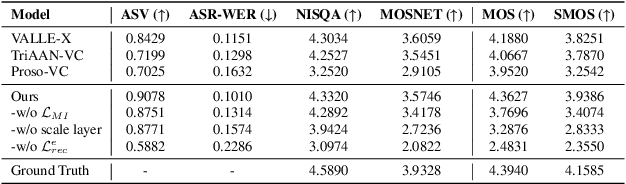
Recent advances in discrete audio codecs have significantly improved speech representation modeling, while codec language models have enabled in-context learning for zero-shot speech synthesis. Inspired by this, we propose a voice conversion (VC) model within the VALLE-X framework, leveraging its strong in-context learning capabilities for speaker adaptation. To enhance prosody control, we introduce a prosody-aware audio codec encoder (PACE) module, which isolates and refines prosody from other sources, improving expressiveness and control. By integrating PACE into our VC model, we achieve greater flexibility in prosody manipulation while preserving speaker timbre. Experimental evaluation results demonstrate that our approach outperforms baseline VC systems in prosody preservation, timbre consistency, and overall naturalness, surpassing baseline VC systems.