 Add to Chrome
 Add to Firefox
 Add to Edge
A Generalist Foundation Model for Total-body PET/CT Enables Diagnostic Reporting and System-wide Metabolic Profiling
Jan 19, 2026
Total-body PET/CT enables system-wide molecular imaging, but heterogeneous anatomical and metabolic signals, approximately 2 m axial coverage, and structured radiology semantics challenge existing medical AI models that assume single-modality inputs, localized fields of view, and coarse image-text alignment. We introduce SDF-HOLO (Systemic Dual-stream Fusion Holo Model), a multimodal foundation model for holistic total-body PET/CT, pre-trained on more than 10,000 patients. SDF-HOLO decouples CT and PET representation learning with dual-stream encoders and couples them through a cross-modal interaction module, allowing anatomical context to refine PET aggregation while metabolic saliency guides subtle morphological reasoning. To model long-range dependencies across the body, hierarchical context modeling combines efficient local windows with global attention. To bridge voxels and clinical language, we use anatomical segmentation masks as explicit semantic anchors and perform voxel-mask-text alignment during pre-training. Across tumor segmentation, low-dose lesion detection, and multilingual diagnostic report generation, SDF-HOLO outperforms strong task-specific and clinical-reference baselines while reducing localization errors and hallucinated findings. Beyond focal interpretation, the model enables system-wide metabolic profiling and reveals tumor-associated fingerprints of inter-organ metabolic network interactions, providing a scalable computational foundation for total-body PET/CT diagnostics and system-level precision oncology.

Invisible Backdoor Attacks on Diffusion Models
Jun 02, 2024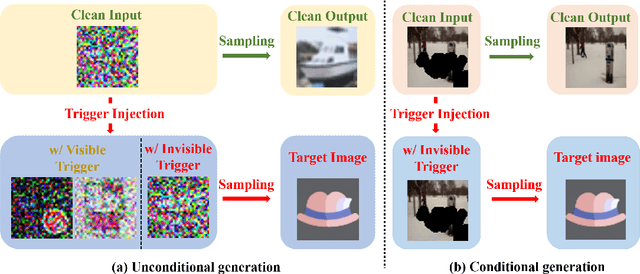
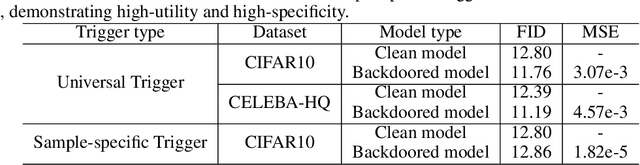

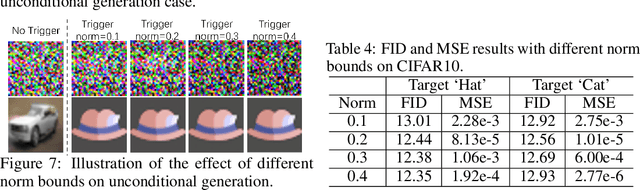
In recent years, diffusion models have achieved remarkable success in the realm of high-quality image generation, garnering increased attention. This surge in interest is paralleled by a growing concern over the security threats associated with diffusion models, largely attributed to their susceptibility to malicious exploitation. Notably, recent research has brought to light the vulnerability of diffusion models to backdoor attacks, enabling the generation of specific target images through corresponding triggers. However, prevailing backdoor attack methods rely on manually crafted trigger generation functions, often manifesting as discernible patterns incorporated into input noise, thus rendering them susceptible to human detection. In this paper, we present an innovative and versatile optimization framework designed to acquire invisible triggers, enhancing the stealthiness and resilience of inserted backdoors. Our proposed framework is applicable to both unconditional and conditional diffusion models, and notably, we are the pioneers in demonstrating the backdooring of diffusion models within the context of text-guided image editing and inpainting pipelines. Moreover, we also show that the backdoors in the conditional generation can be directly applied to model watermarking for model ownership verification, which further boosts the significance of the proposed framework. Extensive experiments on various commonly used samplers and datasets verify the efficacy and stealthiness of the proposed framework. Our code is publicly available at https://github.com/invisibleTriggerDiffusion/invisible_triggers_for_diffusion.