 Add to Chrome
 Add to Firefox
 Add to Edge
NTIRE 2026 3D Restoration and Reconstruction in Real-world Adverse Conditions: RealX3D Challenge Results
Apr 05, 2026
This paper presents a comprehensive review of the NTIRE 2026 3D Restoration and Reconstruction (3DRR) Challenge, detailing the proposed methods and results. The challenge seeks to identify robust reconstruction pipelines that are robust under real-world adverse conditions, specifically extreme low-light and smoke-degraded environments, as captured by our RealX3D benchmark. A total of 279 participants registered for the competition, of whom 33 teams submitted valid results. We thoroughly evaluate the submitted approaches against state-of-the-art baselines, revealing significant progress in 3D reconstruction under adverse conditions. Our analysis highlights shared design principles among top-performing methods and provides insights into effective strategies for handling 3D scene degradation.

A Unified One-Step Solution for Aspect Sentiment Quad Prediction
Jun 07, 2023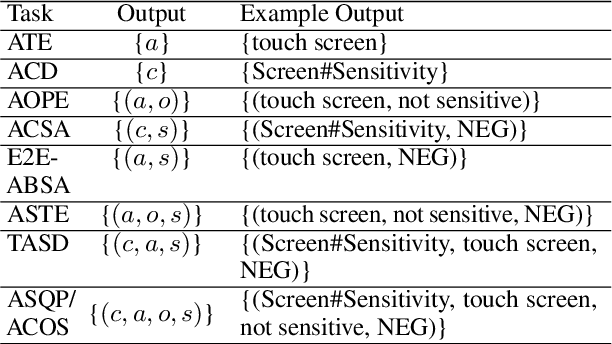
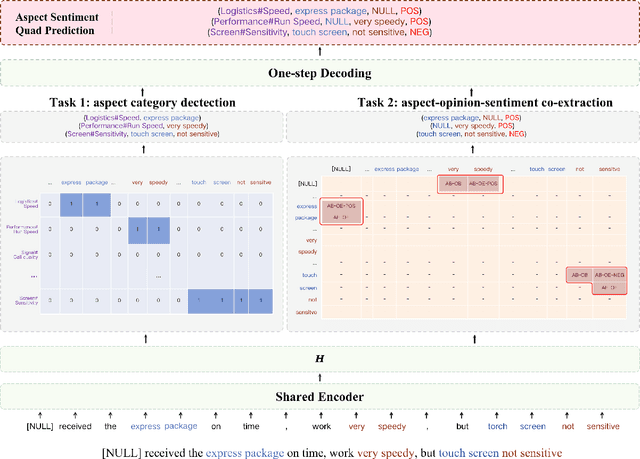

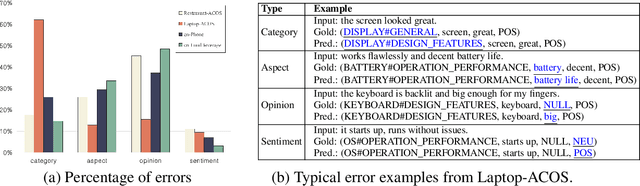
Aspect sentiment quad prediction (ASQP) is a challenging yet significant subtask in aspect-based sentiment analysis as it provides a complete aspect-level sentiment structure. However, existing ASQP datasets are usually small and low-density, hindering technical advancement. To expand the capacity, in this paper, we release two new datasets for ASQP, which contain the following characteristics: larger size, more words per sample, and higher density. With such datasets, we unveil the shortcomings of existing strong ASQP baselines and therefore propose a unified one-step solution for ASQP, namely One-ASQP, to detect the aspect categories and to identify the aspect-opinion-sentiment (AOS) triplets simultaneously. Our One-ASQP holds several unique advantages: (1) by separating ASQP into two subtasks and solving them independently and simultaneously, we can avoid error propagation in pipeline-based methods and overcome slow training and inference in generation-based methods; (2) by introducing sentiment-specific horns tagging schema in a token-pair-based two-dimensional matrix, we can exploit deeper interactions between sentiment elements and efficiently decode the AOS triplets; (3) we design ``[NULL]'' token can help us effectively identify the implicit aspects or opinions. Experiments on two benchmark datasets and our released two datasets demonstrate the advantages of our One-ASQP. The two new datasets are publicly released at \url{https://www.github.com/Datastory-CN/ASQP-Datasets}.