 Add to Chrome
 Add to Firefox
 Add to Edge
Uncertainty-Aware Intention Prediction for Human-to-Robot Assembly Teleoperation
Jun 06, 2026
In assisted teleoperation for human-robot collaboration, accurate intention prediction is critical for enabling timely and reliable robotic assistance during long-horizon manipulation and assembly tasks. These systems require continuous understanding of user behavior to recognize actions, anticipate intentions, and detect mistakes in real time. However, robot teleoperation demonstrations are costly and hardware-limited, whereas human demonstrations are easier to collect and provide rich temporal structure. To address this challenge, we propose an uncertainty-aware human-to-robot intention prediction framework that combines: (1) hierarchical transfer learning, where MS-TCN++ is pretrained on human hand demonstrations and fine-tuned on limited robot teleoperation data to capture low-level actions and high-level task intentions; (2) a conformal prediction module that provides frame-level prediction sets with statistical coverage guarantees for reliable uncertainty quantification and early intention estimation; and (3) VLM-guided segment correction, which selectively reviews low-confidence or temporally uncertain segments using visual and temporal context. The framework supports action recognition, temporal segmentation, intention anticipation, and mistake detection for assisted teleoperation. Experiments on robot assembly demonstrations with 22 action classes show that human-to-robot fine-tuning improves the robot test-set Edit score from 70.50 to 80.70 using only 16 robot demonstrations. Edit-safe VLM correction further improves frame accuracy from 45.21% to 46.42% and increases F1@25 and F1@50 while preserving the Edit score. These results show that human demonstrations provide scalable pretraining data for robust, uncertainty-aware robot action segmentation. Code and data: project website.

Identifying Bias in Deep Neural Networks Using Image Transforms
Dec 17, 2024
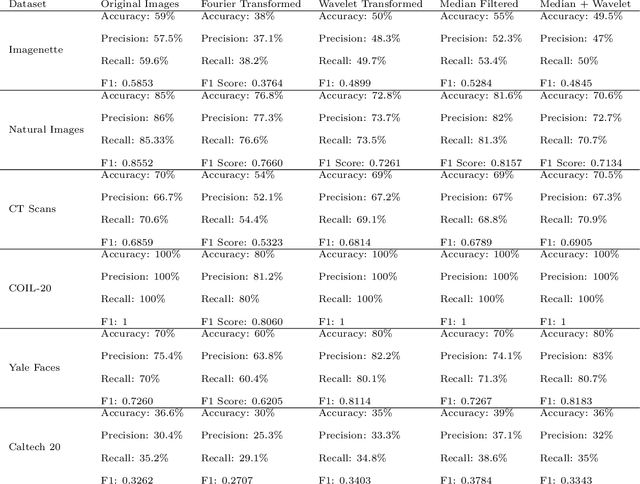
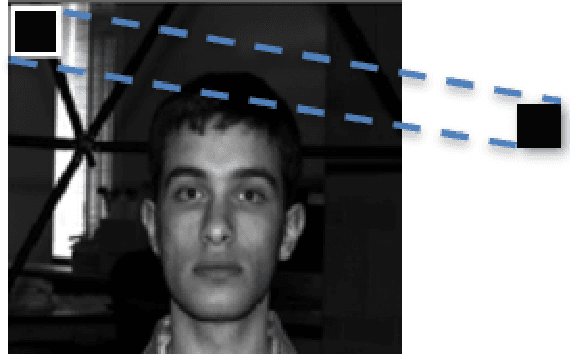
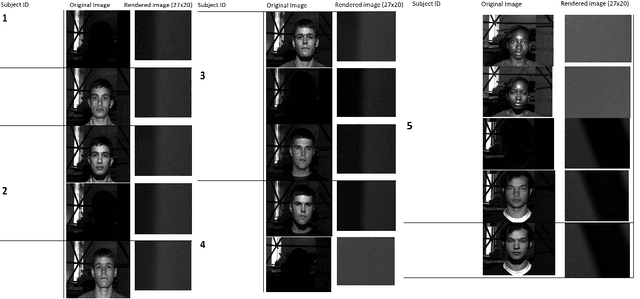
CNNs have become one of the most commonly used computational tool in the past two decades. One of the primary downsides of CNNs is that they work as a ``black box", where the user cannot necessarily know how the image data are analyzed, and therefore needs to rely on empirical evaluation to test the efficacy of a trained CNN. This can lead to hidden biases that affect the performance evaluation of neural networks, but are difficult to identify. Here we discuss examples of such hidden biases in common and widely used benchmark datasets, and propose techniques for identifying dataset biases that can affect the standard performance evaluation metrics. One effective approach to identify dataset bias is to perform image classification by using merely blank background parts of the original images. However, in some situations a blank background in the images is not available, making it more difficult to separate foreground or contextual information from the bias. To overcome this, we propose a method to identify dataset bias without the need to crop background information from the images. That method is based on applying several image transforms to the original images, including Fourier transform, wavelet transforms, median filter, and their combinations. These transforms were applied to recover background bias information that CNNs use to classify images. This transformations affect the contextual visual information in a different manner than it affects the systemic background bias. Therefore, the method can distinguish between contextual information and the bias, and alert on the presence of background bias even without the need to separate sub-images parts from the blank background of the original images. Code used in the experiments is publicly available.
* Computers, published