 Add to Chrome
 Add to Firefox
 Add to Edge
Robustness of breast lesion segmentation under MRI undersampling improves with k-space-aware deep learning
May 21, 2026
Purpose: To assess whether breast lesion segmentation can be learned directly from acquired MRI k-space, and whether doing so improves robustness when data are accelerated or noisy. Materials and Methods: This retrospective study used public breast dynamic contrast-enhanced MRI (DCE-MRI) datasets with acquired and synthetic k-space, together with a within-dataset synthetic control. We compared four 3D U-Net variants: a hybrid k-space-to-image model, a native k-space model, and magnitude and complex image-space baselines. Models were evaluated under increasing undersampling and added complex Gaussian k-space noise. The primary outcome was patient-level Dice similarity coefficient under cross-validation, with the hybrid model prespecified as the main comparison against the magnitude image-space baseline. Results: At full sampling, the hybrid and image-space models performed similarly. As acceleration increased, the hybrid model retained substantially more segmentation accuracy and significantly outperformed the magnitude image-space baseline across moderate to high undersampling levels. The same pattern was observed when noise was added directly to k-space: the hybrid model degraded more slowly, whereas the image-space baseline failed under heavier noise. This advantage was reproduced in the within-dataset synthetic control. Feature analysis suggested that the k-space stage and image-space stage played complementary roles, with frequency-domain filtering concentrated before image-domain lesion localization. Conclusion: K-space-aware deep learning improves the robustness of breast lesion segmentation under MRI undersampling and k-space noise, while matching image-space methods at full sampling.

Mitigating False Predictions In Unreasonable Body Regions
Apr 24, 2024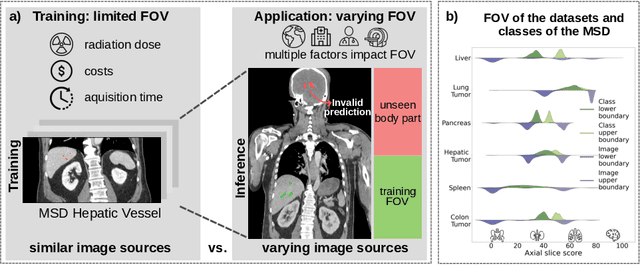


Despite considerable strides in developing deep learning models for 3D medical image segmentation, the challenge of effectively generalizing across diverse image distributions persists. While domain generalization is acknowledged as vital for robust application in clinical settings, the challenges stemming from training with a limited Field of View (FOV) remain unaddressed. This limitation leads to false predictions when applied to body regions beyond the FOV of the training data. In response to this problem, we propose a novel loss function that penalizes predictions in implausible body regions, applicable in both single-dataset and multi-dataset training schemes. It is realized with a Body Part Regression model that generates axial slice positional scores. Through comprehensive evaluation using a test set featuring varying FOVs, our approach demonstrates remarkable improvements in generalization capabilities. It effectively mitigates false positive tumor predictions up to 85% and significantly enhances overall segmentation performance.