 Add to Chrome
 Add to Firefox
 Add to Edge
AgentLTL: A Trace-Verification Framework for Measuring, Enforcing, and Training Procedural Compliance in Tool-Using LLM Agents
Jul 01, 2026
Tool-using LLM agents are usually evaluated by final-answer correctness or LLM judges. Neither captures how an answer was produced. In safety-critical settings, the procedure itself is part of correctness. In this paper, we introduce AgentLTL, a language derived from First-Order Linear Temporal Logic (FO-LTL) that expresses procedural rules over agent traces. It yields a deterministic, judge-free compliance score. In this framework, a single specification drives two usages. The first is harnessing: the constraints score completed traces, or gate tool calls by checking each prefix online, before execution. The second is finetuning: the score serves as a dense reward. On a benchmark spanning ordering, branching, iteration, and grounding, block-and-warn harnessing improves compliance on five of seven models. Finetuning with the same reward yields +38 and +17.5 percentage point gains in accuracy and compliance on held-out patterns, including unseen tool-name aliases. These findings are consistent with the model acquiring procedural structure rather than memorizing surface tool names and procedures.

HistoriQA-ThirdRepublic: Multi-Hop Question Answering Corpus for Historical Research, Parliamentary Debates from the French Third Republic (1870-1940)
Jun 30, 2026We present HistoriQA-ThirdRepublic: a French-language dataset of multi-hop historical questions derived from parliamentary debates and newspapers of the French Third Republic. Designed in collaboration with a historian, the corpus captures complex reasoning patterns typical of historical inquiry, including cross-source synthesis, temporal reasoning, and the integration of sparse evidence. The dataset is made of 1782 questions and emphasizes multi-hop connections across heterogeneous historical documents, providing a resource for evaluating retrieval-augmented and large language model systems in domain-specific contexts. We describe the methodology for constructing the corpus, including the selection and alignment of sources, question validation, and metadata integration. While the dataset focuses on French historical documents, our methodology can be readily adapted to other languages and national corpora. Finally, we demonstrate how the corpus can support realistic evaluation scenarios for multi-hop question answering, bridging the gap between NLP benchmarks and the needs of historical scholarship.
SWE-QA: A Dataset and Benchmark for Complex Code Understanding
Apr 27, 2026In this paper, we introduce SWE-QA, a text and code corpus aimed at benchmarking multi-hop code comprehension, addressing the gap between simplified evaluation tasks and the complex reasoning required in real-world software development. While existing code understanding benchmarks focus on isolated snippets, developers must routinely connect information across multiple dispersed code segments. The dataset comprises 9,072 multiple-choice questions systematically generated from 12 Python repositories of SWE-bench, evaluating several recurrent reasoning patterns like Declaration-and-Call questions that link entity definitions to their usage, and Interacting-Entity questions that examine the dynamic relationships among multiple collaborating components. Generated through parsing-based entity extraction and Large Language Model assisted question construction with carefully validated distractors, the benchmark distinguishes genuine comprehension from superficial pattern matching. Evaluation of 15 language models (360M to 671B parameters) reveals significant challenges in multi-hop reasoning, with best performance reaching 74.41% accuracy. Dense architectures consistently outperform mixture-of-experts models by 10-14 percentage points, while reasoning-enhanced variants show inconsistent benefits.
AKD : Adversarial Knowledge Distillation For Large Language Models Alignment on Coding tasks
May 05, 2025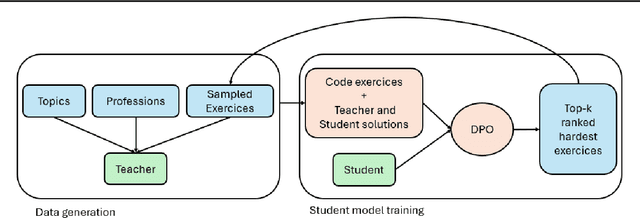
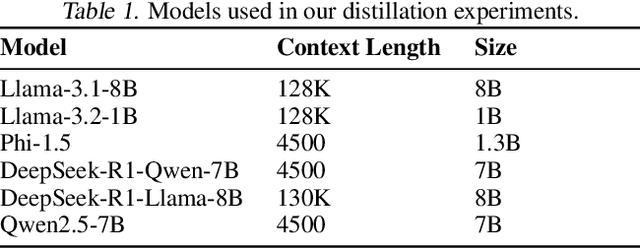
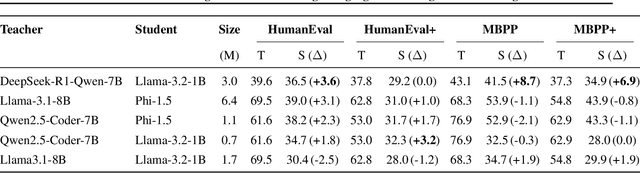
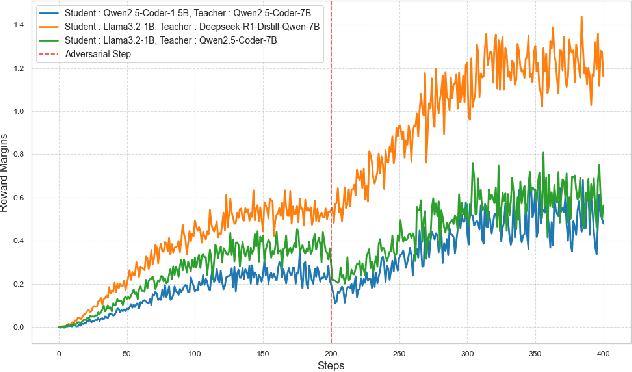
The widespread adoption of Large Language Models (LLMs) for code generation, exemplified by GitHub Copilot\footnote{A coding extension powered by a Code-LLM to assist in code completion tasks} surpassing a million users, highlights the transformative potential of these tools in improving developer productivity. However, this rapid growth also underscores critical concerns regarding the quality, safety, and reliability of the code they generate. As Code-LLMs evolve, they face significant challenges, including the diminishing returns of model scaling and the scarcity of new, high-quality training data. To address these issues, this paper introduces Adversarial Knowledge Distillation (AKD), a novel approach that leverages adversarially generated synthetic datasets to distill the capabilities of larger models into smaller, more efficient ones. By systematically stress-testing and refining the reasoning capabilities of Code-LLMs, AKD provides a framework for enhancing model robustness, reliability, and security while improving their parameter-efficiency. We believe this work represents a critical step toward ensuring dependable automated code generation within the constraints of existing data and the cost-efficiency of model execution.
Unsupervised Skill Discovery for Robotic Manipulation through Automatic Task Generation
Oct 07, 2024Learning skills that interact with objects is of major importance for robotic manipulation. These skills can indeed serve as an efficient prior for solving various manipulation tasks. We propose a novel Skill Learning approach that discovers composable behaviors by solving a large and diverse number of autonomously generated tasks. Our method learns skills allowing the robot to consistently and robustly interact with objects in its environment. The discovered behaviors are embedded in primitives which can be composed with Hierarchical Reinforcement Learning to solve unseen manipulation tasks. In particular, we leverage Asymmetric Self-Play to discover behaviors and Multiplicative Compositional Policies to embed them. We compare our method to Skill Learning baselines and find that our skills are more interactive. Furthermore, the learned skills can be used to solve a set of unseen manipulation tasks, in simulation as well as on a real robotic platform.
SLIM: Skill Learning with Multiple Critics
Feb 01, 2024Self-supervised skill learning aims to acquire useful behaviors that leverage the underlying dynamics of the environment. Latent variable models, based on mutual information maximization, have been particularly successful in this task but still struggle in the context of robotic manipulation. As it requires impacting a possibly large set of degrees of freedom composing the environment, mutual information maximization fails alone in producing useful manipulation behaviors. To address this limitation, we introduce SLIM, a multi-critic learning approach for skill discovery with a particular focus on robotic manipulation. Our main insight is that utilizing multiple critics in an actor-critic framework to gracefully combine multiple reward functions leads to a significant improvement in latent-variable skill discovery for robotic manipulation while overcoming possible interference occurring among rewards which hinders convergence to useful skills. Furthermore, in the context of tabletop manipulation, we demonstrate the applicability of our novel skill discovery approach to acquire safe and efficient motor primitives in a hierarchical reinforcement learning fashion and leverage them through planning, surpassing the state-of-the-art approaches for skill discovery by a large margin.
LARG, Language-based Automatic Reward and Goal Generation
Jun 19, 2023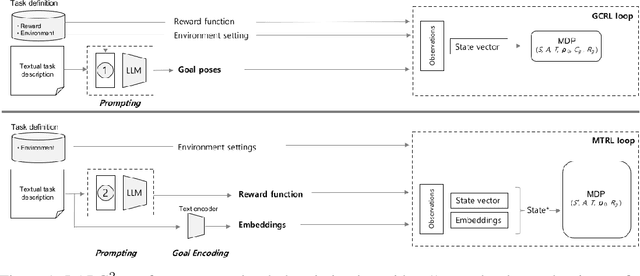
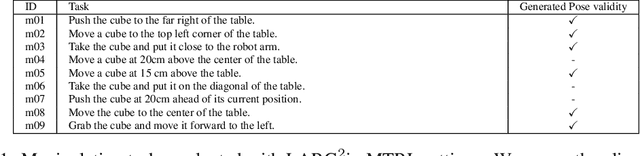

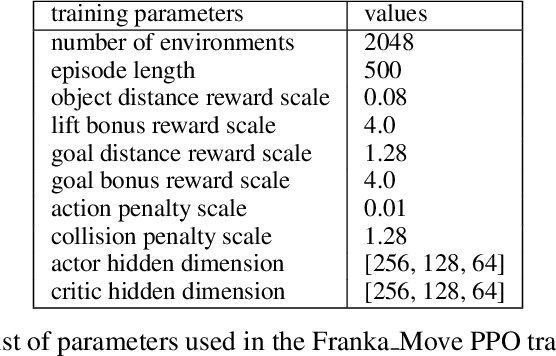
Goal-conditioned and Multi-Task Reinforcement Learning (GCRL and MTRL) address numerous problems related to robot learning, including locomotion, navigation, and manipulation scenarios. Recent works focusing on language-defined robotic manipulation tasks have led to the tedious production of massive human annotations to create dataset of textual descriptions associated with trajectories. To leverage reinforcement learning with text-based task descriptions, we need to produce reward functions associated with individual tasks in a scalable manner. In this paper, we leverage recent capabilities of Large Language Models (LLMs) and introduce \larg, Language-based Automatic Reward and Goal Generation, an approach that converts a text-based task description into its corresponding reward and goal-generation functions We evaluate our approach for robotic manipulation and demonstrate its ability to train and execute policies in a scalable manner, without the need for handcrafted reward functions.
Learning Visual Representations with Caption Annotations
Aug 04, 2020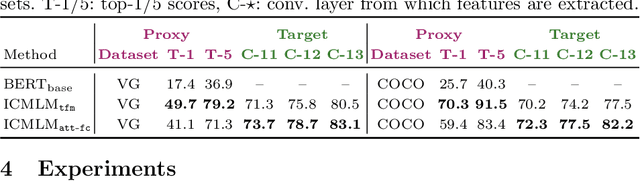
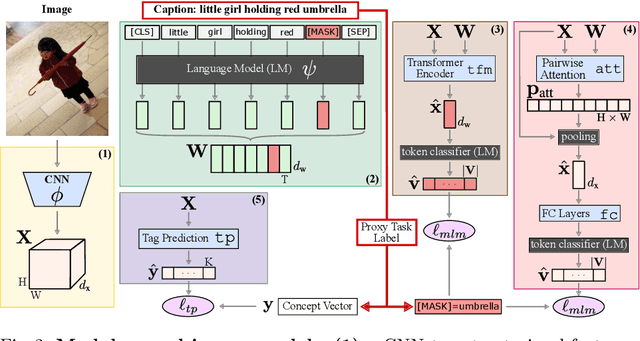
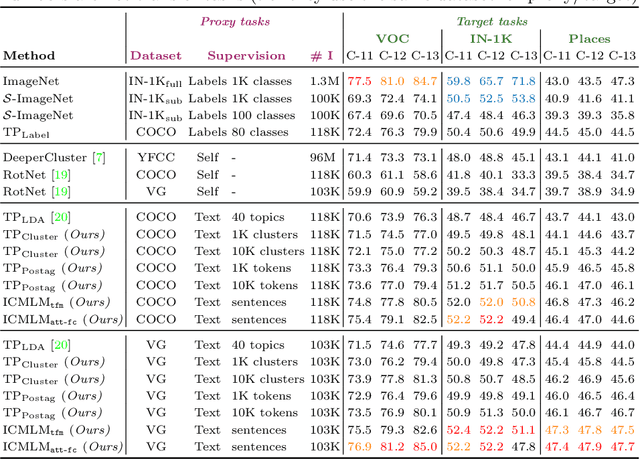
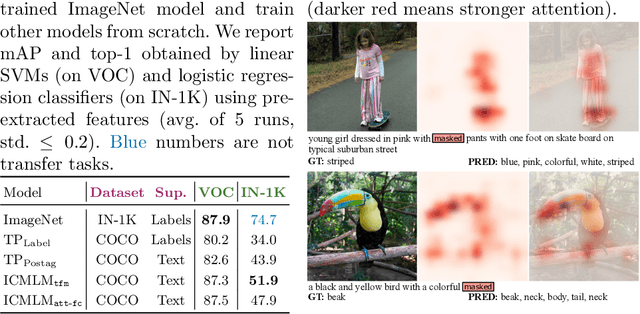
Pretraining general-purpose visual features has become a crucial part of tackling many computer vision tasks. While one can learn such features on the extensively-annotated ImageNet dataset, recent approaches have looked at ways to allow for noisy, fewer, or even no annotations to perform such pretraining. Starting from the observation that captioned images are easily crawlable, we argue that this overlooked source of information can be exploited to supervise the training of visual representations. To do so, motivated by the recent progresses in language models, we introduce {\em image-conditioned masked language modeling} (ICMLM) -- a proxy task to learn visual representations over image-caption pairs. ICMLM consists in predicting masked words in captions by relying on visual cues. To tackle this task, we propose hybrid models, with dedicated visual and textual encoders, and we show that the visual representations learned as a by-product of solving this task transfer well to a variety of target tasks. Our experiments confirm that image captions can be leveraged to inject global and localized semantic information into visual representations. Project website: https://europe.naverlabs.com/icmlm.
Dialog System Technology Challenge 7
Jan 11, 2019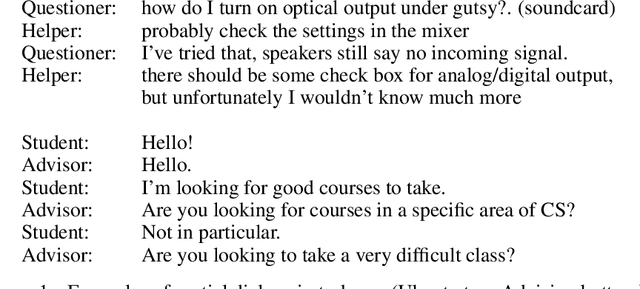
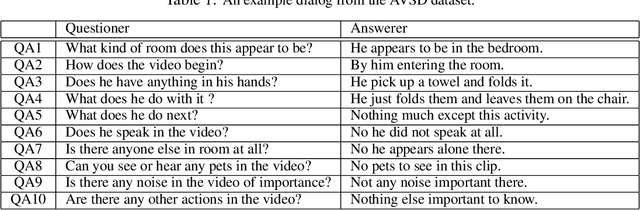
This paper introduces the Seventh Dialog System Technology Challenges (DSTC), which use shared datasets to explore the problem of building dialog systems. Recently, end-to-end dialog modeling approaches have been applied to various dialog tasks. The seventh DSTC (DSTC7) focuses on developing technologies related to end-to-end dialog systems for (1) sentence selection, (2) sentence generation and (3) audio visual scene aware dialog. This paper summarizes the overall setup and results of DSTC7, including detailed descriptions of the different tracks and provided datasets. We also describe overall trends in the submitted systems and the key results. Each track introduced new datasets and participants achieved impressive results using state-of-the-art end-to-end technologies.
ReviewQA: a relational aspect-based opinion reading dataset
Oct 29, 2018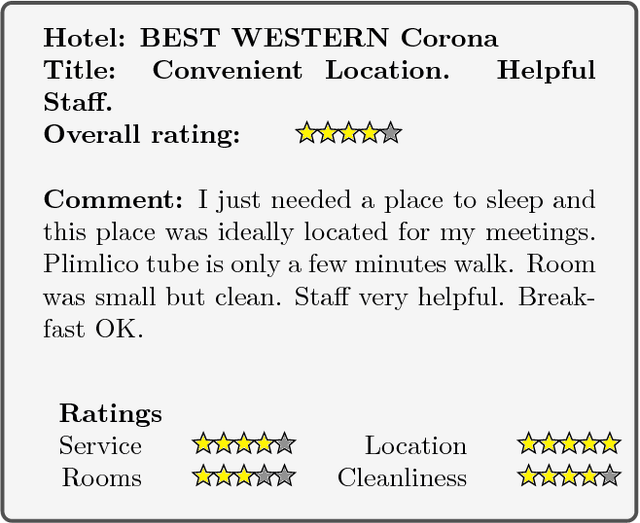
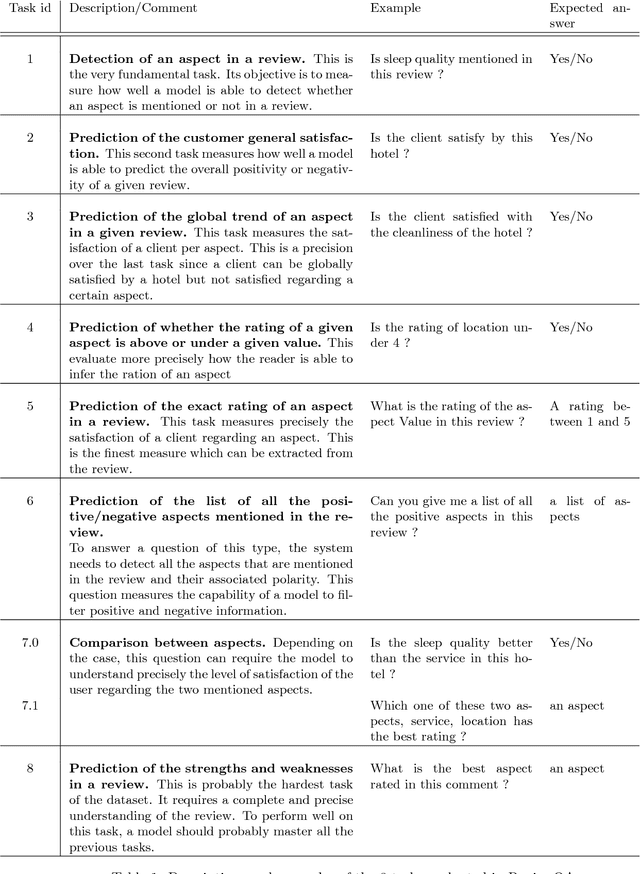
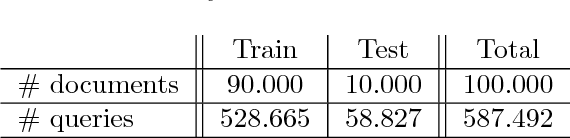
Deep reading models for question-answering have demonstrated promising performance over the last couple of years. However current systems tend to learn how to cleverly extract a span of the source document, based on its similarity with the question, instead of seeking for the appropriate answer. Indeed, a reading machine should be able to detect relevant passages in a document regarding a question, but more importantly, it should be able to reason over the important pieces of the document in order to produce an answer when it is required. To motivate this purpose, we present ReviewQA, a question-answering dataset based on hotel reviews. The questions of this dataset are linked to a set of relational understanding competencies that we expect a model to master. Indeed, each question comes with an associated type that characterizes the required competency. With this framework, it is possible to benchmark the main families of models and to get an overview of what are the strengths and the weaknesses of a given model on the set of tasks evaluated in this dataset. Our corpus contains more than 500.000 questions in natural language over 100.000 hotel reviews. Our setup is projective, the answer of a question does not need to be extracted from a document, like in most of the recent datasets, but selected among a set of candidates that contains all the possible answers to the questions of the dataset. Finally, we present several baselines over this dataset.