 Add to Chrome
 Add to Firefox
 Add to Edge
Optimizing Reinforcement Learning Training over Digital Twin Enabled Multi-fidelity Networks
Mar 09, 2026
In this paper, we investigate a novel digital network twin (DNT) assisted deep learning (DL) model training framework. In particular, we consider a physical network where a base station (BS) uses several antennas to serve multiple mobile users, and a DNT that is a virtual representation of the physical network. The BS must adjust its antenna tilt angles to optimize the data rates of all users. Due to user mobility, the BS may not be able to accurately track network dynamics such as wireless channels and user mobilities. Hence, a reinforcement learning (RL) approach is used to dynamically adjust the antenna tilt angles. To train the RL, we can use data collected from the physical network and the DNT. The data collected from the physical network is more accurate but incurs more communication overhead compared to the data collected from the DNT. Therefore, it is necessary to determine the ratio of data collected from the physical network and the DNT to improve the training of the RL model. We formulate this problem as an optimization problem whose goal is to jointly optimize the tilt angle adjustment policy and the data collection strategy, aiming to maximize the data rates of all users while constraining the time delay introduced by collecting data from the physical network. To solve this problem, we propose a hierarchical RL framework that integrates robust adversarial loss and proximal policy optimization (PPO). Simulation results show that our proposed method reduces the physical network data collection delay by up to 28.01% and 1x compared to a hierarchical RL that uses vanilla PPO as the first level RL, and the baseline that uses robust-RL at the first level and selects the data collection ratio randomly.

Coordinated Reinforcement Learning for Optimizing Mobile Networks
Sep 30, 2021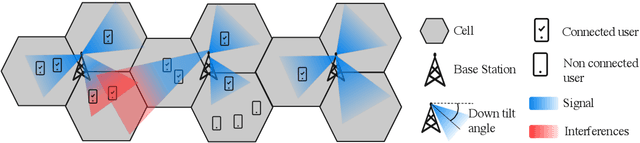
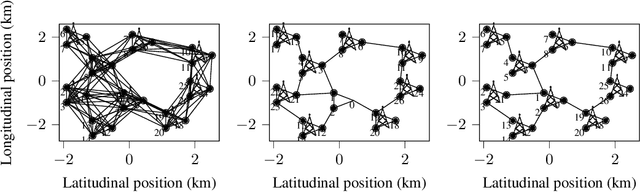
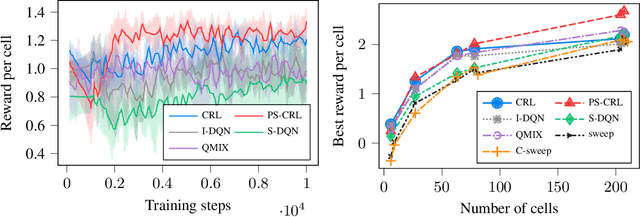
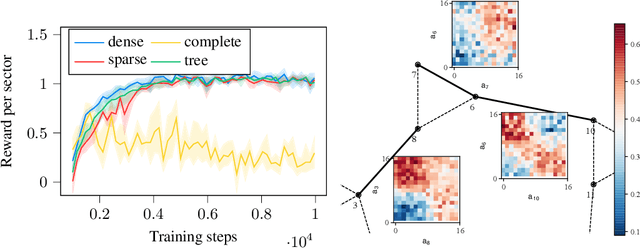
Mobile networks are composed of many base stations and for each of them many parameters must be optimized to provide good services. Automatically and dynamically optimizing all these entities is challenging as they are sensitive to variations in the environment and can affect each other through interferences. Reinforcement learning (RL) algorithms are good candidates to automatically learn base station configuration strategies from incoming data but they are often hard to scale to many agents. In this work, we demonstrate how to use coordination graphs and reinforcement learning in a complex application involving hundreds of cooperating agents. We show how mobile networks can be modeled using coordination graphs and how network optimization problems can be solved efficiently using multi- agent reinforcement learning. The graph structure occurs naturally from expert knowledge about the network and allows to explicitly learn coordinating behaviors between the antennas through edge value functions represented by neural networks. We show empirically that coordinated reinforcement learning outperforms other methods. The use of local RL updates and parameter sharing can handle a large number of agents without sacrificing coordination which makes it well suited to optimize the ever denser networks brought by 5G and beyond.