 Add to Chrome
 Add to Firefox
 Add to Edge
Diverse Agents for Ad-Hoc Cooperation in Hanabi
Jul 08, 2019
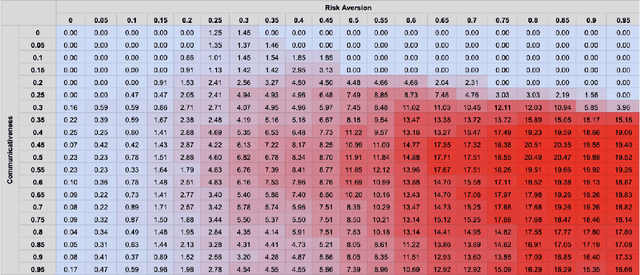
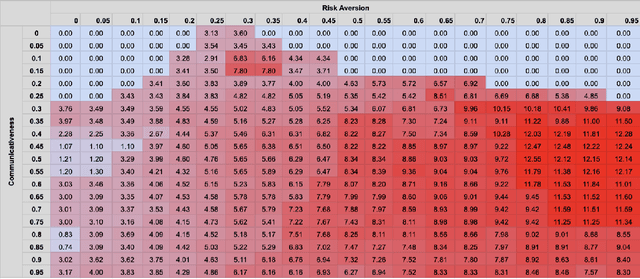
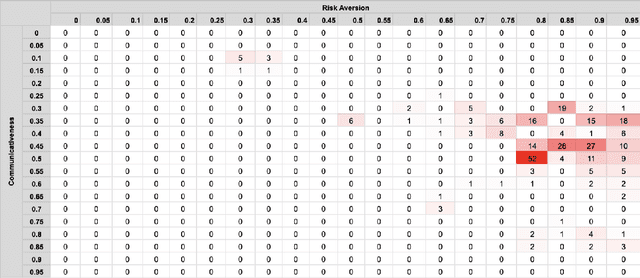
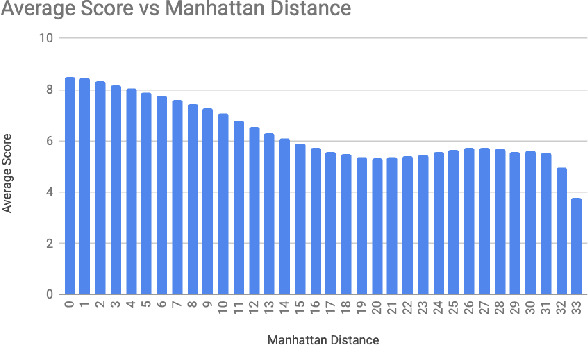
In complex scenarios where a model of other actors is necessary to predict and interpret their actions, it is often desirable that the model works well with a wide variety of previously unknown actors. Hanabi is a card game that brings the problem of modeling other players to the forefront, but there is no agreement on how to best generate a pool of agents to use as partners in ad-hoc cooperation evaluation. This paper proposes Quality Diversity algorithms as a promising class of algorithms to generate populations for this purpose and shows an initial implementation of an agent generator based on this idea. We also discuss what metrics can be used to compare such generators, and how the proposed generator could be leveraged to help build adaptive agents for the game.

Evolving the Hearthstone Meta
Jul 02, 2019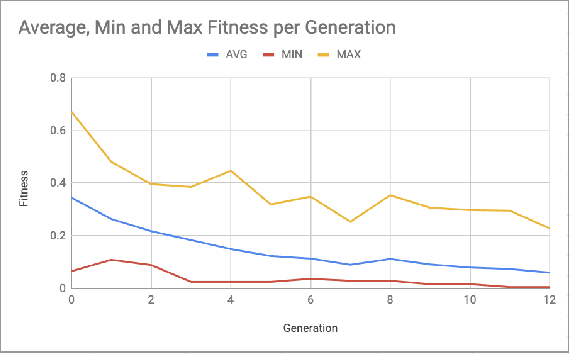
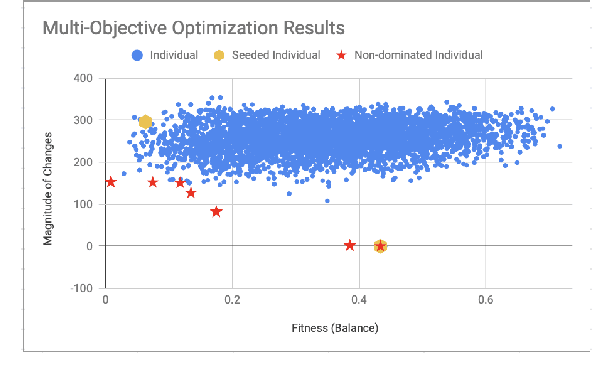
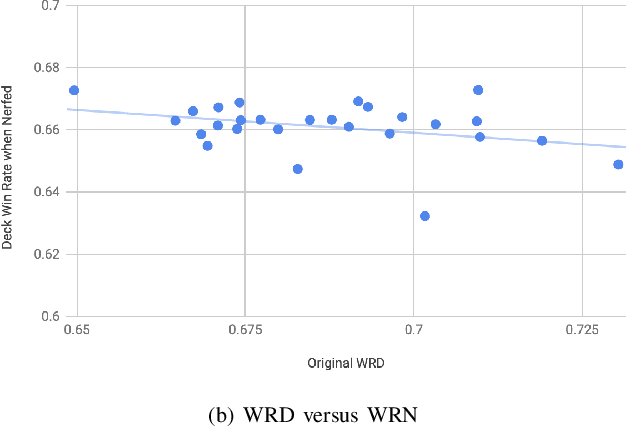
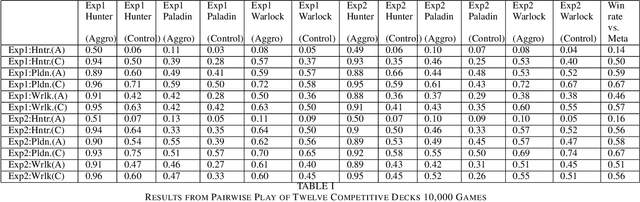
Balancing an ever growing strategic game of high complexity, such as Hearthstone is a complex task. The target of making strategies diverse and customizable results in a delicate intricate system. Tuning over 2000 cards to generate the desired outcome without disrupting the existing environment becomes a laborious challenge. In this paper, we discuss the impacts that changes to existing cards can have on strategy in Hearthstone. By analyzing the win rate on match-ups across different decks, being played by different strategies, we propose to compare their performance before and after changes are made to improve or worsen different cards. Then, using an evolutionary algorithm, we search for a combination of changes to the card attributes that cause the decks to approach equal, 50% win rates. We then expand our evolutionary algorithm to a multi-objective solution to search for this result, while making the minimum amount of changes, and as a consequence disruption, to the existing cards. Lastly, we propose and evaluate metrics to serve as heuristics with which to decide which cards to target with balance changes.
ACM-DE: Adaptive p-best Cauchy Mutation with linear failure threshold reduction for Differential Evolution in numerical optimization
Jul 01, 2019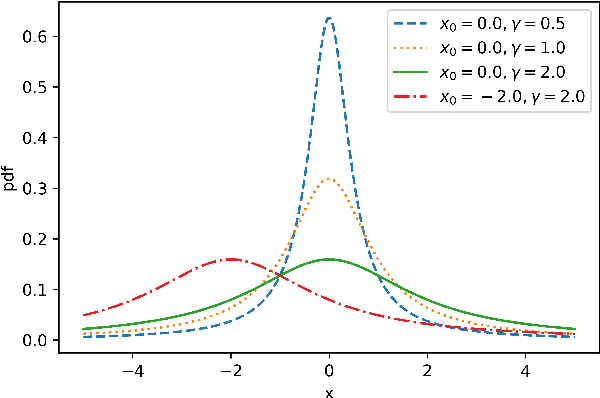
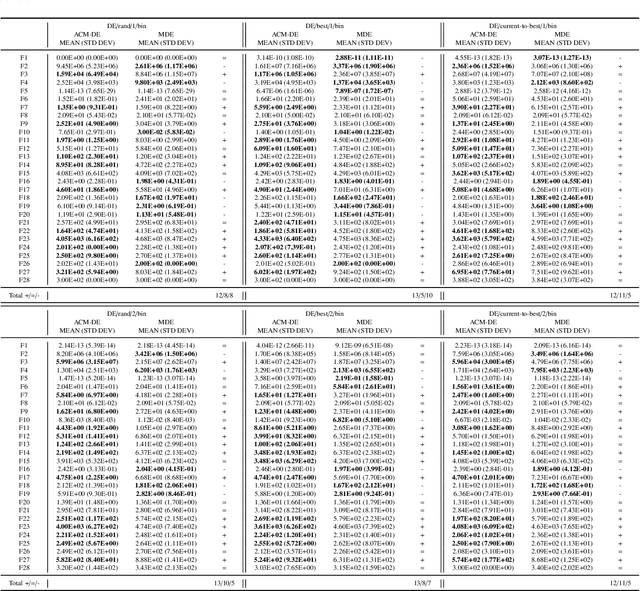
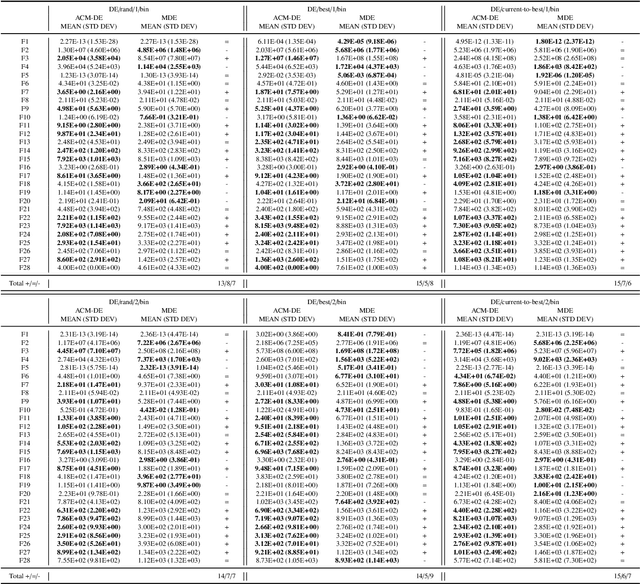
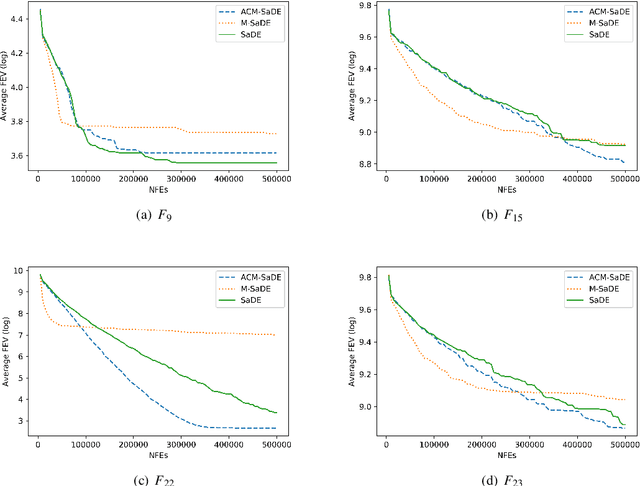
Differential evolution (DE) is an efficient evolutionary algorithm for optimizing continuous optimization problems. Although DE has been successfully applied to various real-world problems, it suffers from premature convergence where all individuals converge to a suboptimal solution too early. To address this problem, modified DE that uses the Cauchy mutation was proposed, but it has serious limitations of 1) controlling the balance between exploration and exploitation; 2) adjusting the algorithm to a given problem; 3) having less reliable performance on multimodal problems. In this paper, we propose a new adaptive Cauchy mutation based DE variant called ACM-DE (Adaptive Cauchy Mutation Differential Evolution), which removes all of these limitations. Specifically, two popular parameter controls are employed for the exploration and exploitation scheme and robust performance. Also, a less greedy approach is employed, which uses any of the top p% individuals in the phase of the Cauchy mutation. Experimental results on a set of 58 benchmark problems show that ACM-DE is capable of finding more accurate solutions than modified DE, especially for multimodal problems. In addition, we applied ACM to two state-of-the-art DE variants, and similar to the previous results, ACM based variants exhibit significantly improved performance.
Empowering Quality Diversity in Dungeon Design with Interactive Constrained MAP-Elites
Jun 12, 2019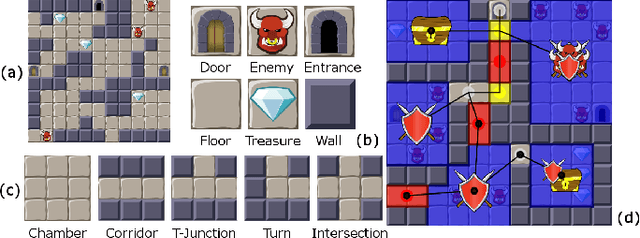
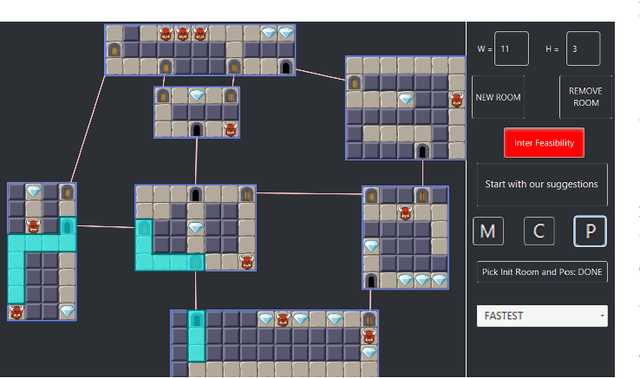
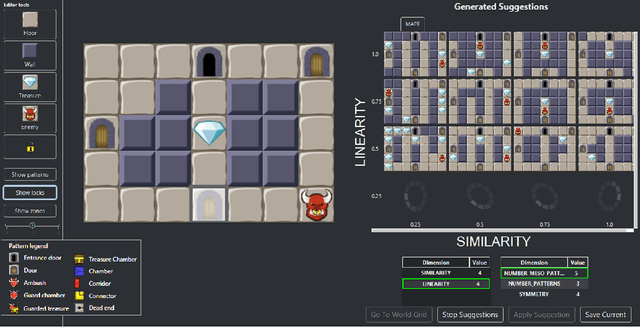
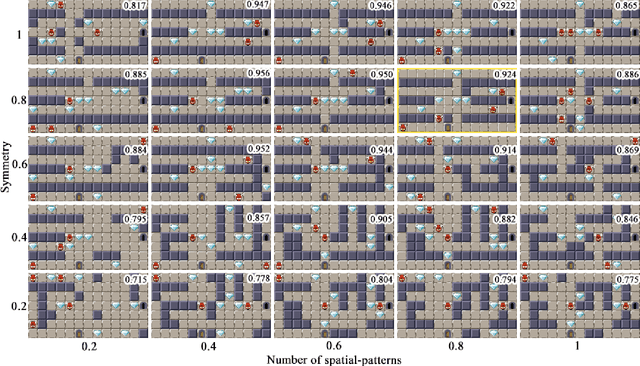
We propose the use of quality-diversity algorithms for mixed-initiative game content generation. This idea is implemented as a new feature of the Evolutionary Dungeon Designer, a system for mixed-initiative design of the type of levels you typically find in computer role playing games. The feature uses the MAP-Elites algorithm, an illumination algorithm which divides the population into a number of cells depending on their values along several behavioral dimensions. Users can flexibly and dynamically choose relevant dimensions of variation, and incorporate suggestions produced by the algorithm in their map designs. At the same time, any modifications performed by the human feed back into MAP-Elites, and are used to generate further suggestions.
General Video Game Rule Generation
Jun 12, 2019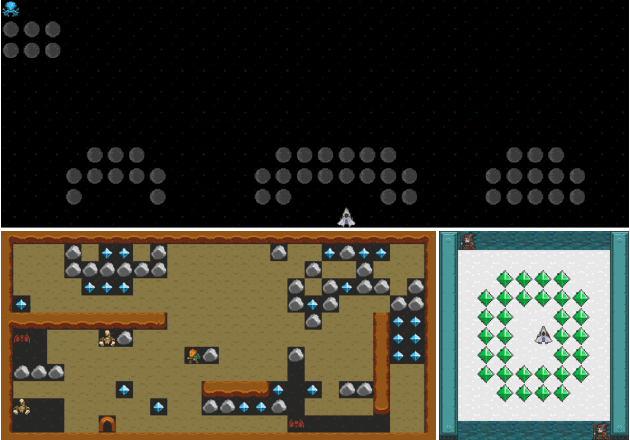
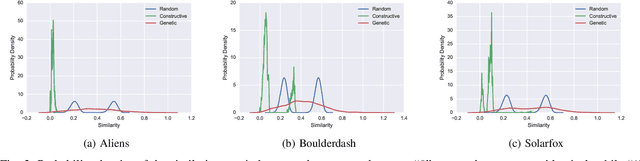
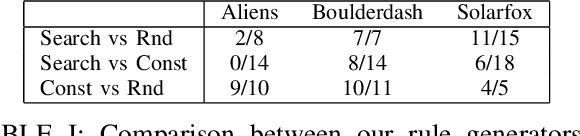
We introduce the General Video Game Rule Generation problem, and the eponymous software framework which will be used in a new track of the General Video Game AI (GVGAI) competition. The problem is, given a game level as input, to generate the rules of a game that fits that level. This can be seen as the inverse of the General Video Game Level Generation problem. Conceptualizing these two problems as separate helps breaking the very hard problem of generating complete games into smaller, more manageable subproblems. The proposed framework builds on the GVGAI software and thus asks the rule generator for rules defined in the Video Game Description Language. We describe the API, and three different rule generators: a random, a constructive and a search-based generator. Early results indicate that the constructive generator generates playable and somewhat interesting game rules but has a limited expressive range, whereas the search-based generator generates remarkably diverse rulesets, but with an uneven quality.
Two-step Constructive Approaches for Dungeon Generation
Jun 11, 2019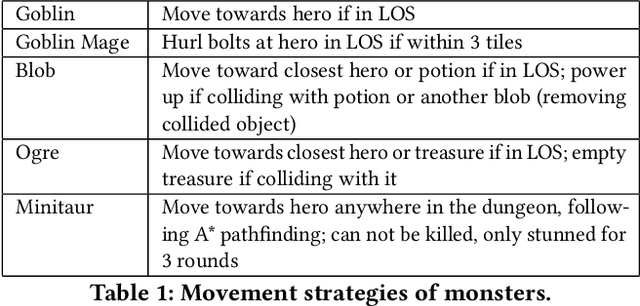
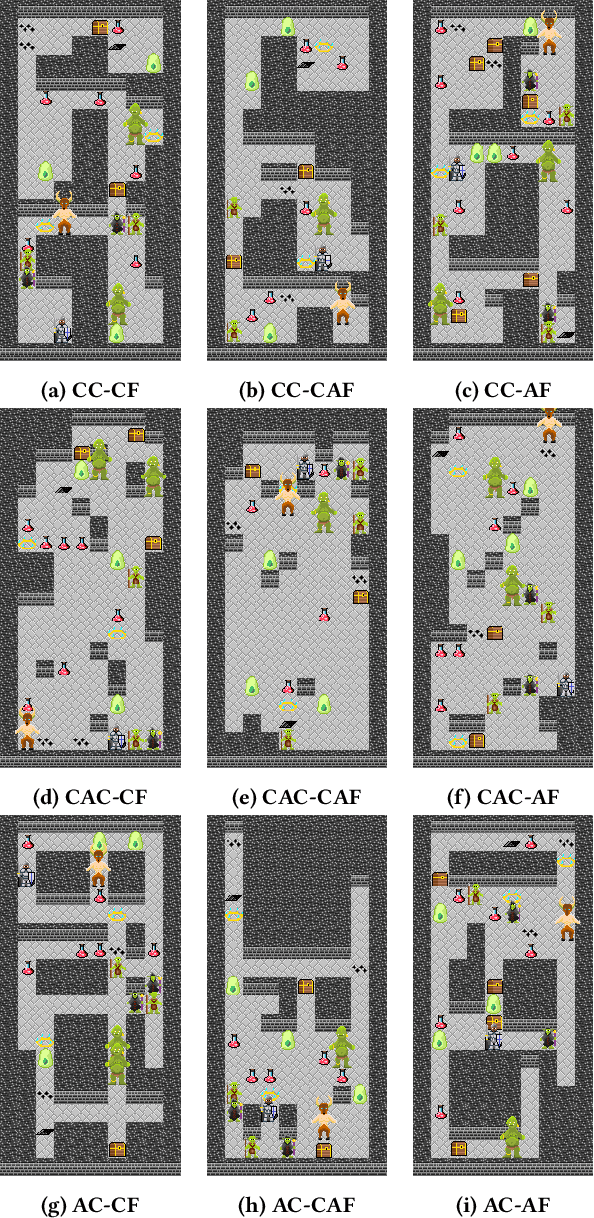
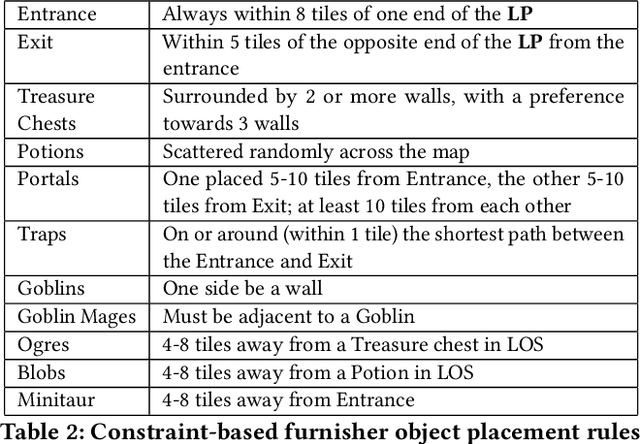
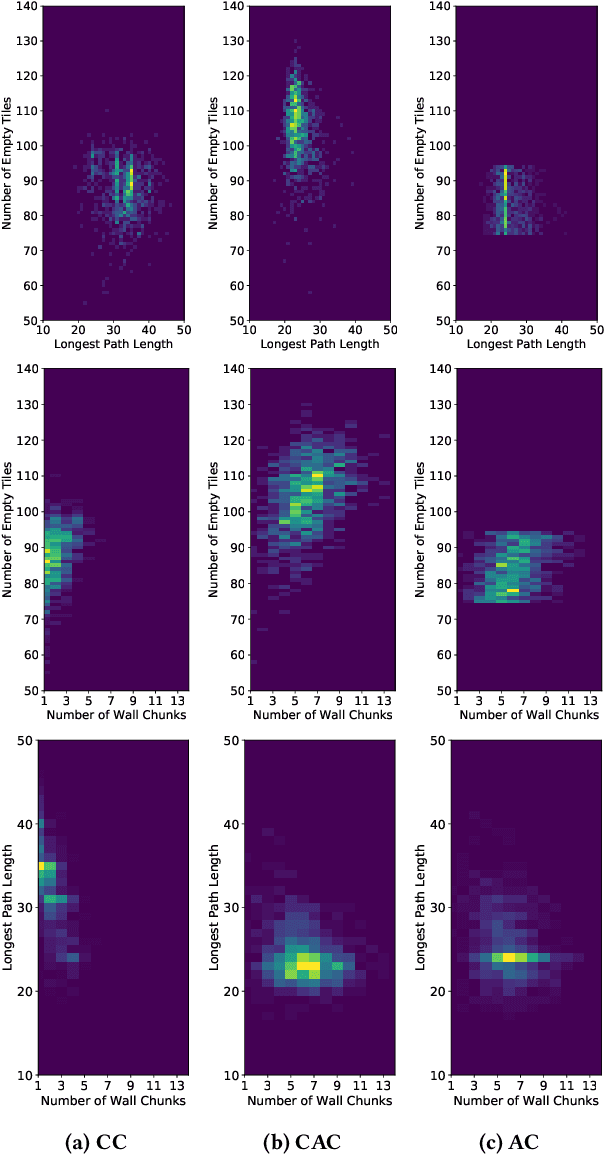
This paper presents a two-step generative approach for creating dungeons in the rogue-like puzzle game MiniDungeons 2. Generation is split into two steps, initially producing the architectural layout of the level as its walls and floor tiles, and then furnishing it with game objects representing the player's start and goal position, challenges and rewards. Three layout creators and three furnishers are introduced in this paper, which can be combined in different ways in the two-step generative process for producing diverse dungeons levels. Layout creators generate the floors and walls of a level, while furnishers populate it with monsters, traps, and treasures. We test the generated levels on several expressivity measures, and in simulations with procedural persona agents.
ELIMINATION from Design to Analysis
May 15, 2019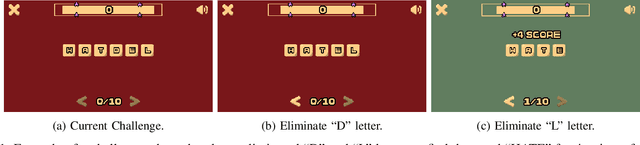
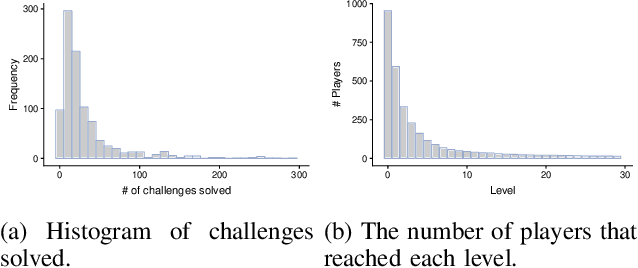
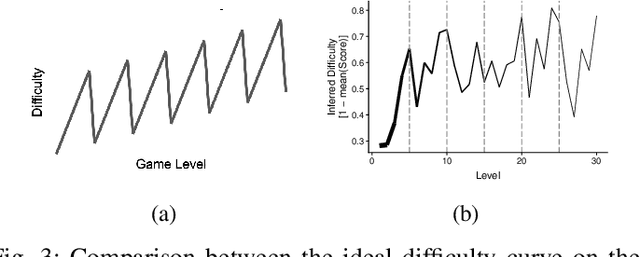
Elimination is a word puzzle game for browsers and mobile devices, where all levels are generated by a constrained evolutionary algorithm with no human intervention. This paper describes the design of the game and its level generation methods, and analysis of playtraces from almost a thousand users who played the game since its release. The analysis corroborates that the level generator creates a sawtooth-shaped difficulty curve, as intended. The analysis also offers insights into player behavior in this game.
Generative Design in Minecraft: Chronicle Challenge
May 14, 2019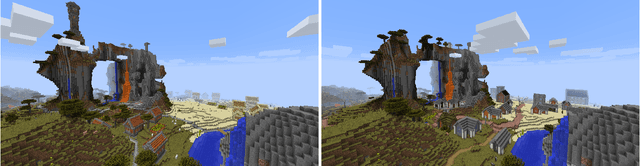
We introduce the Chronicle Challenge as an optional addition to the Settlement Generation Challenge in Minecraft. One of the foci of the overall competition is adaptive procedural content generation (PCG), an arguably under-explored problem in computational creativity. In the base challenge, participants must generate new settlements that respond to and ideally interact with existing content in the world, such as the landscape or climate. The goal is to understand the underlying creative process, and to design better PCG systems. The Chronicle Challenge in particular focuses on the generation of a narrative based on the history of a generated settlement, expressed in natural language. We discuss the unique features of the Chronicle Challenge in comparison to other competitions, clarify the characteristics of a chronicle eligible for submission and describe the evaluation criteria. We furthermore draw on simulation-based approaches in computational storytelling as examples to how this challenge could be approached.
Mapping Hearthstone Deck Spaces through MAP-Elites with Sliding Boundaries
Apr 24, 2019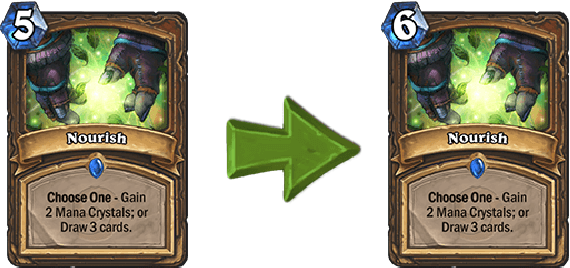
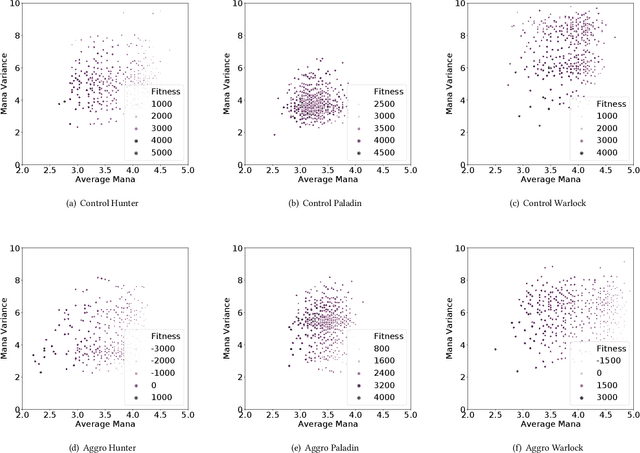
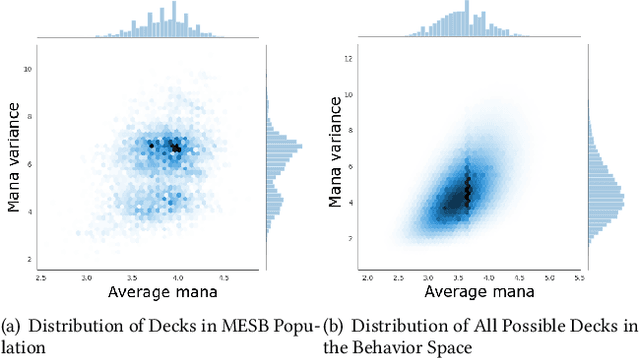
Quality diversity (QD) algorithms such as MAP-Elites have emerged as a powerful alternative to traditional single-objective optimization methods. They were initially applied to evolutionary robotics problems such as locomotion and maze navigation, but have yet to see widespread application. We argue that these algorithms are perfectly suited to the rich domain of video games, which contains many relevant problems with a multitude of successful strategies and often also multiple dimensions along which solutions can vary. This paper introduces a novel modification of the MAP-Elites algorithm called MAP-Elites with Sliding Boundaries (MESB) and applies it to the design and rebalancing of Hearthstone, a popular collectible card game chosen for its number of multidimensional behavior features relevant to particular styles of play. To avoid overpopulating cells with conflated behaviors, MESB slides the boundaries of cells based on the distribution of evolved individuals. Experiments in this paper demonstrate the performance of MESB in Hearthstone. Results suggest MESB finds diverse ways of playing the game well along the selected behavioral dimensions. Further analysis of the evolved strategies reveals common patterns that recur across behavioral dimensions and explores how MESB can help rebalance the game.
Intentional Computational Level Design
Apr 18, 2019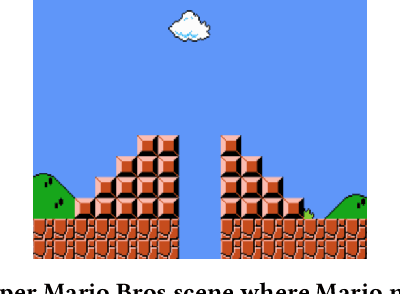
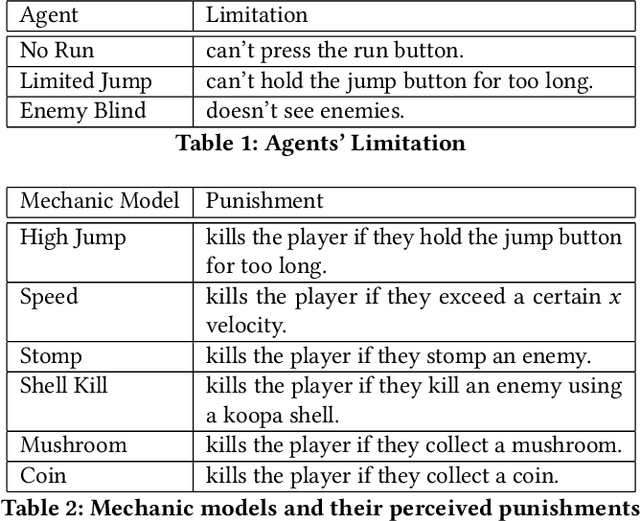
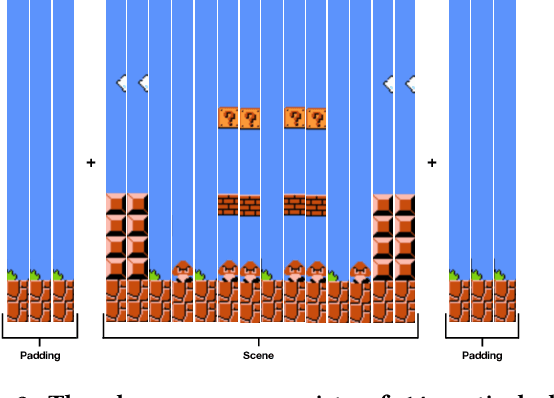
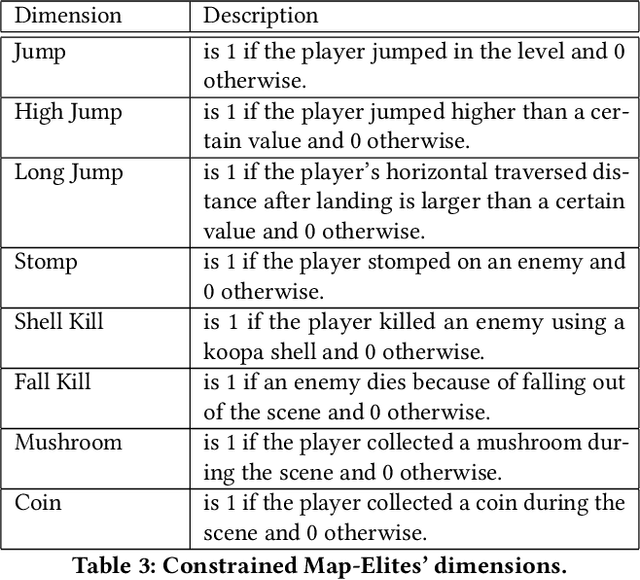
The procedural generation of levels and content in video games is a challenging AI problem. Often such generation relies on an intelligent way of evaluating the content being generated so that constraints are satisfied and/or objectives maximized. In this work, we address the problem of creating levels that are not only playable but also revolve around specific mechanics in the game. We use constrained evolutionary algorithms and quality-diversity algorithms to generate small sections of Super Mario Bros levels called scenes, using three different simulation approaches: Limited Agents, Punishing Model, and Mechanics Dimensions. All three approaches are able to create scenes that give opportunity for a player to encounter or use targeted mechanics with different properties. We conclude by discussing the advantages and disadvantages of each approach and compare them to each other.