 Add to Chrome
 Add to Firefox
 Add to Edge
Theory of Mind for Explainable Human-Robot Interaction
Dec 31, 2025
Within the context of human-robot interaction (HRI), Theory of Mind (ToM) is intended to serve as a user-friendly backend to the interface of robotic systems, enabling robots to infer and respond to human mental states. When integrated into robots, ToM allows them to adapt their internal models to users' behaviors, enhancing the interpretability and predictability of their actions. Similarly, Explainable Artificial Intelligence (XAI) aims to make AI systems transparent and interpretable, allowing humans to understand and interact with them effectively. Since ToM in HRI serves related purposes, we propose to consider ToM as a form of XAI and evaluate it through the eValuation XAI (VXAI) framework and its seven desiderata. This paper identifies a critical gap in the application of ToM within HRI, as existing methods rarely assess the extent to which explanations correspond to the robot's actual internal reasoning. To address this limitation, we propose to integrate ToM within XAI frameworks. By embedding ToM principles inside XAI, we argue for a shift in perspective, as current XAI research focuses predominantly on the AI system itself and often lacks user-centered explanations. Incorporating ToM would enable a change in focus, prioritizing the user's informational needs and perspective.

Talking to Robots: A Practical Examination of Speech Foundation Models for HRI Applications
Aug 25, 2025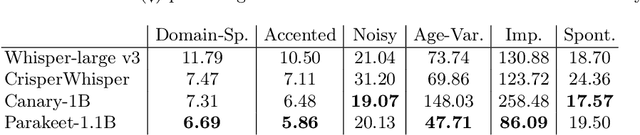
Automatic Speech Recognition (ASR) systems in real-world settings need to handle imperfect audio, often degraded by hardware limitations or environmental noise, while accommodating diverse user groups. In human-robot interaction (HRI), these challenges intersect to create a uniquely challenging recognition environment. We evaluate four state-of-the-art ASR systems on eight publicly available datasets that capture six dimensions of difficulty: domain-specific, accented, noisy, age-variant, impaired, and spontaneous speech. Our analysis demonstrates significant variations in performance, hallucination tendencies, and inherent biases, despite similar scores on standard benchmarks. These limitations have serious implications for HRI, where recognition errors can interfere with task performance, user trust, and safety.