 Add to Chrome
 Add to Firefox
 Add to Edge
Cascade Forgery Mining Network for Fingerprint Presentation Attack Detection
Jul 27, 2026
Fingerprint Presentation Attack Detection (PAD) is a critical component of fingerprint identification systems, serving as a protective measure against unauthorized access. In this paper, we observe that different regions of a fingerprint image can exhibit varying Artifact Extraction Difficulty (AED), with high-AED regions requiring more sophisticated extraction mechanisms to capture more subtle discriminative evidence. To address this issue, we propose to quantify AED using local Gabor feature certainty and partition fingerprint images into multiple regions based on their respective AED values. We then propose an AED guided Cascade Forgery Mining Network (CFM-Net) that employs an adaptive-depth feature extraction architecture to detect more precise and comprehensive artifact evidence across regions with heterogeneous AED values. Furthermore, we introduce an Orientation Guided Adversarial Training (OGAT) module to filter out identity information from PAD features while preserving the integrity of original artifact evidence. Experimental evaluations on LivDet datasets demonstrate the superior performance of our approach compared to state-of-the-art methods and achieve significant improvement in the classification ability of high AED fingerprints.

FingerNet: An Unified Deep Network for Fingerprint Minutiae Extraction
Sep 07, 2017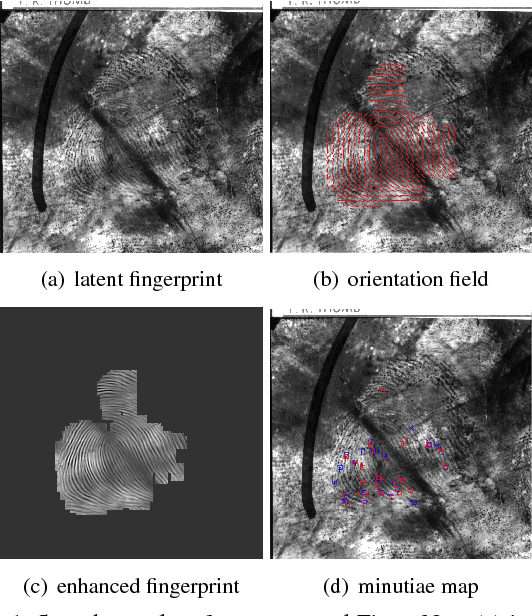
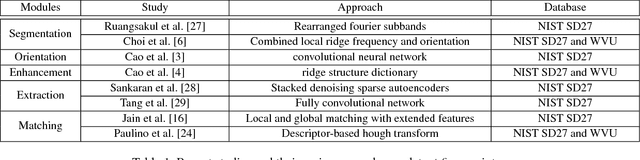

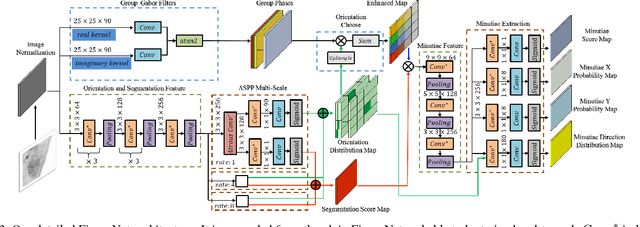
Minutiae extraction is of critical importance in automated fingerprint recognition. Previous works on rolled/slap fingerprints failed on latent fingerprints due to noisy ridge patterns and complex background noises. In this paper, we propose a new way to design deep convolutional network combining domain knowledge and the representation ability of deep learning. In terms of orientation estimation, segmentation, enhancement and minutiae extraction, several typical traditional methods performed well on rolled/slap fingerprints are transformed into convolutional manners and integrated as an unified plain network. We demonstrate that this pipeline is equivalent to a shallow network with fixed weights. The network is then expanded to enhance its representation ability and the weights are released to learn complex background variance from data, while preserving end-to-end differentiability. Experimental results on NIST SD27 latent database and FVC 2004 slap database demonstrate that the proposed algorithm outperforms the state-of-the-art minutiae extraction algorithms. Code is made publicly available at: https://github.com/felixTY/FingerNet.
Latent fingerprint minutia extraction using fully convolutional network
Sep 07, 2017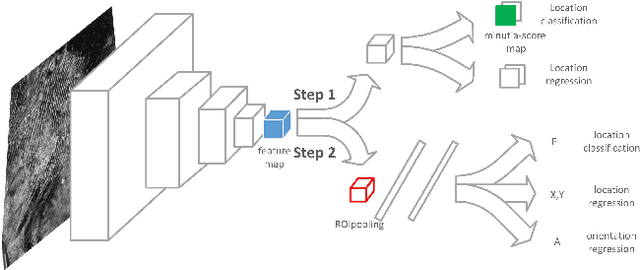
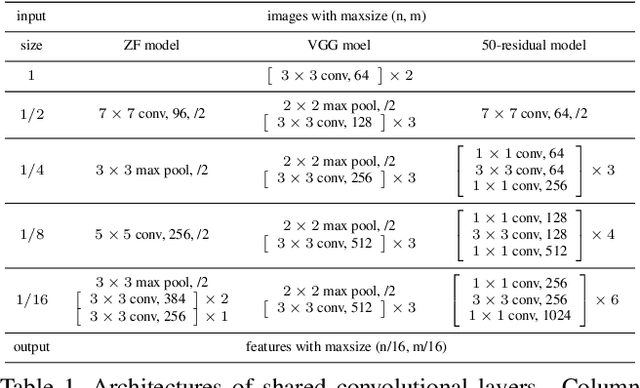
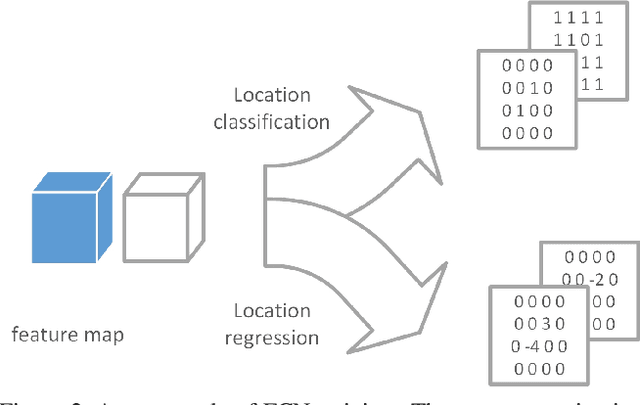
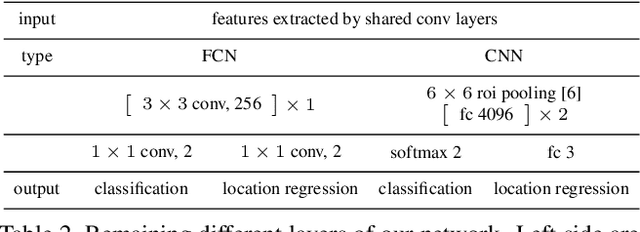
Minutiae play a major role in fingerprint identification. Extracting reliable minutiae is difficult for latent fingerprints which are usually of poor quality. As the limitation of traditional handcrafted features, a fully convolutional network (FCN) is utilized to learn features directly from data to overcome complex background noises. Raw fingerprints are mapped to a correspondingly-sized minutia-score map with a fixed stride. And thus a large number of minutiae will be extracted through a given threshold. Then small regions centering at these minutia points are entered into a convolutional neural network (CNN) to reclassify these minutiae and calculate their orientations. The CNN shares convolutional layers with the fully convolutional network to speed up. 0.45 second is used on average to detect one fingerprint on a GPU. On the NIST SD27 database, we achieve 53\% recall rate and 53\% precise rate that outperform many other algorithms. Our trained model is also visualized to show that we have successfully extracted features preserving ridge information of a latent fingerprint.