 Add to Chrome
 Add to Firefox
 Add to Edge
Operational machine learning for remote spectroscopic detection of CH$_{4}$ point sources
Nov 11, 2025
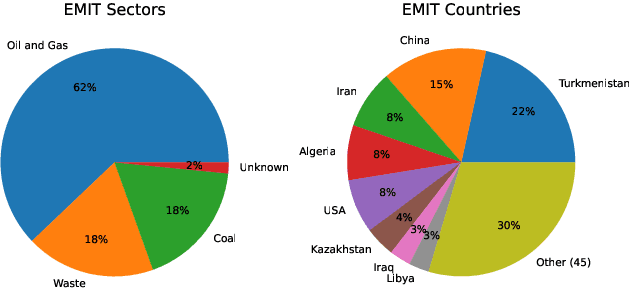
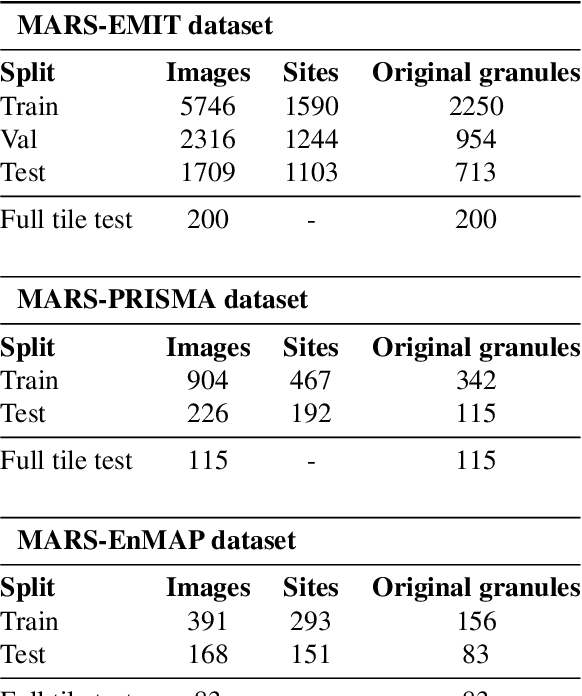
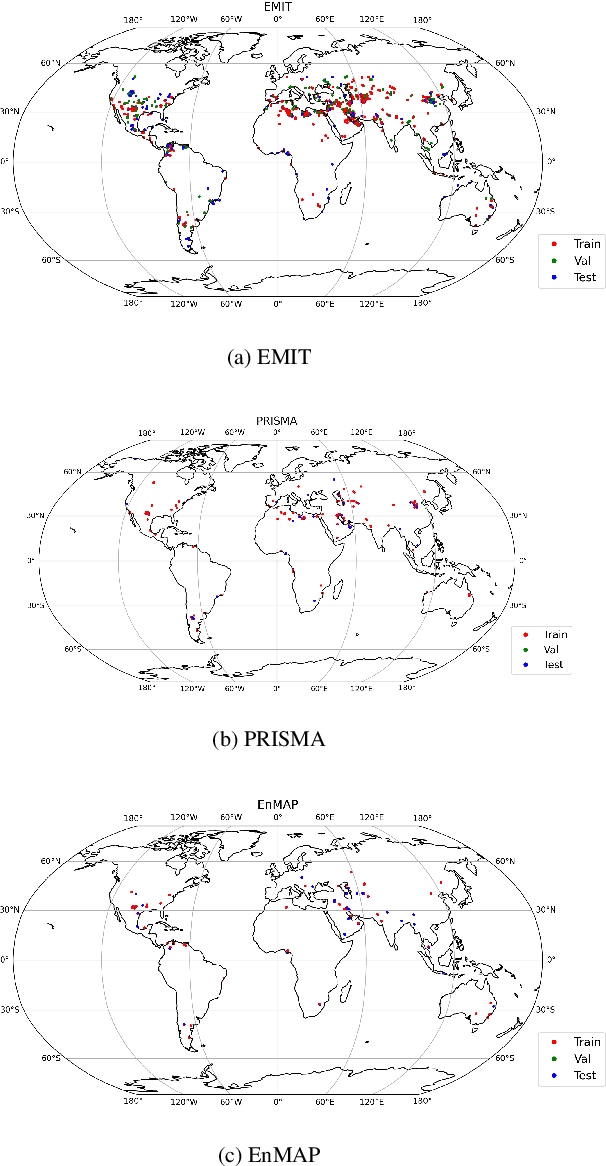
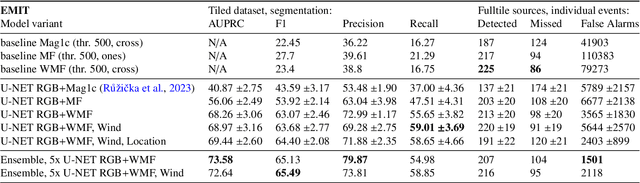
Mitigating anthropogenic methane sources is one the most cost-effective levers to slow down global warming. While satellite-based imaging spectrometers, such as EMIT, PRISMA, and EnMAP, can detect these point sources, current methane retrieval methods based on matched filters still produce a high number of false detections requiring laborious manual verification. This paper describes the operational deployment of a machine learning system for detecting methane emissions within the Methane Alert and Response System (MARS) of the United Nations Environment Programme's International Methane Emissions Observatory. We created the largest and most diverse global dataset of annotated methane plumes from three imaging spectrometer missions and quantitatively compared different deep learning model configurations. Focusing on the requirements for operational deployment, we extended prior evaluation methodologies from small tiled datasets to full granule evaluation. This revealed that deep learning models still produce a large number of false detections, a problem we address with model ensembling, which reduced false detections by over 74%. Deployed in the MARS pipeline, our system processes scenes and proposes plumes to analysts, accelerating the detection and analysis process. During seven months of operational deployment, it facilitated the verification of 1,351 distinct methane leaks, resulting in 479 stakeholder notifications. We further demonstrate the model's utility in verifying mitigation success through case studies in Libya, Argentina, Oman, and Azerbaijan. Our work represents a critical step towards a global AI-assisted methane leak detection system, which is required to process the dramatically higher data volumes expected from new and current imaging spectrometers.

Disentangling Derivatives, Uncertainty and Error in Gaussian Process Models
Dec 09, 2020
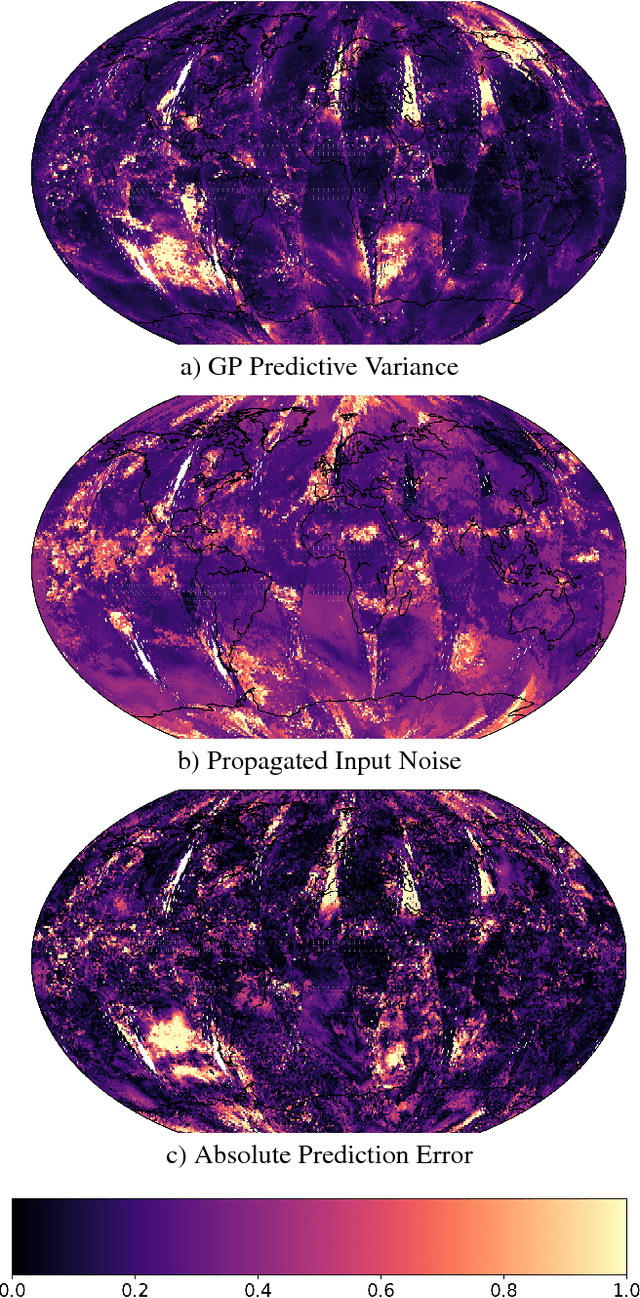
Gaussian Processes (GPs) are a class of kernel methods that have shown to be very useful in geoscience applications. They are widely used because they are simple, flexible and provide very accurate estimates for nonlinear problems, especially in parameter retrieval. An addition to a predictive mean function, GPs come equipped with a useful property: the predictive variance function which provides confidence intervals for the predictions. The GP formulation usually assumes that there is no input noise in the training and testing points, only in the observations. However, this is often not the case in Earth observation problems where an accurate assessment of the instrument error is usually available. In this paper, we showcase how the derivative of a GP model can be used to provide an analytical error propagation formulation and we analyze the predictive variance and the propagated error terms in a temperature prediction problem from infrared sounding data.
* arXiv admin note: text overlap with arXiv:2005.09907