 Add to Chrome
 Add to Firefox
 Add to Edge
Amortized Bayesian Causal Discovery of Extended Factor Graphs
Jul 24, 2026
Learning causal graphs from interventional data is a challenging problem with broad applications. In molecular biology, for example, a central goal is to uncover gene regulatory networks from large-scale perturbation data. An ideal algorithm for this task should scale to thousands of nodes, incorporate interventions even when their targets are unknown, quantify uncertainty, and provide identifiability guarantees. However, existing approaches---e.g. approaches using score-based optimization or approximate Bayesian inference---often fail to meet all of these criteria. To address these limitations, we develop Amortized Bayesian Causal Discovery of Extended Factor Graphs (ABCDEFG). Our method guarantees exact acyclicity, scales to graphs with thousands of nodes, and naturally handles interventions even when their targets are unknown. Additionally, ABCDEFG estimates a posterior distribution whose maximum a posteriori estimate provably identifies the true causal graph up to an equivalence class. On simulated datasets, ABCDEFG achieves state-of-the-art accuracy, producing a well-calibrated posterior distribution while outperforming previous score-based and approximate Bayesian methods. Applied to large-scale single-cell perturbation data, ABCDEFG identifies both established and novel gene targets of growth factors.

Variational Mixtures of ODEs for Inferring Cellular Gene Expression Dynamics
Jul 09, 2022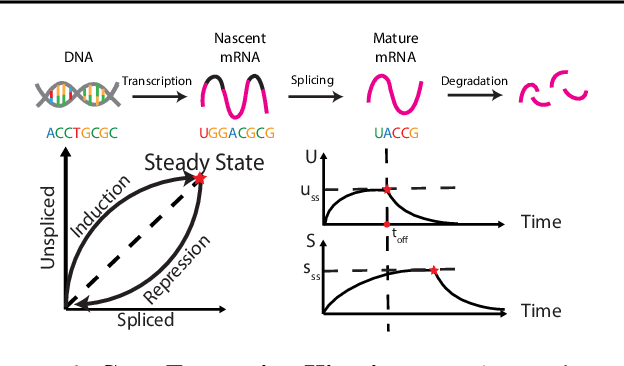
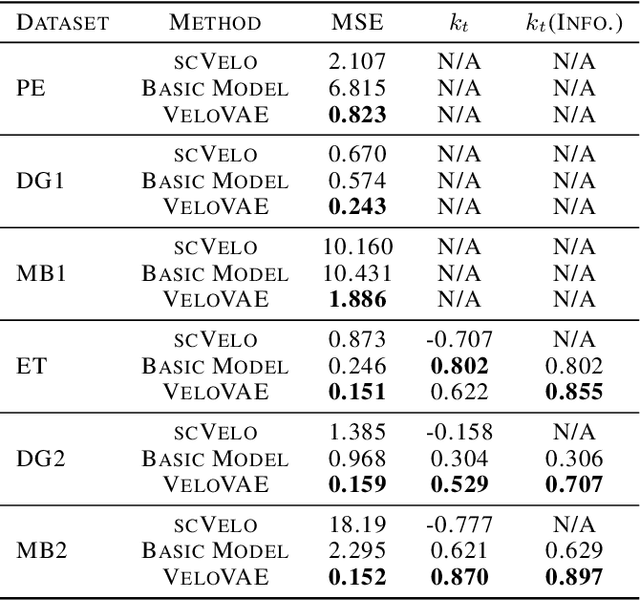
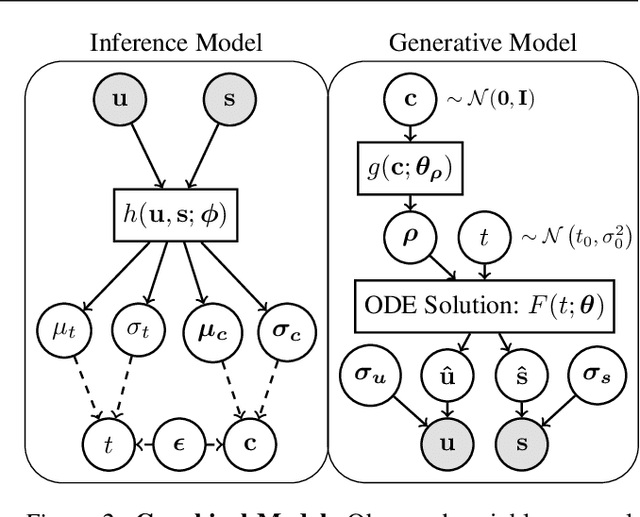
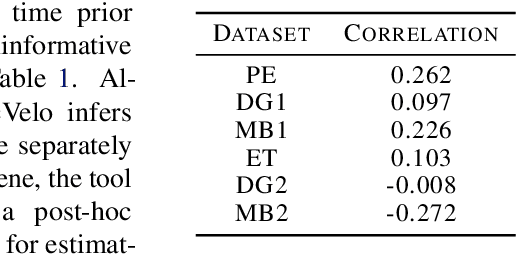
A key problem in computational biology is discovering the gene expression changes that regulate cell fate transitions, in which one cell type turns into another. However, each individual cell cannot be tracked longitudinally, and cells at the same point in real time may be at different stages of the transition process. This can be viewed as a problem of learning the behavior of a dynamical system from observations whose times are unknown. Additionally, a single progenitor cell type often bifurcates into multiple child cell types, further complicating the problem of modeling the dynamics. To address this problem, we developed an approach called variational mixtures of ordinary differential equations. By using a simple family of ODEs informed by the biochemistry of gene expression to constrain the likelihood of a deep generative model, we can simultaneously infer the latent time and latent state of each cell and predict its future gene expression state. The model can be interpreted as a mixture of ODEs whose parameters vary continuously across a latent space of cell states. Our approach dramatically improves data fit, latent time inference, and future cell state estimation of single-cell gene expression data compared to previous approaches.