 Add to Chrome
 Add to Firefox
 Add to Edge
amc: The Automated Mission Classifier for Telescope Bibliographies
Dec 12, 2025
Telescope bibliographies record the pulse of astronomy research by capturing publication statistics and citation metrics for telescope facilities. Robust and scalable bibliographies ensure that we can measure the scientific impact of our facilities and archives. However, the growing rate of publications threatens to outpace our ability to manually label astronomical literature. We therefore present the Automated Mission Classifier (amc), a tool that uses large language models (LLMs) to identify and categorize telescope references by processing large quantities of paper text. A modified version of amc performs well on the TRACS Kaggle challenge, achieving a macro $F_1$ score of 0.84 on the held-out test set. amc is valuable for other telescopes beyond TRACS; we developed the initial software for identifying papers that featured scientific results by NASA missions. Additionally, we investigate how amc can also be used to interrogate historical datasets and surface potential label errors. Our work demonstrates that LLM-based applications offer powerful and scalable assistance for library sciences.

Designing an Evaluation Framework for Large Language Models in Astronomy Research
May 30, 2024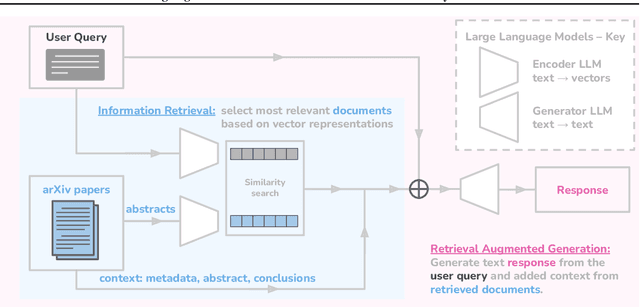
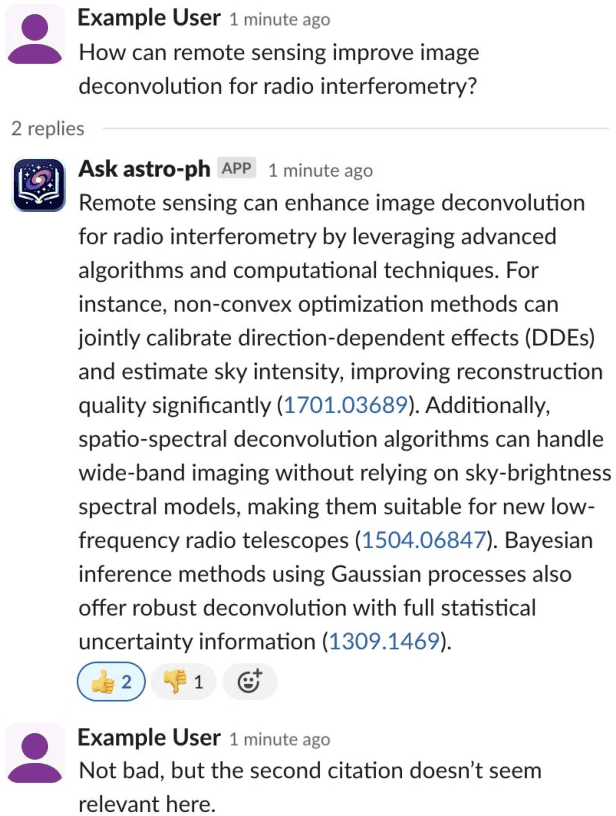
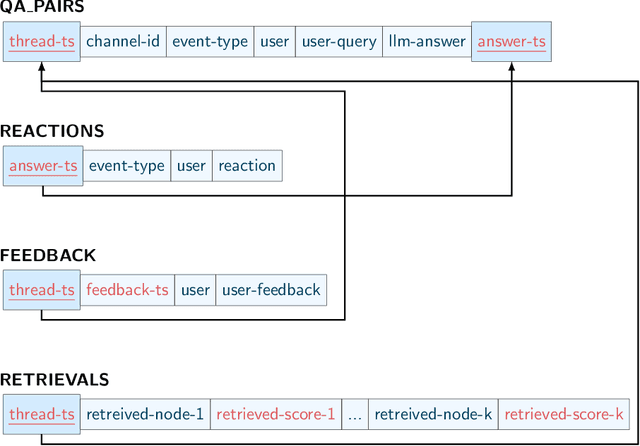
Large Language Models (LLMs) are shifting how scientific research is done. It is imperative to understand how researchers interact with these models and how scientific sub-communities like astronomy might benefit from them. However, there is currently no standard for evaluating the use of LLMs in astronomy. Therefore, we present the experimental design for an evaluation study on how astronomy researchers interact with LLMs. We deploy a Slack chatbot that can answer queries from users via Retrieval-Augmented Generation (RAG); these responses are grounded in astronomy papers from arXiv. We record and anonymize user questions and chatbot answers, user upvotes and downvotes to LLM responses, user feedback to the LLM, and retrieved documents and similarity scores with the query. Our data collection method will enable future dynamic evaluations of LLM tools for astronomy.
Algorithms and Statistical Models for Scientific Discovery in the Petabyte Era
Nov 05, 2019The field of astronomy has arrived at a turning point in terms of size and complexity of both datasets and scientific collaboration. Commensurately, algorithms and statistical models have begun to adapt --- e.g., via the onset of artificial intelligence --- which itself presents new challenges and opportunities for growth. This white paper aims to offer guidance and ideas for how we can evolve our technical and collaborative frameworks to promote efficient algorithmic development and take advantage of opportunities for scientific discovery in the petabyte era. We discuss challenges for discovery in large and complex data sets; challenges and requirements for the next stage of development of statistical methodologies and algorithmic tool sets; how we might change our paradigms of collaboration and education; and the ethical implications of scientists' contributions to widely applicable algorithms and computational modeling. We start with six distinct recommendations that are supported by the commentary following them. This white paper is related to a larger corpus of effort that has taken place within and around the Petabytes to Science Workshops (https://petabytestoscience.github.io/).