 Add to Chrome
 Add to Firefox
 Add to Edge
Nonstationary Generalized Linear Bandits with Discounted Online Mirror Descent
May 25, 2026
We study nonstationary generalized linear bandits (GLBs), where the expected reward is modeled through a nonlinear link function with an unknown time-varying parameter. This framework encompasses a broad class of reward models, including linear, Bernoulli, and binomial rewards. Existing approaches are predominantly based on maximum-likelihood estimation (MLE), using sliding-window, restart, or discounting mechanisms to handle nonstationarity. Although these methods achieve statistically efficient regret guarantees, they generally require revisiting past observations at every round, which leads to computation and memory costs that grow with time; moreover, several of them rely on a non-convex projection step. In this paper, we propose DOMD-GLB, a new algorithm for nonstationary GLBs that utilizes discounted online mirror descent (DOMD) for parameter estimation, thereby incurring only $O(1)$ computation and memory costs per round. We prove dynamic regret bounds of order $\tilde{O} \big(c_μ^{-1/2} d^{3/4} P_T^{1/4} T^{3/4}\big)$ in drifting environments and $\tilde{O}\big(c_μ^{-1/3} d^{2/3} Γ_T^{1/3} T^{2/3}\big) $in piecewise-stationary environments, where $d$ denotes the feature dimension, $T$ the time horizon, $P_T$ the path length, $Γ_T$ the number of change points, and $c_μ$ a curvature parameter associated with the link function, while substantially improving computational efficiency over prior work. To the best of our knowledge, this is the first algorithm for nonstationary GLBs with per-round computation and memory costs independent of time.

Optimal Design for Multinomial Logit Model with Applications to Best Assortment Identification
May 25, 2026We study optimal experimental design for multinomial logit (MNL) bandits, where an agent repeatedly selects a subset of $K$ items from a ground set of size $N$ and observes single-choice feedback. Unlike linear or generalized linear bandits, MNL bandits have a combinatorial action space, which makes classical optimal design approaches and naive optimization over all subsets computationally intractable. We propose a computationally efficient optimal design framework for MNL models that achieves both statistical efficiency and scalability through two complementary approaches: (i) an exact or certified-approximate reformulation of the design oracle as a $0$-$1$ mixed-integer linear program (MILP) with solver-certified early stopping, and (ii) a fully polynomial-time lifted design that replaces the nonlinear objective with a tractable surrogate. Using the Kiefer-Wolfowitz equivalence theorem, we establish near G-optimality guarantees and characterize the induced statistical-computational trade-offs. As an application, we develop a best assortment identification algorithm for MNL bandits with linear utilities and non-uniform revenues, and prove an instance-dependent sample complexity of $\tilde{O}\big(\frac{d \log N}{Δ^2}\big)$, where $d$ is the feature dimension, $N$ is the number of arms, and $Δ$ is the minimum revenue gap.
Multi-Step Likelihood-Ratio Correction for Reinforcement Learning with Verifiable Rewards
May 20, 2026Reinforcement learning with verifiable rewards (RLVR) plays a pivotal role in improving the reasoning ability of large language models. However, widely used PPO surrogate objectives are fundamentally local, as they rely on a local approximation of the exact policy gradient objective. While this approximation improves stability by reducing the variance induced by importance sampling, it also introduces structural bias into the surrogate objective, which must be controlled through trust region mechanisms. In this work, we introduce the $N$-step forward trace, which augments the PPO surrogate objective using the cumulative likelihood ratio of the next $N-1$ tokens. Building on this idea, we propose $N$-Step Forward-Trace Policy Optimization (NFPO), a practical RLVR algorithm that integrates the $N$-step forward trace into the masked policy gradient framework. NFPO provides a continuous bridge between the PPO surrogate objective and the exact policy gradient objective, offering a principled mechanism for controlling the bias-variance trade-off. Our theoretical analysis shows that, with an appropriate choice of $N$, the proposed objective yields a tighter policy-improvement bound than the standard PPO surrogate. Experiments on comprehensive reasoning benchmarks demonstrate that NFPO consistently improves performance, supporting our theoretical findings.
Block-Sphere Vector Quantization
May 19, 2026Vector quantization is a fundamental primitive for scalable machine learning systems, enabling memory-efficient storage, fast retrieval, and compressed inference. Recent rotation-based quantizers such as EDEN, RabitQ, and TurboQuant have introduced strong guarantees and empirical performance, but the surrounding comparisons have been difficult to interpret because they rely on different distortion criteria, probability regimes, and implementation assumptions. As our first contribution, we provide a unified theoretical comparison of these methods and show that their relative advantages are criterion-dependent rather than absolute: EDEN and TurboQuant are favorable for MSE distortion, EDEN is also effective for expected inner-product distortion, and RabitQ provides strong high-probability control. This comparison further clarifies that EDEN provides particularly strong guarantees for expected distortion measures. As our second contribution, we introduce Block-Sphere Quantization (BlockQuant), a new rotation-based block quantization algorithm designed around the spherical geometry of randomly rotated vectors. Unlike coordinate-wise quantizers, BlockQuant quantizes blocks on the sphere, preserving the geometry of rotated embeddings more faithfully. We prove that this block-spherical design theoretically improves over the baselines considered in this paper for both reconstruction MSE and expected inner-product distortion. Our experiments on real embedding datasets and long-context LLM inference tasks show practical gains that are consistent with our theoretical improvements.
Demystifying Linear MDPs and Novel Dynamics Aggregation Framework
Oct 31, 2024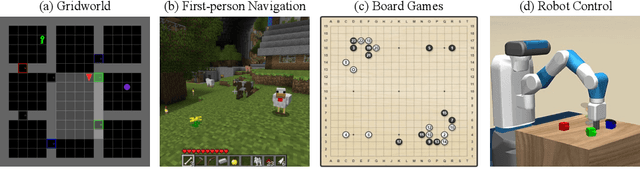
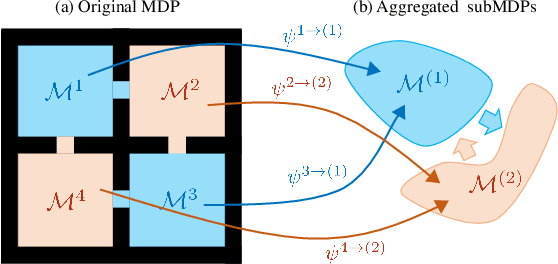
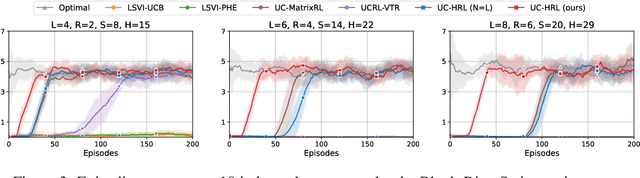
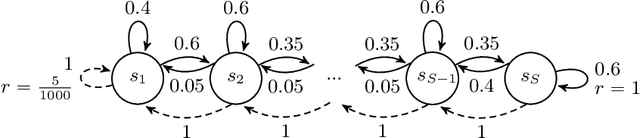
In this work, we prove that, in linear MDPs, the feature dimension $d$ is lower bounded by $S/U$ in order to aptly represent transition probabilities, where $S$ is the size of the state space and $U$ is the maximum size of directly reachable states. Hence, $d$ can still scale with $S$ depending on the direct reachability of the environment. To address this limitation of linear MDPs, we propose a novel structural aggregation framework based on dynamics, named as the "dynamics aggregation". For this newly proposed framework, we design a provably efficient hierarchical reinforcement learning algorithm in linear function approximation that leverages aggregated sub-structures. Our proposed algorithm exhibits statistical efficiency, achieving a regret of $ \tilde{O} ( d_{\psi}^{3/2} H^{3/2}\sqrt{ N T} )$, where $d_{\psi}$ represents the feature dimension of aggregated subMDPs and $N$ signifies the number of aggregated subMDPs. We establish that the condition $d_{\psi}^3 N \ll d^{3}$ is readily met in most real-world environments with hierarchical structures, enabling a substantial improvement in the regret bound compared to LSVI-UCB, which enjoys a regret of $ \tilde{O} (d^{3/2} H^{3/2} \sqrt{ T})$. To the best of our knowledge, this work presents the first HRL algorithm with linear function approximation that offers provable guarantees.
Nearly Minimax Optimal Regret for Multinomial Logistic Bandit
May 16, 2024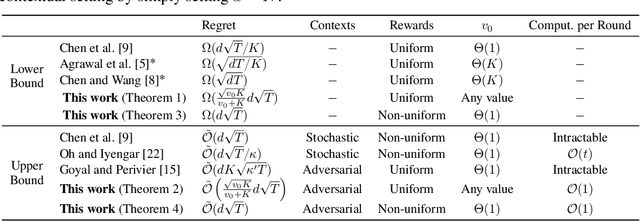
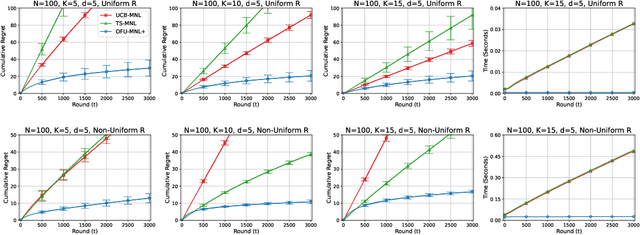
In this paper, we investigate the contextual multinomial logit (MNL) bandit problem in which a learning agent sequentially selects an assortment based on contextual information, and user feedback follows an MNL choice model. There has been a significant discrepancy between lower and upper regret bounds, particularly regarding the feature dimension $d$ and the maximum assortment size $K$. Additionally, the variation in reward structures between these bounds complicates the quest for optimality. Under uniform rewards, where all items have the same expected reward, we establish a regret lower bound of $\Omega(d\sqrt{\smash[b]{T/K}})$ and propose a constant-time algorithm, OFU-MNL+, that achieves a matching upper bound of $\tilde{\mathcal{O}}(d\sqrt{\smash[b]{T/K}})$. Under non-uniform rewards, we prove a lower bound of $\Omega(d\sqrt{T})$ and an upper bound of $\tilde{\mathcal{O}}(d\sqrt{T})$, also achievable by OFU-MNL+. Our empirical studies support these theoretical findings. To the best of our knowledge, this is the first work in the MNL contextual bandit literature to prove minimax optimality -- for either uniform or non-uniform reward setting -- and to propose a computationally efficient algorithm that achieves this optimality up to logarithmic factors.
Learning Uncertainty-Aware Temporally-Extended Actions
Feb 08, 2024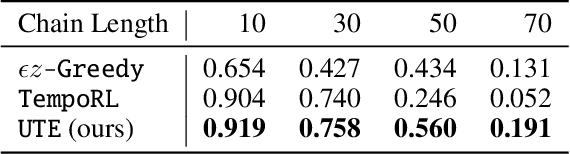
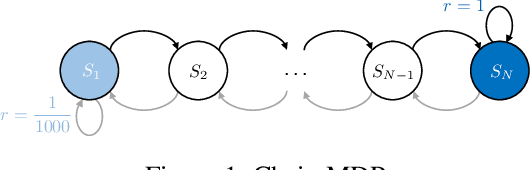
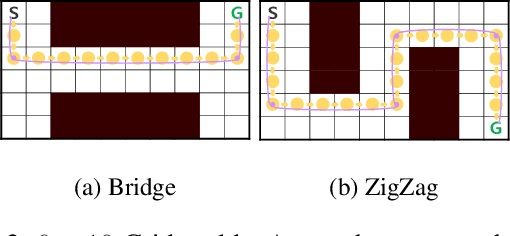
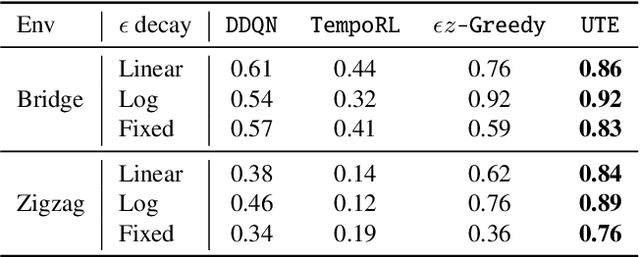
In reinforcement learning, temporal abstraction in the action space, exemplified by action repetition, is a technique to facilitate policy learning through extended actions. However, a primary limitation in previous studies of action repetition is its potential to degrade performance, particularly when sub-optimal actions are repeated. This issue often negates the advantages of action repetition. To address this, we propose a novel algorithm named Uncertainty-aware Temporal Extension (UTE). UTE employs ensemble methods to accurately measure uncertainty during action extension. This feature allows policies to strategically choose between emphasizing exploration or adopting an uncertainty-averse approach, tailored to their specific needs. We demonstrate the effectiveness of UTE through experiments in Gridworld and Atari 2600 environments. Our findings show that UTE outperforms existing action repetition algorithms, effectively mitigating their inherent limitations and significantly enhancing policy learning efficiency.