 Add to Chrome
 Add to Firefox
 Add to Edge
Solar Open 2 Technical Report
Jul 24, 2026
We present Solar Open 2, a 250B-A15B Mixture-of-Experts language model built for long-horizon agentic tasks, scaled up from Solar Open 1 (Solar Open 100B). To hold entire agent trajectories in a single context, Solar Open 2 reaches a 1M-token window through a hybrid attention stack that interleaves one softmax layer among every three linear-attention layers, using no positional encoding and a gated delta rule extended to negative eigenvalues. To train at this scale under a fixed compute budget, we make training efficient in two ways: a stronger starting point, and higher-value data. For the starting point, we initialize Solar Open 2 from Solar Open 1, transferring the 5.69B-parameter shared skeleton that survives the architectural change and learning everything else through full pre-training. For the data, we curate for value per token: quality- and rarity-aware data curation and mixture-ratio optimization refine a 20T pool into a 10T mixture that, at equal token budget, outperforms the Solar Open 1 recipe. To build its agent skills, we train twelve domain specialists across purpose-built scenarios, then consolidate them into a single model by Multi-teacher On-Policy Distillation (MOPD). Against comparably sized open-weight models on English benchmarks, Solar Open 2 leads on MMLU-Pro, LiveCodeBench, and the APEX-Agents agentic suite, and stays competitive with the strongest (DeepSeek-V4-Flash and MiMo-V2.5) elsewhere. On Korean benchmarks, Solar Open 2 records the highest average of any model compared, including fast-tier closed APIs, and on Ko-GDPval, an in-house Korean officework-agent benchmark, it is competitive with DeepSeek-V4-Pro (1.6T) at less than a sixth of its size.

Latent Representation Alignment for Offline Goal-Conditioned Reinforcement Learning
May 25, 2026Offline goal-conditioned reinforcement learning (GCRL) provides a practical framework for obtaining goal-reaching policies from fixed datasets. However, learning a reliable goal-conditioned value function in long-horizon tasks remains challenging. In this paper, we identify erroneous generalization in goal-conditioned value functions as a fundamental bottleneck, and demonstrate that appropriate inductive bias in the value function is crucial for addressing the bottleneck. Building on these findings, we propose Latent-Aligned Value Learning (LAVL), an offline GCRL algorithm that integrates latent-representation-based value generalization with hierarchical planning in a unified framework. Extensive experiments on OGBench demonstrate that LAVL consistently outperforms existing offline GCRL methods, achieving the highest performance on 20 out of 22 datasets. Notably, LAVL exhibits strong performance in long-horizon tasks and trajectory stitching datasets, where prior methods suffer significant performance degradation. Our code is available at https://github.com/oh-lab/LAVL.git.
Multi-Step Likelihood-Ratio Correction for Reinforcement Learning with Verifiable Rewards
May 20, 2026Reinforcement learning with verifiable rewards (RLVR) plays a pivotal role in improving the reasoning ability of large language models. However, widely used PPO surrogate objectives are fundamentally local, as they rely on a local approximation of the exact policy gradient objective. While this approximation improves stability by reducing the variance induced by importance sampling, it also introduces structural bias into the surrogate objective, which must be controlled through trust region mechanisms. In this work, we introduce the $N$-step forward trace, which augments the PPO surrogate objective using the cumulative likelihood ratio of the next $N-1$ tokens. Building on this idea, we propose $N$-Step Forward-Trace Policy Optimization (NFPO), a practical RLVR algorithm that integrates the $N$-step forward trace into the masked policy gradient framework. NFPO provides a continuous bridge between the PPO surrogate objective and the exact policy gradient objective, offering a principled mechanism for controlling the bias-variance trade-off. Our theoretical analysis shows that, with an appropriate choice of $N$, the proposed objective yields a tighter policy-improvement bound than the standard PPO surrogate. Experiments on comprehensive reasoning benchmarks demonstrate that NFPO consistently improves performance, supporting our theoretical findings.
Adversarial Policy Optimization for Offline Preference-based Reinforcement Learning
Mar 07, 2025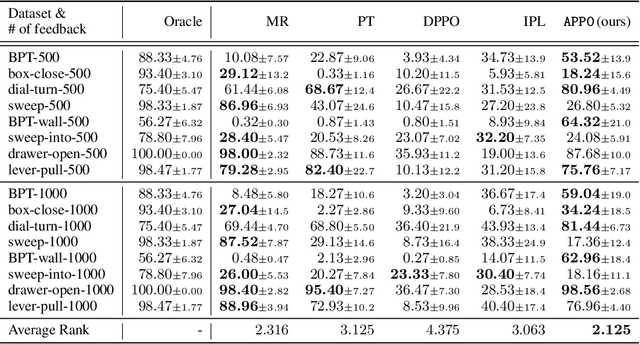
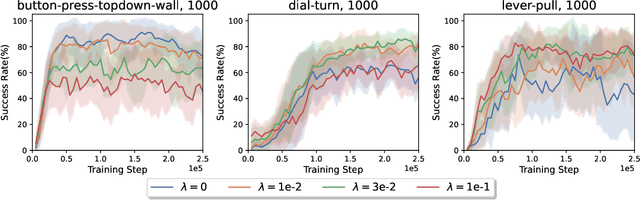
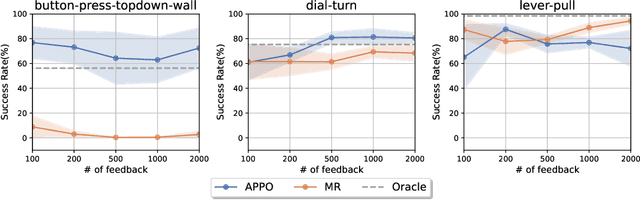
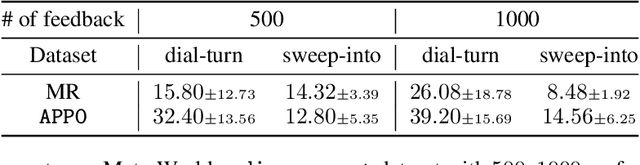
In this paper, we study offline preference-based reinforcement learning (PbRL), where learning is based on pre-collected preference feedback over pairs of trajectories. While offline PbRL has demonstrated remarkable empirical success, existing theoretical approaches face challenges in ensuring conservatism under uncertainty, requiring computationally intractable confidence set constructions. We address this limitation by proposing Adversarial Preference-based Policy Optimization (APPO), a computationally efficient algorithm for offline PbRL that guarantees sample complexity bounds without relying on explicit confidence sets. By framing PbRL as a two-player game between a policy and a model, our approach enforces conservatism in a tractable manner. Using standard assumptions on function approximation and bounded trajectory concentrability, we derive a sample complexity bound. To our knowledge, APPO is the first offline PbRL algorithm to offer both statistical efficiency and practical applicability. Experimental results on continuous control tasks demonstrate that APPO effectively learns from complex datasets, showing comparable performance with existing state-of-the-art methods.