 Add to Chrome
 Add to Firefox
 Add to Edge
POPSICLE: Benchmark Datasets for Segmentation and Localization in CryoET
Jun 08, 2026
Cryo-electron tomography (cryoET) has emerged as a powerful tool in structural and cellular biology by enabling direct visualization of macromolecular structures within intact cells, thereby linking molecular architecture to cellular organization in a native context. Realizing the full potential of cryoET, however, increasingly depends on advances in computational analysis, particularly machine learning (ML), to interpret its complex and information-rich data. Despite rapid progress, ML development for cryoET remains bottlenecked by the lack of standardized, well-annotated benchmarks. Existing evaluations are typically small, task-specific, and are assembled in isolation, limiting robust comparisons across methods. Here, we present POPSICLE, a benchmark suite for cryoET segmentation and macromolecular localization built from the CryoET Data Portal - an open, ML-ready repository of tomographic data, metadata, and annotations. POPSICLE spans eukaryotic and prokaryotic systems, both purified and fully in situ samples, and dense voxel-wise segmentation as well as sparse localization tasks. Built on a living data resource, it can expand as new datasets and annotations become available. Baseline experiments reveal substantial variation in model rankings across tasks, underscoring the need for benchmarks tailored to the unique characteristics of cryoET rather than evaluation practices adapted from adjacent biomedical imaging domains. POPSICLE thus provides an open and extensible foundation for reproducible ML evaluation in cryoET.

Removing Stripes, Scratches, and Curtaining with Non-Recoverable Compressed Sensing
Jan 23, 2019
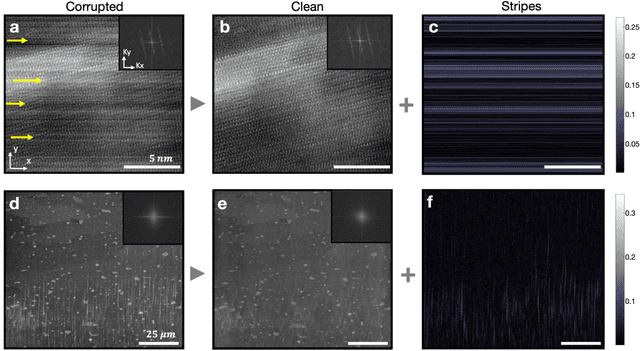
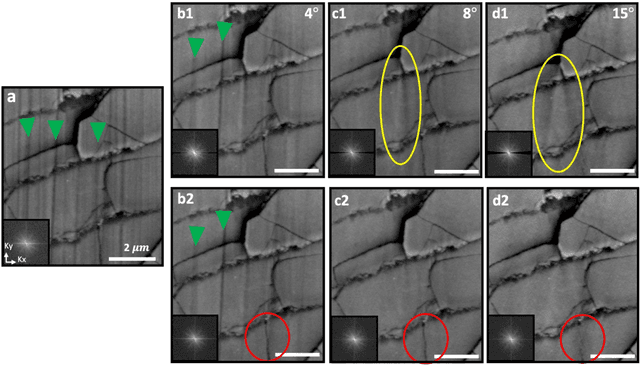
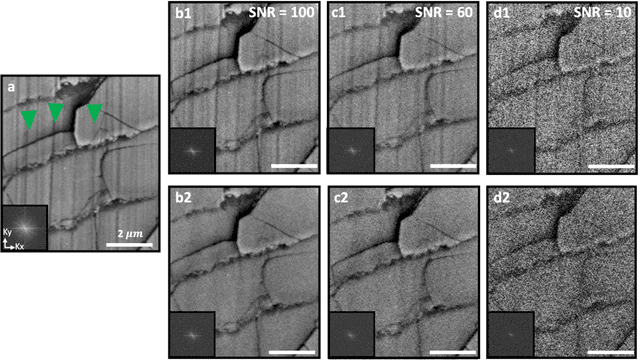
Highly-directional image artifacts such as ion mill curtaining, mechanical scratches, or image striping from beam instability degrade the interpretability of micrographs. These unwanted, aperiodic features extend the image along a primary direction and occupy a small wedge of information in Fourier space. Deleting this wedge of data replaces stripes, scratches, or curtaining, with more complex streaking and blurring artifacts-known within the tomography community as missing wedge artifacts. Here, we overcome this problem by recovering the missing region using total variation minimization, which leverages image sparsity based reconstruction techniques-colloquially referred to as compressed sensing-to reliably restore images corrupted by stripe like features. Our approach removes beam instability, ion mill curtaining, mechanical scratches, or any stripe features and remains robust at low signal-to-noise. The success of this approach is achieved by exploiting compressed sensings inability to recover directional structures that are highly localized and missing in Fourier Space.