 Add to Chrome
 Add to Firefox
 Add to Edge
Otter Weather: Skillful and Computationally Efficient Medium-Range Weather Forecasting
Jun 24, 2026
State-of-the-art medium-range AI weather models can outperform traditional Numerical Weather Prediction (NWP) but require massive training budgets. This restricts usage for under-resourced groups and severely limits fast model iteration. Here we develop Otter Weather, a highly efficient spatiotemporal forecasting model designed to democratise high-performance weather prediction with AI. Evaluated on ERA5 reanalysis data at 1.5° resolution using standard WeatherBench protocols, the Otter family significantly advances the skill-compute Pareto frontier. The deterministic version outperforms the best NWP baseline by 9.6% at a 24-hour lead time while requiring fewer than 3.5 A100-days for training. It provides a 2x efficiency gain over lightweight AI models and a 100-fold reduction in compute compared to resource-intensive frontier architectures. We extend these efficiency gains into probabilistic forecasting by training via the Continuous Ranked Probability Score (CRPS). Scaling to a larger architecture, Otter-XL achieves a 9.7% CRPS improvement over the IFS ENS baseline. This yields an almost two-fold increase in predictive skill over comparable lightweight models at similar compute budgets. Otter-XL also outperforms frontier architectures like GenCast by over 2%, while using an order of magnitude less compute. Finally, Otter is applied out-of-the-box to a complex acoustic scattering PDE task where it outperforms a state-of-the-art foundation modelling approach, suggesting that the advances made here might apply across a range of scientific domains.

Toward Reasonable Parrots: Why Large Language Models Should Argue with Us by Design
May 08, 2025
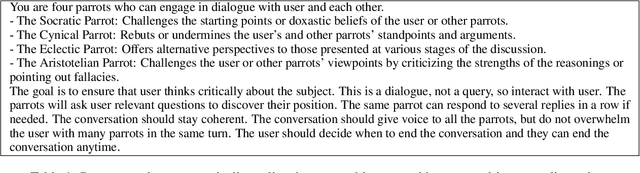
In this position paper, we advocate for the development of conversational technology that is inherently designed to support and facilitate argumentative processes. We argue that, at present, large language models (LLMs) are inadequate for this purpose, and we propose an ideal technology design aimed at enhancing argumentative skills. This involves re-framing LLMs as tools to exercise our critical thinking rather than replacing them. We introduce the concept of 'reasonable parrots' that embody the fundamental principles of relevance, responsibility, and freedom, and that interact through argumentative dialogical moves. These principles and moves arise out of millennia of work in argumentation theory and should serve as the starting point for LLM-based technology that incorporates basic principles of argumentation.
Sim2Real for Environmental Neural Processes
Oct 30, 2023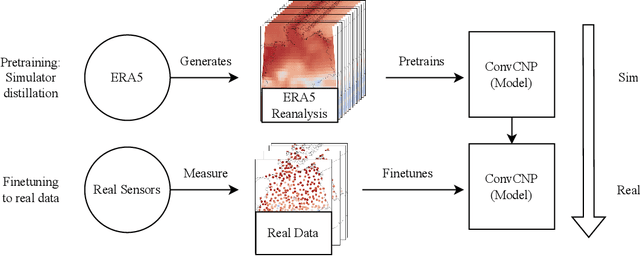
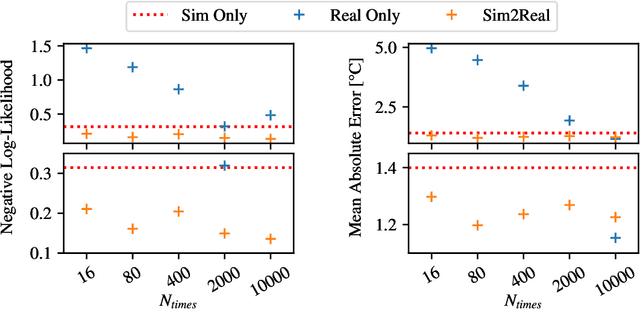
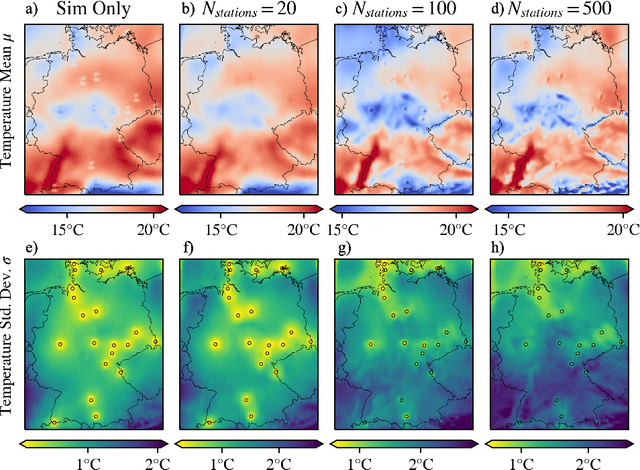
Machine learning (ML)-based weather models have recently undergone rapid improvements. These models are typically trained on gridded reanalysis data from numerical data assimilation systems. However, reanalysis data comes with limitations, such as assumptions about physical laws and low spatiotemporal resolution. The gap between reanalysis and reality has sparked growing interest in training ML models directly on observations such as weather stations. Modelling scattered and sparse environmental observations requires scalable and flexible ML architectures, one of which is the convolutional conditional neural process (ConvCNP). ConvCNPs can learn to condition on both gridded and off-the-grid context data to make uncertainty-aware predictions at target locations. However, the sparsity of real observations presents a challenge for data-hungry deep learning models like the ConvCNP. One potential solution is 'Sim2Real': pre-training on reanalysis and fine-tuning on observational data. We analyse Sim2Real with a ConvCNP trained to interpolate surface air temperature over Germany, using varying numbers of weather stations for fine-tuning. On held-out weather stations, Sim2Real training substantially outperforms the same model architecture trained only with reanalysis data or only with station data, showing that reanalysis data can serve as a stepping stone for learning from real observations. Sim2Real could thus enable more accurate models for weather prediction and climate monitoring.