 Add to Chrome
 Add to Firefox
 Add to Edge
Scaling Nonlinear Optimization: Many Problems One GPU
Jun 24, 2026
Many robotics problems, including trajectory optimization, inverse kinematics, and contact-rich motion planning, reduce to nonlinear programs (NLPs). Mature NLP solvers such as IPOPT can solve these problems, offering hard constraint satisfaction, optimality guarantees, and favorable scaling with problem dimension. These solvers underpin gradient-based methods in robotics, yet remain CPU-bound and solve only one problem at a time, preventing their integration into GPU-batched learning pipelines. On the other hand, sampling-based approaches such as reinforcement learning, model predictive path integral, and imitation learning have become the core of modern robotics research due to their ability to leverage GPU-batched simulators. These simulators can generate orders of magnitude more dynamics rollouts per second than was previously possible. If a GPU-batched NLP solver existed, it would unlock similar speedups in the number of constrained, locally optimal solutions generated per second. This regime of solving many problems concurrently versus solving a single problem at a time is a key requirement for integrating NLP solvers in modern GPU-batched robotics frameworks. To this end, we introduce \texttt{jaxipm}, the first GPU-batched NLP solver, based on IPOPT, and implemented in JAX. We accomplish this by redesigning IPOPT's algorithm to eliminate control flow with \textit{heterogeneous iteration fusion}, and by minimizing GPU idle time with \textit{iteration level batching}. We evaluate \texttt{jaxipm} on a variety of quadrotor nonlinear model predictive control benchmarks, including reference tracking in the presence of obstacles, multi-quadrotor navigation without collision, and navigation in a cluttered environment. We demonstrate up to a $32.85\times$ increase in throughput over IPOPT. Our complete open-source codebase is available at https://github.com/johnviljoen/jaxipm.

Differentiable Predictive Control for Robotics: A Data-Driven Predictive Safety Filter Approach
Sep 20, 2024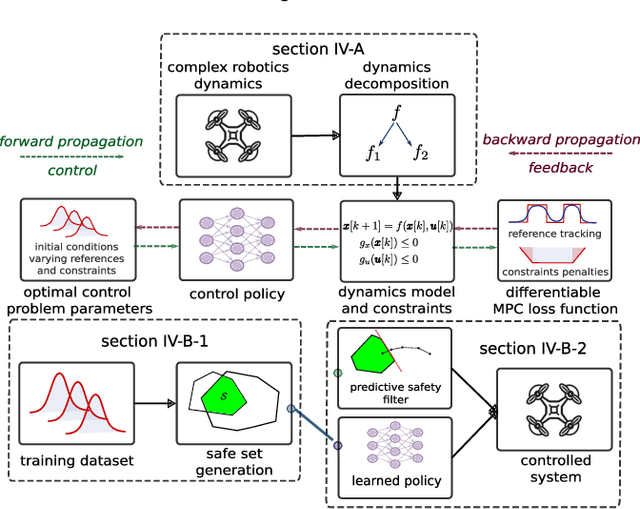
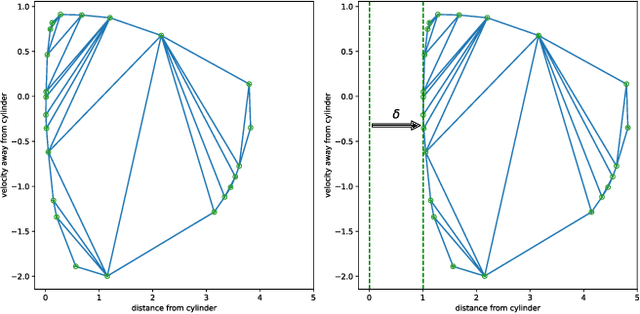
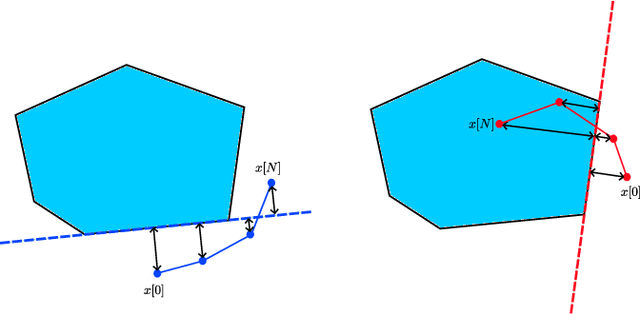
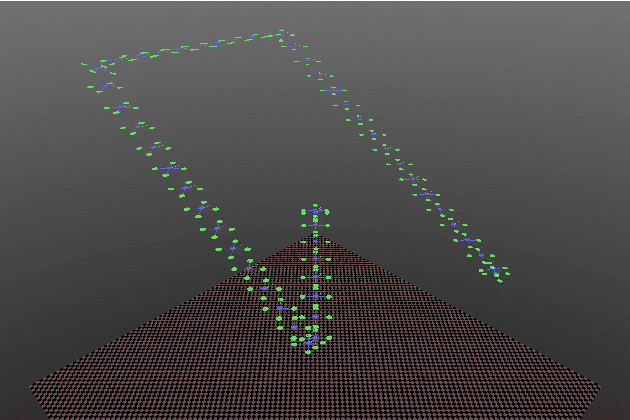
Model Predictive Control (MPC) is effective at generating safe control strategies in constrained scenarios, at the cost of computational complexity. This is especially the case in robots that require high sampling rates and have limited computing resources. Differentiable Predictive Control (DPC) trains offline a neural network approximation of the parametric MPC problem leading to computationally efficient online control laws at the cost of losing safety guarantees. DPC requires a differentiable model, and performs poorly when poorly conditioned. In this paper we propose a system decomposition technique based on relative degree to overcome this. We also develop a novel safe set generation technique based on the DPC training dataset and a novel event-triggered predictive safety filter which promotes convergence towards the safe set. Our empirical results on a quadcopter demonstrate that the DPC control laws have comparable performance to the state-of-the-art MPC whilst having up to three orders of magnitude reduction in computation time and satisfy safety requirements in a scenario that DPC was not trained on.