 Add to Chrome
 Add to Firefox
 Add to Edge
Non-variational supervised quantum kernel methods: a review
Apr 09, 2026
Quantum kernel methods (QKMs) have emerged as a prominent framework for supervised quantum machine learning. Unlike variational quantum algorithms, which rely on gradient-based optimisation and may suffer from issues such as barren plateaus, non-variational QKMs employ fixed quantum feature maps, with model selection performed classically via convex optimisation and cross-validation. This separation of quantum feature embedding from classical training ensures stable optimisation while leveraging quantum circuits to encode data in high-dimensional Hilbert spaces. In this review, we provide a thorough analysis of non-variational supervised QKMs, covering their foundations in classical kernel theory, constructions of fidelity and projected quantum kernels, and methods for their estimation in practice. We examine frameworks for assessing quantum advantage, including generalisation bounds and necessary conditions for separation from classical models, and analyse key challenges such as exponential concentration, dequantisation via tensor-network methods, and the spectral properties of kernel integral operators. We further discuss structured problem classes that may enable advantage, and synthesise insights from comparative and hardware studies. Overall, this review aims to clarify the regimes in which QKMs may offer genuine advantages, and to delineate the conceptual, methodological, and technical obstacles that must be overcome for practical quantum-enhanced learning.

Maritime object classification with SAR imagery using quantum kernel methods
Dec 12, 2025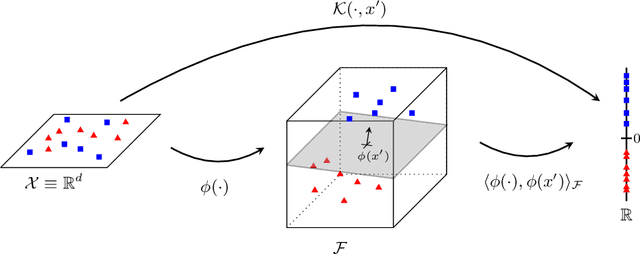
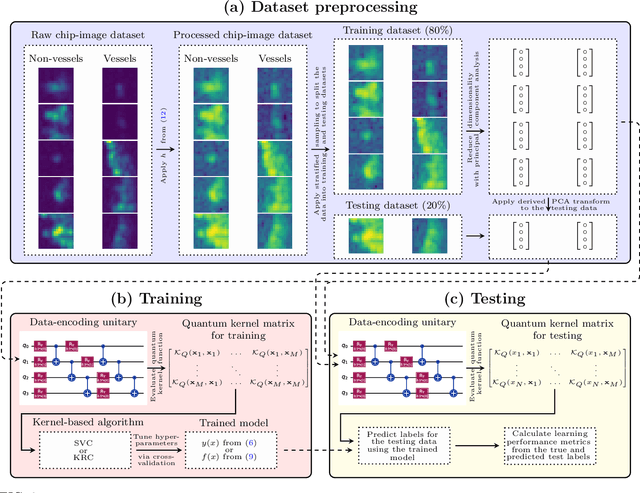
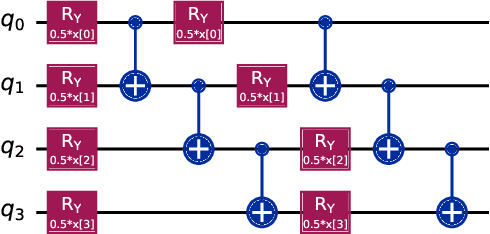
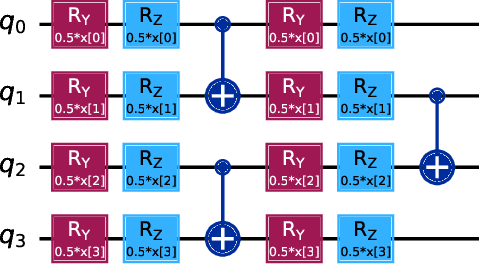
Illegal, unreported, and unregulated (IUU) fishing causes global economic losses of \$10-25 billion annually and undermines marine sustainability and governance. Synthetic Aperture Radar (SAR) provides reliable maritime surveillance under all weather and lighting conditions, but classifying small maritime objects in SAR imagery remains challenging. We investigate quantum machine learning for this task, focusing on Quantum Kernel Methods (QKMs) applied to real and complex SAR chips extracted from the SARFish dataset. We tackle two binary classification problems, the first for distinguishing vessels from non-vessels, and the second for distinguishing fishing vessels from other types of vessels. We compare QKMs applied to real and complex SAR chips against classical Laplacian, RBF, and linear kernels applied to real SAR chips. Using noiseless numerical simulations of the quantum kernels, we find that QKMs are capable of obtaining equal or better performance than the classical kernel on these tasks in the best case, but do not demonstrate a clear advantage for the complex SAR data. This work presents the first application of QKMs to maritime classification in SAR imagery and offers insight into the potential and current limitations of quantum-enhanced learning for maritime surveillance.
Learning out-of-time-ordered correlators with classical kernel methods
Sep 03, 2024
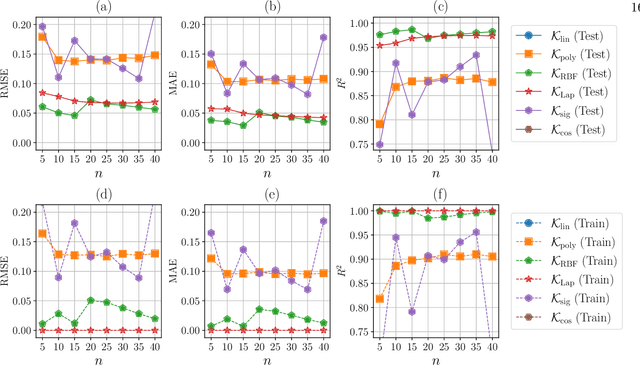

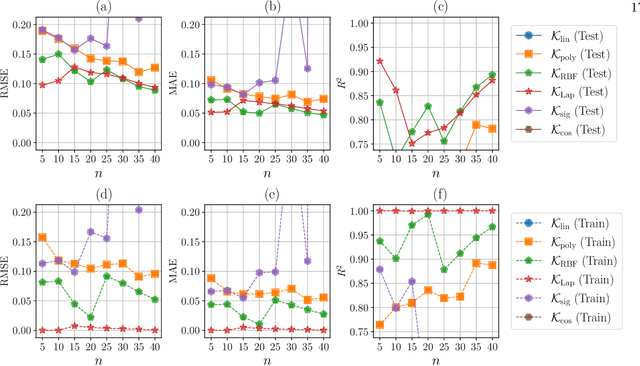
Out-of-Time Ordered Correlators (OTOCs) are widely used to investigate information scrambling in quantum systems. However, directly computing OTOCs with classical computers is often impractical. This is due to the need to simulate the dynamics of quantum many-body systems, which entails exponentially-scaling computational costs with system size. Similarly, exact simulation of the dynamics with a quantum computer (QC) will generally require a fault-tolerant QC, which is currently beyond technological capabilities. Therefore, alternative approaches are needed for computing OTOCs and related quantities. In this study, we explore four parameterised sets of Hamiltonians describing quantum systems of interest in condensed matter physics. For each set, we investigate whether classical kernel methods can accurately learn the XZ-OTOC as well as a particular sum of OTOCs, as functions of the Hamiltonian parameters. We frame the problem as a regression task, generating labelled data via an efficient numerical algorithm that utilises matrix product operators to simulate quantum many-body systems, with up to 40 qubits. Using this data, we train a variety of standard kernel machines and observe that the best kernels consistently achieve a high coefficient of determination ($R^2$) on the testing sets, typically between 0.9 and 0.99, and almost always exceeding 0.8. This demonstrates that classical kernels supplied with a moderate amount of training data can be used to closely and efficiently approximate OTOCs and related quantities for a diverse range of quantum many-body systems.