 Add to Chrome
 Add to Firefox
 Add to Edge
Align and Segment: Unsupervised Learning for Building Segmentation From Misaligned Labels
Jul 12, 2026
Supervised learning for image segmentation typically requires spatially aligned image and label sets. When images and labels originate from different sources, the pairing may be misaligned, which can significantly deteriorate the performance of the learned models. This is especially common in remote sensing, when aerial or satellite images are co-registered with labels from another source (e.g., OpenStreetMap). In this work, we propose a novel approach for training on misaligned labels, where we simultaneously learn the label alignment. Our align and segment (AnS) approach builds on the spatial transformer module to transform the misaligned labels using an affine transformation to provide a better learning target for a canonical semantic segmentation network. We prevent shortcut learning of misaligned labels in these semantic segmentation networks through a self-supervised regularization loss and show that it is complementary to data augmentation, especially for systematically misaligned training data. A decisive characteristic of our AnS approach is that it learns without requiring any golden labels. We experimentally show on both synthetic and real-world data from different cities that our approach enables high-quality building segmentation and precise label-image alignment at the same time. Code and derived datasets are available at https://github.com/venkanna37/align-and-segment

Nacala-Roof-Material: Drone Imagery for Roof Detection, Classification, and Segmentation to Support Mosquito-borne Disease Risk Assessment
Jun 07, 2024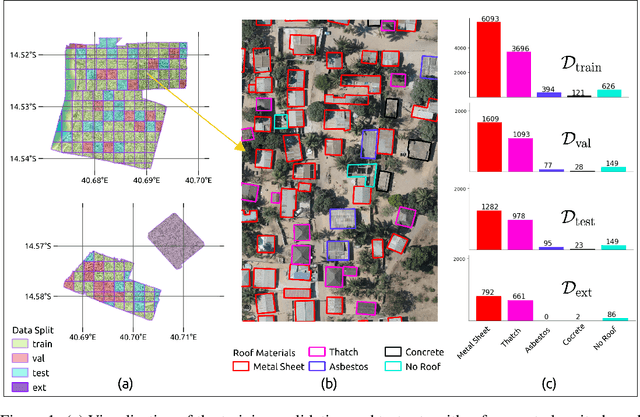
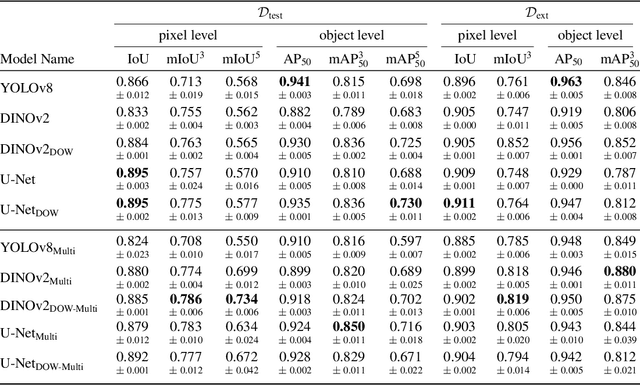
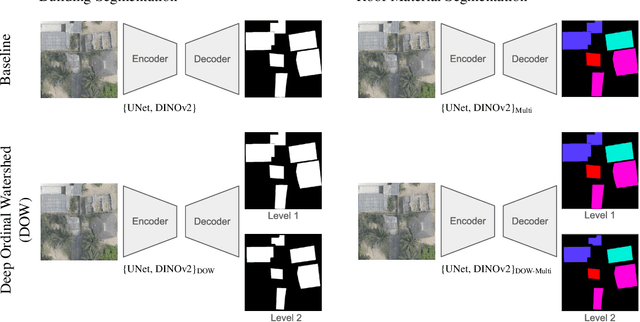
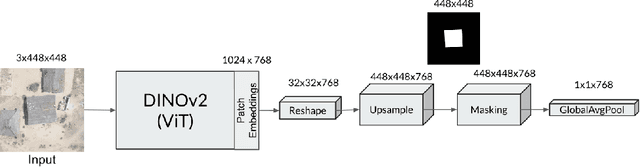
As low-quality housing and in particular certain roof characteristics are associated with an increased risk of malaria, classification of roof types based on remote sensing imagery can support the assessment of malaria risk and thereby help prevent the disease. To support research in this area, we release the Nacala-Roof-Material dataset, which contains high-resolution drone images from Mozambique with corresponding labels delineating houses and specifying their roof types. The dataset defines a multi-task computer vision problem, comprising object detection, classification, and segmentation. In addition, we benchmarked various state-of-the-art approaches on the dataset. Canonical U-Nets, YOLOv8, and a custom decoder on pretrained DINOv2 served as baselines. We show that each of the methods has its advantages but none is superior on all tasks, which highlights the potential of our dataset for future research in multi-task learning. While the tasks are closely related, accurate segmentation of objects does not necessarily imply accurate instance separation, and vice versa. We address this general issue by introducing a variant of the deep ordinal watershed (DOW) approach that additionally separates the interior of objects, allowing for improved object delineation and separation. We show that our DOW variant is a generic approach that improves the performance of both U-Net and DINOv2 backbones, leading to a better trade-off between semantic segmentation and instance segmentation.