 Add to Chrome
 Add to Firefox
 Add to Edge
GIP-RAG: An Evidence-Grounded Retrieval-Augmented Framework for Interpretable Gene Interaction and Pathway Impact Analysis
Mar 19, 2026
Understanding mechanistic relationships among genes and their impacts on biological pathways is essential for elucidating disease mechanisms and advancing precision medicine. Despite the availability of extensive molecular interaction and pathway data in public databases, integrating heterogeneous knowledge sources and enabling interpretable multi-step reasoning across biological networks remain challenging. We present GIP-RAG (Gene Interaction Prediction through Retrieval-Augmented Generation), a computational framework that combines biomedical knowledge graphs with large language models (LLMs) to infer and interpret gene interactions. The framework constructs a unified gene interaction knowledge graph by integrating curated data from KEGG, WikiPathways, SIGNOR, Pathway Commons, and PubChem. Given user-specified genes, a query-driven module retrieves relevant subgraphs, which are incorporated into structured prompts to guide LLM-based stepwise reasoning. This enables identification of direct and indirect regulatory relationships and generation of mechanistic explanations supported by biological evidence. Beyond pairwise interactions, GIP-RAG includes a pathway-level functional impact module that simulates propagation of gene perturbations through signaling networks and evaluates potential pathway state changes. Evaluation across diverse biological scenarios demonstrates that the framework generates consistent, interpretable, and evidence-supported insights into gene regulatory mechanisms. Overall, GIP-RAG provides a general and interpretable approach for integrating knowledge graphs with retrieval-augmented LLMs to support mechanistic reasoning in complex molecular systems.

OncoGPT: A Medical Conversational Model Tailored with Oncology Domain Expertise on a Large Language Model Meta-AI (LLaMA)
Feb 26, 2024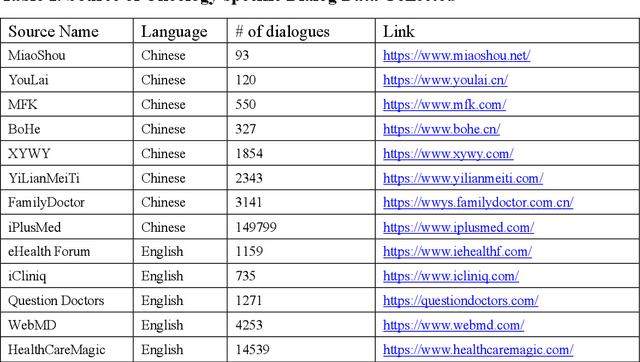
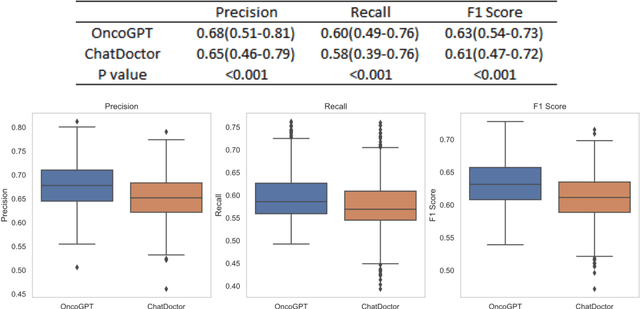
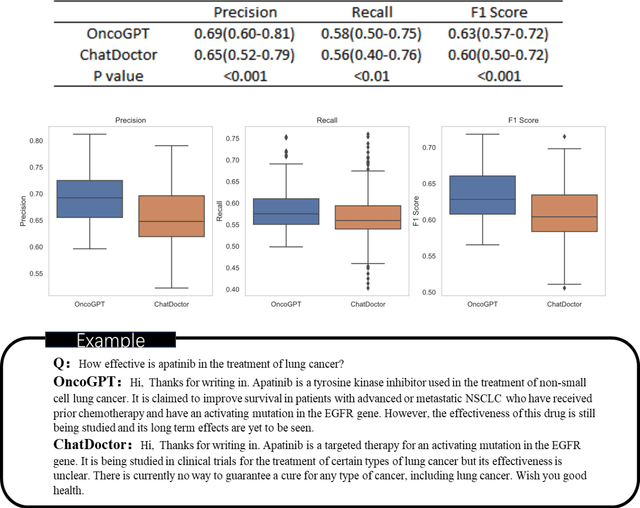
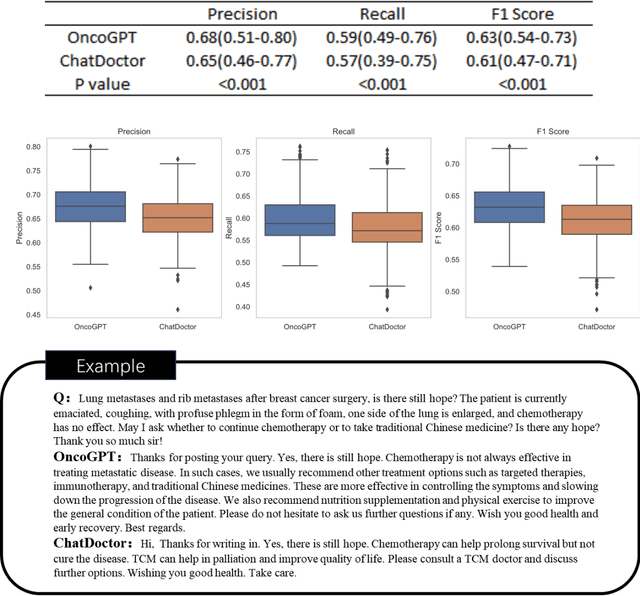
In the past year, there has been a growing trend in applying Large Language Models (LLMs) to the field of medicine, particularly with the advent of advanced language models such as ChatGPT developed by OpenAI. However, there is limited research on LLMs specifically addressing oncology-related queries. The primary aim of this research was to develop a specialized language model that demonstrates improved accuracy in providing advice related to oncology. We performed an extensive data collection of online question-answer interactions centered around oncology, sourced from reputable doctor-patient platforms. Following data cleaning and anonymization, a dataset comprising over 180K+ oncology-related conversations was established. The conversations were categorized and meticulously reviewed by field specialists and clinicians to ensure precision. Employing the LLaMA model and other selected open-source datasets, we conducted iterative fine-tuning to enhance the model's proficiency in basic medical conversation and specialized oncology knowledge. We observed a substantial enhancement in the model's understanding of genuine patient inquiries and its reliability in offering oncology-related advice through the utilization of real online question-answer interactions in the fine-tuning process. We release database and models to the research community (https://github.com/OncoGPT1).