 Add to Chrome
 Add to Firefox
 Add to Edge
MatrAIx: Simulating the World with 8.3 Billion Persona Agents
Aug 04, 2026
Human evaluation of AI systems and digital products is costly, slow, and difficult to scale. Offline evaluations are more scalable but often abstract away human diversity and interactive behavior. We therefore introduce MatrAIx, a population-scale simulated-user evaluation infrastructure for testing AI systems and digital products with heterogeneous users. MatrAIx has three core components: First, Persona 8B contains 8.3 billion persona records represented by 1,290 categorical dimensions. Records are either sampled from a dependency graph that preserves correlated attributes or derived from human-authored profiles. We release a quality-filtered coreset of approximately 1 million personas, comprising 599,847 human-grounded and 400,000 synthetic records. Second, the MatrAIx Playground provides four environments in which diverse users evaluate and interact with digital products: Survey, AI Chatbot, Web, and App. Third, MatrAIx provides 1,010 application tasks spanning more than 25 domains, including Commerce, Software, Finance, and Healthcare. We conducted 18,189 evaluation trials across eight representative tasks. Persona agents were powered by three LLMs: Claude Opus 4.8, GPT 5.5, and Claude Haiku 4.5. The resulting feedback captures how decisions and preferences vary across persona backgrounds, including hesitation after a price increase, willingness to continue after an AI assistant fails, and latency tolerance. We conducted two main validation studies: First, a 400-trial controlled study evaluated persona adherence across ten behavioral attributes and all four environments. The declared behavior was expressed or correctly suppressed in 366 trials (91.5%). Second, human and LLM judges evaluated the extraction quality of human-grounded personas. Overall, MatrAIx provides an end-to-end infrastructure for evaluating AI systems and digital products with diverse simulated human users.

Sample Complexity of Multicalibration for Multilevel Properties
Aug 04, 2026Calibration requires a predictor to be unbiased after conditioning on its own predictions. Multicalibration asks for this guarantee simultaneously across a collection of groups. Many prediction tasks ask for several related features of the same conditional outcome distribution: variance is defined relative to the mean, skewness relative to both mean and variance, and conditional value at risk relative to a quantile. We study multicalibration for a sequence of $k$ properties in which each property is identifiable once the preceding properties are fixed. This framework includes Bayes pairs but does not require the properties to arise from a single loss. For every fixed $k\ge2$, we establish matching upper and lower sample-complexity bounds up to logarithmic factors under regularity conditions. Even with only polylogarithmically many binary groups, achieving multicalibration error $\varepsilon$ requires $\widetildeΩ(\varepsilon^{-(k+2)})$ samples. Conversely, for any finite group family $\mathcal G$, we give a randomized learner using $O(\varepsilon^{-(k+2)}+\varepsilon^{-2}\log|\mathcal G|)$ samples. Thus the sample complexity is $\widetildeΘ(\varepsilon^{-(k+2)})$ for polynomial-size group families. We instantiate the theory for three canonical examples.
The Sample Complexity of Multicalibration
Apr 23, 2026We study the minimax sample complexity of multicalibration in the batch setting. A learner observes $n$ i.i.d. samples from an unknown distribution and must output a (possibly randomized) predictor whose population multicalibration error, measured by Expected Calibration Error (ECE), is at most $\varepsilon$ with respect to a given family of groups. For every fixed $κ> 0$, in the regime $|G|\le \varepsilon^{-κ}$, we prove that $\widetildeΘ(\varepsilon^{-3})$ samples are necessary and sufficient, up to polylogarithmic factors. The lower bound holds even for randomized predictors, and the upper bound is realized by a randomized predictor obtained via an online-to-batch reduction. This separates the sample complexity of multicalibration from that of marginal calibration, which scales as $\widetildeΘ(\varepsilon^{-2})$, and shows that mean-ECE multicalibration is as difficult in the batch setting as it is in the online setting, in contrast to marginal calibration which is strictly more difficult in the online setting. In contrast we observe that for $κ= 0$, the sample complexity of multicalibration remains $\widetildeΘ(\varepsilon^{-2})$ exhibiting a sharp threshold phenomenon. More generally, we establish matching upper and lower bounds, up to polylogarithmic factors, for a weighted $L_p$ multicalibration metric for all $1 \le p \le 2$, with optimal exponent $3/p$. We also extend the lower-bound template to a regular class of elicitable properties, and combine it with the online upper bounds of Hu et al. (2025) to obtain matching bounds for calibrating properties including expectiles and bounded-density quantiles.
Fast Rerandomization for Balancing Covariates in Randomized Experiments: A Metropolis-Hastings Framework
Feb 07, 2026Balancing covariates is critical for credible and efficient randomized experiments. Rerandomization addresses this by repeatedly generating treatment assignments until covariate balance meets a prespecified threshold. By shrinking this threshold, it can achieve arbitrarily strong balance, with established results guaranteeing optimal estimation and valid inference in both finite-sample and asymptotic settings across diverse complex experimental settings. Despite its rigorous theoretical foundations, practical use is limited by the extreme inefficiency of rejection sampling, which becomes prohibitively slow under small thresholds and often forces practitioners to adopt suboptimal settings, leading to degraded performance. Existing work focusing on acceleration typically fail to maintain the uniformity over the acceptable assignment space, thus losing the theoretical grounds of classical rerandomization. Building upon a Metropolis-Hastings framework, we address this challenge by introducing an additional sampling-importance resampling step, which restores uniformity and preserves statistical guarantees. Our proposed algorithm, PSRSRR, achieves speedups ranging from 10 to 10,000 times while maintaining exact and asymptotic validity, as demonstrated by simulations and two real-data applications.
Dynamic Regret Bounds for Online Omniprediction with Long Term Constraints
Oct 08, 2025We present an algorithm guaranteeing dynamic regret bounds for online omniprediction with long term constraints. The goal in this recently introduced problem is for a learner to generate a sequence of predictions which are broadcast to a collection of downstream decision makers. Each decision maker has their own utility function, as well as a vector of constraint functions, each mapping their actions and an adversarially selected state to reward or constraint violation terms. The downstream decision makers select actions "as if" the state predictions are correct, and the goal of the learner is to produce predictions such that all downstream decision makers choose actions that give them worst-case utility guarantees while minimizing worst-case constraint violation. Within this framework, we give the first algorithm that obtains simultaneous \emph{dynamic regret} guarantees for all of the agents -- where regret for each agent is measured against a potentially changing sequence of actions across rounds of interaction, while also ensuring vanishing constraint violation for each agent. Our results do not require the agents themselves to maintain any state -- they only solve one-round constrained optimization problems defined by the prediction made at that round.
Causal Feature Learning in the Social Sciences
Mar 17, 2025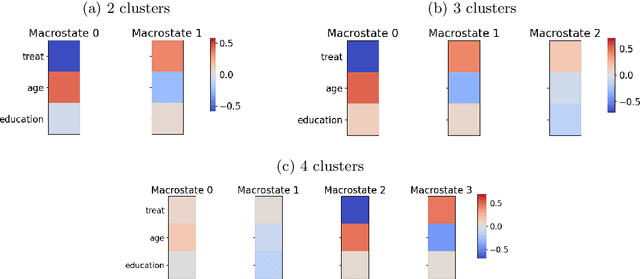
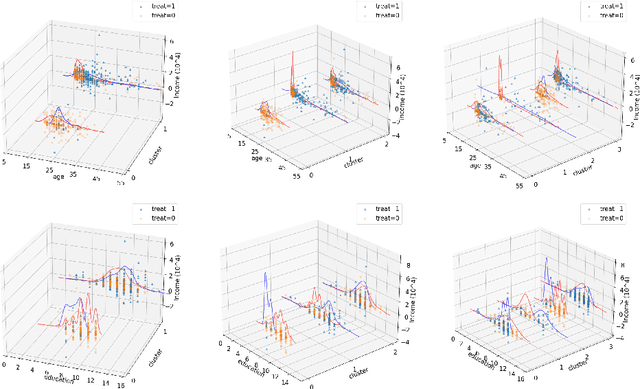
Variable selection poses a significant challenge in causal modeling, particularly within the social sciences, where constructs often rely on inter-related factors such as age, socioeconomic status, gender, and race. Indeed, it has been argued that such attributes must be modeled as macro-level abstractions of lower-level manipulable features, in order to preserve the modularity assumption essential to causal inference. This paper accordingly extends the theoretical framework of Causal Feature Learning (CFL). Empirically, we apply the CFL algorithm to diverse social science datasets, evaluating how CFL-derived macrostates compare with traditional microstates in downstream modeling tasks.
Sample Efficient Omniprediction and Downstream Swap Regret for Non-Linear Losses
Feb 18, 2025We define "decision swap regret" which generalizes both prediction for downstream swap regret and omniprediction, and give algorithms for obtaining it for arbitrary multi-dimensional Lipschitz loss functions in online adversarial settings. We also give sample complexity bounds in the batch setting via an online-to-batch reduction. When applied to omniprediction, our algorithm gives the first polynomial sample-complexity bounds for Lipschitz loss functions -- prior bounds either applied only to linear loss (or binary outcomes) or scaled exponentially with the error parameter even under the assumption that the loss functions were convex. When applied to prediction for downstream regret, we give the first algorithm capable of guaranteeing swap regret bounds for all downstream agents with non-linear loss functions over a multi-dimensional outcome space: prior work applied only to linear loss functions, modeling risk neutral agents. Our general bounds scale exponentially with the dimension of the outcome space, but we give improved regret and sample complexity bounds for specific families of multidimensional functions of economic interest: constant elasticity of substitution (CES), Cobb-Douglas, and Leontief utility functions.