 Add to Chrome
 Add to Firefox
 Add to Edge
Cross-Cultural Simulation of Citizen Emotional Responses to Bureaucratic Red Tape Using LLM Agents
Apr 14, 2026
Improving policymaking is a central concern in public administration. Prior human subject studies reveal substantial cross-cultural differences in citizens' emotional responses to red tape during policy implementation. While LLM agents offer opportunities to simulate human-like responses and reduce experimental costs, their ability to generate culturally appropriate emotional responses to red tape remains unverified. To address this gap, we propose an evaluation framework for assessing LLMs' emotional responses to red tape across diverse cultural contexts. As a pilot study, we apply this framework to a single red-tape scenario. Our results show that all models exhibit limited alignment with human emotional responses, with notably weaker performance in Eastern cultures. Cultural prompting strategies prove largely ineffective in improving alignment. We further introduce \textbf{RAMO}, an interactive interface for simulating citizens' emotional responses to red tape and for collecting human data to improve models. The interface is publicly available at https://ramo-chi.ivia.ch.

CADA-GAN: Context-Aware GAN with Data Augmentation
Jan 21, 2023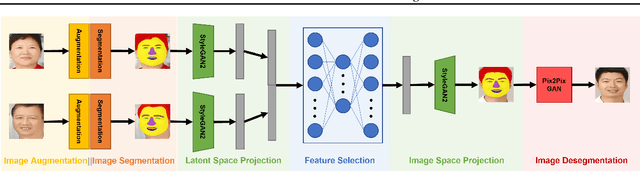
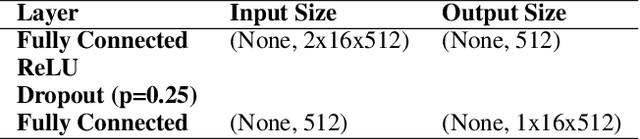
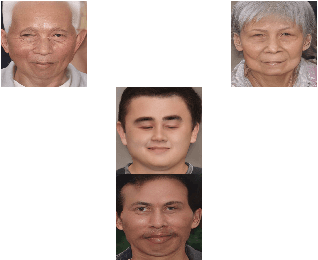
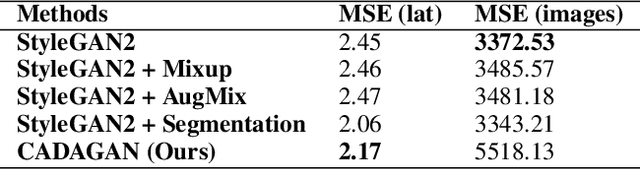
Current child face generators are restricted by the limited size of the available datasets. In addition, feature selection can prove to be a significant challenge, especially due to the large amount of features that need to be trained for. To manage these problems, we proposed CADA-GAN, a \textbf{C}ontext-\textbf{A}ware GAN that allows optimal feature extraction, with added robustness from additional \textbf{D}ata \textbf{A}ugmentation. CADA-GAN is adapted from the popular StyleGAN2-Ada model, with attention on augmentation and segmentation of the parent images. The model has the lowest \textit{Mean Squared Error Loss} (MSEloss) on latent feature representations and the generated child image is robust compared with the one that generated from baseline models.